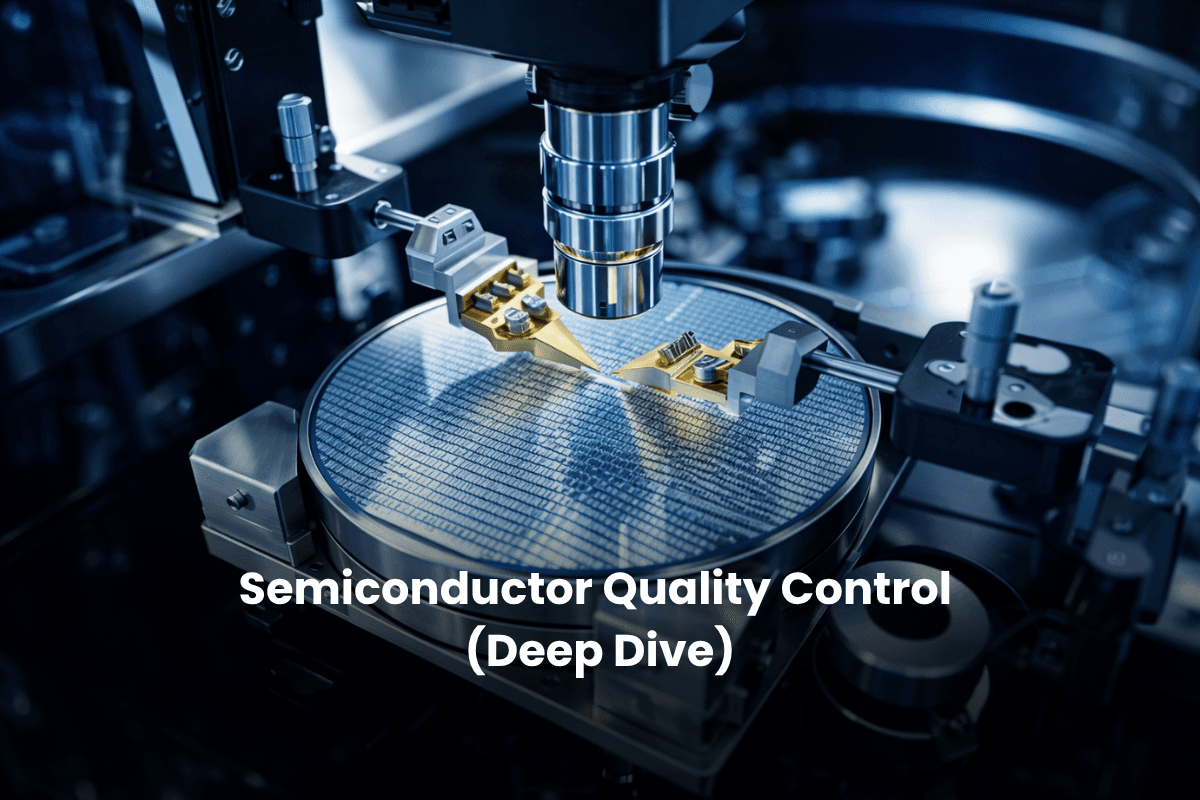
At advanced nodes, semiconductor quality control carries the weight of the entire operation.
A 2% yield drop at high-volume production costs millions per month. An escaped defect that reaches the field can cost far more.
The margin for error has effectively hit zero. And the methods, tools, and AI systems that fabs are deploying to operate within that margin have evolved significantly.
We’ll cover all of it.
Key Notes
Defect risk peaks at lithography, etch, CMP, and packaging interconnects – inspect accordingly.
AI AOI cuts false alarm rates from 40–70% down to 5–10%, eliminating the reinspection burden.
SPC, FDC, R2R, and APC form a layered defense – each watching a different point in the chain.
What Semiconductor Quality Control Covers
Semiconductor quality control is not a single activity. It’s a system of overlapping disciplines applied continuously across the manufacturing lifecycle.
At Its Core, Semiconductor Quality Control Spans 3 Domains:
These don’t operate in sequence. They run in parallel, feeding data into each other:
SPC flags a drift in etch uniformity.
Metrology confirms the CD impact.
The quality system logs the excursion and initiates a corrective action.
That’s the semiconductor quality control loop in practice.
What Makes This Complex At Modern Nodes Is That Defects Are Cumulative
A nanometer-scale particle in a litho step doesn’t necessarily kill a die on contact (but it can degrade a via, weaken an interconnect, and manifest as a field failure months after the device ships).
This is why QC coverage has expanded upstream, and why incoming materials and even design-phase decisions are now part of the semiconductor quality control conversation.
The Semiconductor Manufacturing Lifecycle: Where QC Is Applied
Quality control in semiconductor manufacturing touches every stage of the product lifecycle.
Here’s what’s being controlled at each stage, and what failure looks like:
Lifecycle Stage
What’s Being Controlled
Primary Methods
Design & pre-silicon
Circuit correctness, testability, DFM compliance
Simulation, DFT/DFM/DFR reviews
Incoming materials
Wafer purity, chemical composition, dimensional specs
Bond quality, void detection, structural integrity
AOI, X-ray, mechanical inspection
Final test
Functional, parametric, and performance conformance
ATE under temperature/voltage sweep
Reliability & qualification
Long-term failure modes, early-life failures
HTOL, HAST, burn-in, temperature cycling
Field & failure analysis
Root causes of field returns
FA (FIB/SEM/TEM), CAPA, feedback to design/process
A Few Stages Deserve More Context:
Design & Pre-Silicon
Often underweighted in QC conversations, but latent design defects (DFM violations, untestable nodes, layout hotspots) are among the most expensive failure modes because they’re discovered after significant manufacturing investment.
Getting DFT and DFM right before tape-out is cheap relative to yield loss at high volume.
Wafer Sort
This is where yield data becomes actionable.
Every die is tested electrically before packaging, performance is binned, and the yield map feeds back into fab process tuning. This is one of the tightest feedback loops in the flow.
Reliability & Qualification
Not a one-time gate – ongoing reliability monitor lots run continuously, and any process change triggers requalification.
HTOL, HAST, and temperature cycling are designed to compress years of field stress into weeks of accelerated testing.
Where Defects Are Most Likely To Form
Not all process steps carry equal risk.
Defect probability is highest at particle-sensitive, geometrically aggressive, and mechanically demanding steps (and inspection density should reflect that).
Front-End Fab: The Highest-Risk Zone
Lithography
Pattern collapse, resist contamination, micro-bridging, and misalignment are major contributors. Particles on the reticle or wafer surface during exposure are estimated to cause a significant share of fab defects.
EUV introduces a new failure mode: stochastic defects (randomly missing contacts, unintended bridges) that occur even when the process is nominally in control.
Etch & Post-Etch Clean
Residues, micro-masking, and sidewall damage create electrical shorts and opens.
Etch non-uniformity across the wafer is especially damaging at tight design rules where process windows are already narrow.
CMP and Post-CMP Clean
Scratches, dishing, and slurry particle residues are high-risk at copper interconnect layers. At sub-5nm nodes, even nanometer-scale surface non-uniformity can be yield-killing.
Packaging: The Underestimated Risk Layer
Die-level yield doesn’t tell the full story.
Packaging introduces its own failure modes:
Micro-cracks and chipping at die edges from dicing
Wire bond lift, heel cracks, and intermetallic degradation at bond pads
Voids and delamination in underfill and mold compound – structural stress concentrators that show up in reliability testing, not immediately after assembly
Field & Reliability Failures
The dominant field failure mechanisms are thermo-mechanical: CTE mismatch between die, substrate, and PCB drives bond wire fatigue, die cracking, and solder joint degradation under repeated thermal cycling.
Moisture ingress compounds this – hygrothermal loading causes delamination, popcorning, and corrosion at bond pads and metal lines.
The Practical Implication:
QC investment should be heaviest at litho, etch, CMP, and interconnect-level inspection in the fab, and at bond and underfill inspection in packaging.
These are where escaped defects cause the most downstream damage.
Defect Detection and Inspection Methods
Detection method selection is a tradeoff between sensitivity, throughput, and what you’re looking for.
Optical Inspection
Optical inspection remains the workhorse of in-line wafer inspection.
Bright-field and dark-field optical tools run at high throughput and are effective at capturing:
Surface particles and contamination
Pattern defects and structural anomalies
Gross dimensional deviations across the wafer
The limitation is resolution. As features shrink below the wavelength of light, optical tools miss sub-resolution defects that can still be electrically significant – a gap that becomes more consequential at every new node.
E-Beam Inspection
E-beam inspection fills the sensitivity gap. Voltage contrast imaging detects sub-surface electrical failures that optical tools simply can’t see:
Open vias and contact failures
Leakage paths and resistive shorts
Subsurface structural anomalies at high-risk layers
The tradeoff is throughput. E-beam is orders of magnitude slower than optical, so it’s deployed selectively at the layers where the risk justifies the tool time, not as a blanket inspection step.
CD-SEM and Metrology Tools
CD-SEM and metrology tools are process monitors, not defect finders – an important distinction.
They measure the outputs of inspection and feed that data upstream:
Critical dimension (CD) measurements at patterned layers
Overlay between successive lithography exposures
Film thickness and edge roughness across the wafer
This data feeds directly into SPC and run-to-run control systems. When CD is trending toward spec limit, metrology catches it before the process goes out of control.
X-Ray and AOI in Packaging
In packaging, the inspection toolkit shifts.
X-ray and AOI address failure modes that wafer-level inspection never sees:
Voids in die attach and underfill
Solder bump coplanarity and joint integrity
Wire bond geometry and structural completeness
X-ray is particularly valuable here because it’s non-destructive – a fully packaged device can be inspected without opening it, which matters when you’re screening production volume rather than doing failure analysis.
AI AOI
Traditional AOI operates on template matching and rule-based thresholds – comparing each image against a reference and flagging deviations beyond a set tolerance.
It works, but it has well-documented limitations:
High false positive rates from minor surface variation, lighting inconsistency, or acceptable process drift
Inability to generalize — a new defect type requires a new rule, manually defined
Weak performance on subtle or novel defects that fall outside predefined categories
AI AOI Replaces This With Deep Learning Models Trained On Real Defect Examples.
The practical differences are significant:
False positive reduction – models learn what acceptable variation looks like and stop flagging it, dramatically cutting nuisance alarms and the reinspection burden that comes with them.
Novel defect detection – AI identifies anomalies outside trained classes rather than ignoring them, which is where traditional AOI consistently fails.
Continuous improvement – models retrain on new data, meaning performance improves over time rather than staying fixed at rule-definition quality.
Submicron sensitivity – deep learning models resolve defect boundaries and classify at resolutions that template matching can’t match.
The result is inspection that gets more accurate as production scales, rather than generating more noise.
Process Control Methods: Preventing Defects Before They Form
Detection finds defects. Process control prevents them.
Statistical Process Control (SPC)
SPC monitors key process parameters and measurement outputs against defined control limits – the first line of defense against process drift.
When a parameter moves toward its limit, SPC triggers an alarm before the process goes out of spec.
Key mechanics:
Control charts track parameters like CD, deposition rate, and etch depth in real time.
Cpk measures process capability – a Cpk below 1.33 is typically a red flag in high-volume manufacturing.
Rule violations (single point out of limits, trending runs) trigger investigation before yield is impacted.
The value of SPC is speed. A drift caught at the control chart stage costs far less than one caught at wafer sort.
Fault Detection and Classification (FDC)
FDC operates at the equipment level, monitoring real-time sensor data during each process step.
Where SPC watches outputs, FDC watches the process itself as it runs:
Tracks chamber parameters – RF power, pressure, gas flow, temperature – at high frequency during every run
Flags abnormal signatures that deviate from the known-good process envelope
Classifies fault type to accelerate investigation – distinguishing a gas flow anomaly from a chamber pressure drift, for example
An abnormal chamber signature during etch, even one that doesn’t immediately produce a visible defect, can be caught, logged, and investigated before it impacts yield.
FDC catches what SPC misses because it’s watching earlier in the causal chain.
Run-to-Run (R2R) Control
R2R control closes the feedback loop between metrology and the process recipe – automatically, between wafer runs.
Rather than waiting for an engineer to review metrology data and manually adjust a recipe, R2R does it inline:
Metrology data from completed wafers feeds forward into recipe adjustments for the next run
Overlay drift, CD bias, film thickness variation – all correctable without human intervention
Particularly valuable in high-mix environments where process conditions shift frequently across products
The practical effect is tighter process windows maintained consistently across shifts and tool sets, without depending on engineer availability or shift-to-shift handoff quality.
Advanced Process Control (APC)
APC is the model-driven layer above R2R.
Where R2R reacts to measured outputs, APC uses process models to anticipate variation and optimize setpoints proactively:
Continuously adjusts process parameters to keep quality metrics inside targets
Accounts for equipment aging – recognizing that a chamber behaves differently at 500 hours than at 50
Integrates with MES to execute recipe adjustments without stopping the line
AI Visual Inspection for Semiconductor Quality Control
Averroes deploys directly onto existing inspection equipment – no new hardware, no process changes. Deep learning models trained on your specific defect types go live in 4–6 weeks and improve continuously from there.
99%+ detection accuracy across classification, detection, and segmentation
95% nuisance reduction – false alarm rates drop from 40–70% down to 5–10%
2–5% yield recovery – for a 200mm fab, that’s $5–15M in annual value
90% less review time – lot dispositioning cut from 30–60 minutes to 3–5 minutes
Early excursion detection – systematic defects and process drift caught 2–4 lots earlier than traditional SPC
On-premise deployment – air-gapped, data stays local, integrates via SECS/GEM, E84, or network shares
What Would 99%+ Detection Accuracy Change?
Find out how much yield you’re leaving on the table.
Frequently Asked Questions
What is an acceptable defect density in semiconductor manufacturing?
Acceptable defect density in semiconductor manufacturing depends on the node and application, but leading fabs target below 0.1 defects per cm² for critical layers at advanced nodes. Automotive and high-reliability applications enforce tighter outgoing quality limits than consumer electronics, often requiring zero-defect shipment commitments backed by accelerated qualification data.
How does quality control in semiconductor manufacturing differ at advanced nodes versus mature nodes?
Quality control at advanced nodes shifts from managing random defects to managing systematic design-process interactions, EUV stochastics, and process windows measured in nanometers. Mature node fabs deal with looser tolerances and more predictable failure modes – advanced node QC requires significantly more metrology coverage, AI-assisted inspection, and joint fab-design collaboration to maintain yield.
How long does semiconductor qualification testing take?
Full semiconductor qualification testing – covering electrical characterization, reliability stress, and package-level qualification – typically takes three to six months for a new product or process. Automotive qualifications under AEC-Q100 run longer due to stricter stress conditions and sample size requirements, often extending to nine months or more for a clean qualification.
What is the difference between yield and reliability in semiconductor manufacturing?
Yield measures the fraction of dies that pass electrical test at the end of manufacturing – it’s a production metric. Reliability measures whether those passing dies continue to perform over their intended lifetime under real operating conditions. A process can ship high-yield product that still fails early in the field if reliability screening and qualification testing aren’t applied with equal rigor.
Conclusion
The fabs winning on yield in 2026 share one trait: feedback loops that close faster than the competition’s.
AI-driven inspection, predictive yield modeling, and tighter process control aren’t separate initiatives. They’re the same initiative, and semiconductor quality control is the discipline that holds them together. At advanced nodes, the margin between a contained excursion and a lost week of production is measured in hours.
Escapes, false positives, reinspection burden – these are solvable problems, and the math on solving them is compelling. Averroes deploys onto your existing inspection equipment in 4–6 weeks, no hardware changes required.
If yield recovery or inspection accuracy is on your radar, book a free demo and see what the numbers look like on your line.








At advanced nodes, semiconductor quality control carries the weight of the entire operation.
A 2% yield drop at high-volume production costs millions per month.
An escaped defect that reaches the field can cost far more.
The margin for error has effectively hit zero. And the methods, tools, and AI systems that fabs are deploying to operate within that margin have evolved significantly.
We’ll cover all of it.
Key Notes
What Semiconductor Quality Control Covers
Semiconductor quality control is not a single activity. It’s a system of overlapping disciplines applied continuously across the manufacturing lifecycle.
At Its Core, Semiconductor Quality Control Spans 3 Domains:
These don’t operate in sequence.
They run in parallel, feeding data into each other:
That’s the semiconductor quality control loop in practice.
What Makes This Complex At Modern Nodes Is That Defects Are Cumulative
A nanometer-scale particle in a litho step doesn’t necessarily kill a die on contact (but it can degrade a via, weaken an interconnect, and manifest as a field failure months after the device ships).
This is why QC coverage has expanded upstream, and why incoming materials and even design-phase decisions are now part of the semiconductor quality control conversation.
The Semiconductor Manufacturing Lifecycle: Where QC Is Applied
Quality control in semiconductor manufacturing touches every stage of the product lifecycle.
Here’s what’s being controlled at each stage, and what failure looks like:
A Few Stages Deserve More Context:
Design & Pre-Silicon
Often underweighted in QC conversations, but latent design defects (DFM violations, untestable nodes, layout hotspots) are among the most expensive failure modes because they’re discovered after significant manufacturing investment.
Getting DFT and DFM right before tape-out is cheap relative to yield loss at high volume.
Wafer Sort
This is where yield data becomes actionable.
Every die is tested electrically before packaging, performance is binned, and the yield map feeds back into fab process tuning. This is one of the tightest feedback loops in the flow.
Reliability & Qualification
Not a one-time gate – ongoing reliability monitor lots run continuously, and any process change triggers requalification.
HTOL, HAST, and temperature cycling are designed to compress years of field stress into weeks of accelerated testing.
Where Defects Are Most Likely To Form
Not all process steps carry equal risk.
Defect probability is highest at particle-sensitive, geometrically aggressive, and mechanically demanding steps (and inspection density should reflect that).
Front-End Fab: The Highest-Risk Zone
Lithography
Pattern collapse, resist contamination, micro-bridging, and misalignment are major contributors. Particles on the reticle or wafer surface during exposure are estimated to cause a significant share of fab defects.
EUV introduces a new failure mode: stochastic defects (randomly missing contacts, unintended bridges) that occur even when the process is nominally in control.
Etch & Post-Etch Clean
Residues, micro-masking, and sidewall damage create electrical shorts and opens.
Etch non-uniformity across the wafer is especially damaging at tight design rules where process windows are already narrow.
CMP and Post-CMP Clean
Scratches, dishing, and slurry particle residues are high-risk at copper interconnect layers. At sub-5nm nodes, even nanometer-scale surface non-uniformity can be yield-killing.
Packaging: The Underestimated Risk Layer
Die-level yield doesn’t tell the full story.
Packaging introduces its own failure modes:
Field & Reliability Failures
The dominant field failure mechanisms are thermo-mechanical: CTE mismatch between die, substrate, and PCB drives bond wire fatigue, die cracking, and solder joint degradation under repeated thermal cycling.
Moisture ingress compounds this – hygrothermal loading causes delamination, popcorning, and corrosion at bond pads and metal lines.
The Practical Implication:
QC investment should be heaviest at litho, etch, CMP, and interconnect-level inspection in the fab, and at bond and underfill inspection in packaging.
These are where escaped defects cause the most downstream damage.
Defect Detection and Inspection Methods
Detection method selection is a tradeoff between sensitivity, throughput, and what you’re looking for.
Optical Inspection
Optical inspection remains the workhorse of in-line wafer inspection.
Bright-field and dark-field optical tools run at high throughput and are effective at capturing:
The limitation is resolution. As features shrink below the wavelength of light, optical tools miss sub-resolution defects that can still be electrically significant – a gap that becomes more consequential at every new node.
E-Beam Inspection
E-beam inspection fills the sensitivity gap. Voltage contrast imaging detects sub-surface electrical failures that optical tools simply can’t see:
The tradeoff is throughput. E-beam is orders of magnitude slower than optical, so it’s deployed selectively at the layers where the risk justifies the tool time, not as a blanket inspection step.
CD-SEM and Metrology Tools
CD-SEM and metrology tools are process monitors, not defect finders – an important distinction.
They measure the outputs of inspection and feed that data upstream:
This data feeds directly into SPC and run-to-run control systems. When CD is trending toward spec limit, metrology catches it before the process goes out of control.
X-Ray and AOI in Packaging
In packaging, the inspection toolkit shifts.
X-ray and AOI address failure modes that wafer-level inspection never sees:
X-ray is particularly valuable here because it’s non-destructive – a fully packaged device can be inspected without opening it, which matters when you’re screening production volume rather than doing failure analysis.
AI AOI
Traditional AOI operates on template matching and rule-based thresholds – comparing each image against a reference and flagging deviations beyond a set tolerance.
It works, but it has well-documented limitations:
AI AOI Replaces This With Deep Learning Models Trained On Real Defect Examples.
The practical differences are significant:
The result is inspection that gets more accurate as production scales, rather than generating more noise.
Process Control Methods: Preventing Defects Before They Form
Detection finds defects.
Process control prevents them.
Statistical Process Control (SPC)
SPC monitors key process parameters and measurement outputs against defined control limits – the first line of defense against process drift.
When a parameter moves toward its limit, SPC triggers an alarm before the process goes out of spec.
Key mechanics:
The value of SPC is speed. A drift caught at the control chart stage costs far less than one caught at wafer sort.
Fault Detection and Classification (FDC)
FDC operates at the equipment level, monitoring real-time sensor data during each process step.
Where SPC watches outputs, FDC watches the process itself as it runs:
An abnormal chamber signature during etch, even one that doesn’t immediately produce a visible defect, can be caught, logged, and investigated before it impacts yield.
FDC catches what SPC misses because it’s watching earlier in the causal chain.
Run-to-Run (R2R) Control
R2R control closes the feedback loop between metrology and the process recipe – automatically, between wafer runs.
Rather than waiting for an engineer to review metrology data and manually adjust a recipe, R2R does it inline:
The practical effect is tighter process windows maintained consistently across shifts and tool sets, without depending on engineer availability or shift-to-shift handoff quality.
Advanced Process Control (APC)
APC is the model-driven layer above R2R.
Where R2R reacts to measured outputs, APC uses process models to anticipate variation and optimize setpoints proactively:
AI Visual Inspection for Semiconductor Quality Control
Averroes deploys directly onto existing inspection equipment – no new hardware, no process changes. Deep learning models trained on your specific defect types go live in 4–6 weeks and improve continuously from there.
On-premise deployment – air-gapped, data stays local, integrates via SECS/GEM, E84, or network shares
What Would 99%+ Detection Accuracy Change?
Find out how much yield you’re leaving on the table.
Frequently Asked Questions
What is an acceptable defect density in semiconductor manufacturing?
Acceptable defect density in semiconductor manufacturing depends on the node and application, but leading fabs target below 0.1 defects per cm² for critical layers at advanced nodes. Automotive and high-reliability applications enforce tighter outgoing quality limits than consumer electronics, often requiring zero-defect shipment commitments backed by accelerated qualification data.
How does quality control in semiconductor manufacturing differ at advanced nodes versus mature nodes?
Quality control at advanced nodes shifts from managing random defects to managing systematic design-process interactions, EUV stochastics, and process windows measured in nanometers. Mature node fabs deal with looser tolerances and more predictable failure modes – advanced node QC requires significantly more metrology coverage, AI-assisted inspection, and joint fab-design collaboration to maintain yield.
How long does semiconductor qualification testing take?
Full semiconductor qualification testing – covering electrical characterization, reliability stress, and package-level qualification – typically takes three to six months for a new product or process. Automotive qualifications under AEC-Q100 run longer due to stricter stress conditions and sample size requirements, often extending to nine months or more for a clean qualification.
What is the difference between yield and reliability in semiconductor manufacturing?
Yield measures the fraction of dies that pass electrical test at the end of manufacturing – it’s a production metric. Reliability measures whether those passing dies continue to perform over their intended lifetime under real operating conditions. A process can ship high-yield product that still fails early in the field if reliability screening and qualification testing aren’t applied with equal rigor.
Conclusion
The fabs winning on yield in 2026 share one trait: feedback loops that close faster than the competition’s.
AI-driven inspection, predictive yield modeling, and tighter process control aren’t separate initiatives. They’re the same initiative, and semiconductor quality control is the discipline that holds them together. At advanced nodes, the margin between a contained excursion and a lost week of production is measured in hours.
Escapes, false positives, reinspection burden – these are solvable problems, and the math on solving them is compelling. Averroes deploys onto your existing inspection equipment in 4–6 weeks, no hardware changes required.
If yield recovery or inspection accuracy is on your radar, book a free demo and see what the numbers look like on your line.