15 Solar Panel Defects Explained (Types, Common Issues & Fixes)
Averroes
Apr 21, 2026
A solar panel defect and normal degradation can look identical in a performance chart – until they don’t.
One follows the warranty curve. The other is quietly compounding behind it.
Catching the difference early is where yield, safety, and warranty claims are won or lost.
Here’s a complete breakdown of the 15 most common solar panel defects, from microcracks to PID to delamination, covering root causes, detection methods, and remediation.
Key Notes
Most solar panel defects trace back to manufacturing, handling, or installation.
Hot spots, PID, and delamination are among the costliest defects. All three are detectable early.
Visual inspection alone misses the defects that compound silently – IR, EL, and monitoring fill the gaps.
Drone IR surveys from $300–$500/MW; AI analysis processes 80,000 images in under 20 hours.
What Causes Solar Panel Defects? Root Causes Across The Lifecycle
Before cataloging individual defects, it helps to understand where they originate.
Defects don’t appear randomly. They trace back to four distinct stages, and most field failures involve more than one.
Climate Risk Matters Too
Hot, arid regions drive soiling-induced hot spots and PID.
Humid tropics accelerate moisture ingress and delamination.
Coastal sites corrode frames and connectors.
Cold, snowy environments create mechanical stress at frames and junction box seals.
Industrial and agricultural areas add chemical attack on top of everything else.
Site-specific risk profiling should inform both procurement specs and O&M frequency.
The 15 Most Common Solar Panel Defects
Structural & Physical Defects
1. Cell Cracks and Microcracks
Fine fractures in silicon cells (from hairline to full breaks) that are often invisible to the naked eye. They manifest as inactive cell areas, reduced current, and string underperformance, eventually progressing to hot spots.
Root causes: Poor wafer handling in manufacturing, transport vibration, walking on modules during installation, long-term thermal cycling.
Detection: EL imaging for early-stage cracks (appear as dark lines or patches); IR thermography catches associated hot spots once they develop.
Fix: Replace severely affected modules; prevent with factory EL screening, proper handling protocols, and approved clamp zones.
2. Glass Damage
Chips, cracks, or shattered front glass – usually traceable to mechanical impact during installation or handling, hail events, or frame/clamp misalignment causing point loads.
Cracked glass means moisture ingress risk and safety exposure.
Root causes: Mechanical impact, hail, overtightened clamps creating point loads.
Detection: Usually obvious on visual inspection; IR and EL can quantify whether cells beneath are also compromised.
Fix: Replace – cracked glass modules are not repaired.
3. Backsheet Cracking and Degradation
Cracks, chalking, or embrittlement on the rear surface, sometimes exposing conductors.
UV radiation and temperature cycling degrade backsheet polymers over time; aggressive environments (ammonia from agriculture, industrial pollutants) accelerate this significantly.
Detection:Visual inspection of rear surface; insulation resistance testing if cracks may expose live parts.
Fix: Temporary repair kits for early-stage issues. Significant cracking means replacement.
4. Frame Defects and Mechanical Deformation
Bent, twisted, or cracked frames – and separation of the frame from the laminate. Results include water pooling at lower edges, glass stress, and eventual cracking.
Detection: Level check during installation; post-storm inspection after severe weather.
Fix: Replace modules with severe deformation; minor bends monitored but still pose risk.
Thermal & Electrical Defects
5. Hot Spots
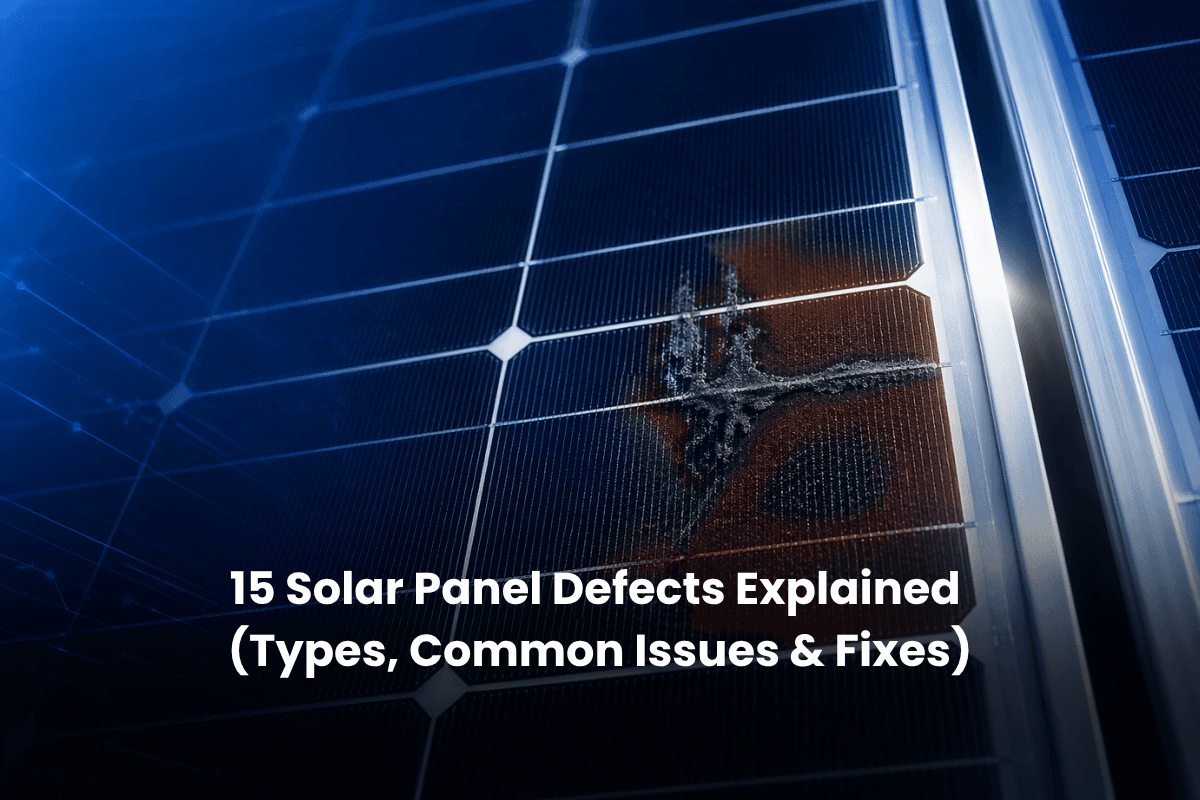
Localized overheating where current is forced through a high-resistance area – a cracked cell, a shading pattern, a failed diode, or a wiring fault. Beyond a yield issue, hot spots are a fire risk too.
Fixing the module without addressing the root cause means the next module fails too.
Detection: IR thermography under load (bright hot patches); advanced cases show browning or burn marks on visual inspection.
Fix: Remove root cause first; replace modules with severe or burned laminates.
6. Junction Box and Bypass Diode Defects
Failed or poorly constructed junction boxes – loose terminals, water ingress, defective bypass diodes.
Bypass diode failures are particularly problematic under partial shading: without a functioning diode, a shaded cell group becomes a resistive load that heats everything around it.
Detection: IR thermography (hot junction boxes or diode areas); visual inspection for burnt or cracked lids; IV curves for abnormal string behavior.
Fix: Replace or re-pot junction boxes where design allows. Diode replacement is feasible in some cases.
7. Busbar, Ribbon, and Solder Joint Defects
Broken, corroded, or poorly bonded metal conductors inside the module – completely invisible on visual inspection. Thermal cycling and mechanical flexing fatigue solder joints over time, causing progressive performance loss that’s easy to miss until it’s significant.
Detection: EL imaging (dark inactive stripes or lines); IR thermography for associated resistive heating; IV tracing for lowered fill factor.
Fix: Module replacement at utility scale – re-soldering isn’t economically viable; prevention via factory QA and EL reports from suppliers.
8. Wiring and Connector Faults
Loose, mismatched, corroded, or burnt DC connectors and cables.
One of the most common installation defects (and one of the most fixable). Mixing connector brands (non-matched MC4-style plugs), improper crimping, and absent strain relief are the typical culprits.
Detection: IR thermography finds hot connectors under load; manual tug tests and visual inspection catch loose or damaged ones.
Fix: Replace with approved, matched connectors using manufacturer-certified crimp tools.
9. Potential Induced Degradation (PID)
A high-voltage leakage mechanism where current flows from cells to frame and ground, eroding cell performance – often silently.
Typically starts at array edges and can spread across strings before monitoring catches it.
Root causes: High system voltages (1,000–1,500 V), certain cell/encapsulant combinations, high humidity, and temperature.
Detection: Monitoring analytics (string-level underperformance vs peers); EL imaging shows characteristic widespread cell darkening; IV curves show reduced Voc and fill factor.
Fix: PID recovery devices for short-term reversal; long-term fix requires grounding reconfiguration and PID-resistant module specification.
Material & Layer Degradation Defects
10. Delamination
Separation of encapsulant or backsheet from the glass or cell stack – presenting as milky patches, blisters, or lifted edges.
Once those gaps form, moisture follows, driving corrosion and compounding power loss.
Root causes: Inadequate lamination temperature/pressure/cure time, low-quality encapsulant, prolonged damp heat, and UV exposure.
Detection: Visual inspection (bubbles, edge lifting, cloudy areas); EL for inactive regions where moisture ingress has caused corrosion.
Fix: Field repair is impractical – delaminated modules are replaced; specify IEC damp-heat-tested encapsulant/backsheet systems at procurement.
11. Discoloration and Yellowing/Browning
Color changes in the encapsulant, backsheet, or cells.
The spectrum matters: mild, uniform yellowing is typically cosmetic. Severe or patchy browning correlates with optical losses, increased series resistance, and sometimes underlying hot spots or microcracks.
Root causes: Photo-oxidation of EVA encapsulant, chemical reactions with cell metallization, UV aging, pollution, or ammonia exposure.
Detection: Visual inspection for degree and pattern; performance data and IV curves to confirm whether losses are meaningful vs unaffected modules.
Fix: No reversal. Replace if losses are significant or safety is compromised; prevent through material specification with proven UV stability.
12. Snail Trails and Surface Staining
Dark, trail-like lines on the glass surface, often following silver grid lines or microcrack patterns. They appear after years of field exposure and are caused by moisture-driven oxidation of silver paste through microcrack pathways.
Root causes: Microcracks allowing moisture ingress, leading to oxidation/corrosion products; interactions between encapsulant additives and silver paste.
Detection: Visual inspection is primary; EL imaging confirms whether underlying cracks are causing real performance loss vs cosmetic only.
Fix: No cleaning removes them; prevention comes down to microcrack control at manufacturing and careful transport/handling.
13. Encapsulation and Sealing Defects / Moisture Ingress
Distinct from full delamination – this is edge seal or encapsulant failure that allows moisture into the laminate before visible layer separation.
Presents as fogging, corrosion of cell fingers, bubbles, or backsheet blistering.
Root causes: Poor lamination vacuum or temperature profile, incomplete curing, gaps in edge seals, prolonged coastal or humid exposure.
Detection: Visual inspection (fogging, water marks, bubbles); EL for dark regions where corrosion has degraded interconnects; insulation resistance testing for safety exposure.
Fix: Modules with substantial moisture ingress are replaced; specify robust edge seals and mounting designs that minimize standing water.
14. Light-Induced Degradation (LID) & LeTID – When Abnormal
Standard LID (1–3% loss in first hours to weeks of exposure) is expected and warrantied for.
The problem is when it isn’t standard – whole batches of PERC cells dropping multi-percent in the first months, signaling LeTID (Light and elevated Temperature Induced Degradation).
Root causes: Specific cell dopant/defect interactions activated under light and heat; certain PERC cell recipes; high operating temperatures amplifying the effect.
Detection: Monitoring and IV tracing vs. warranty curves across a batch – disproportionate early-life loss is the flag; lab testing on sample modules if systemic.
Fix: Some LeTID partially recovers with thermal/light treatment. Utility-scale farms typically handle via warranty claim. Prevent through procurement spec and third-party degradation data.
Environmental & Surface Defects
15. Severe Soiling & Contact Corrosion
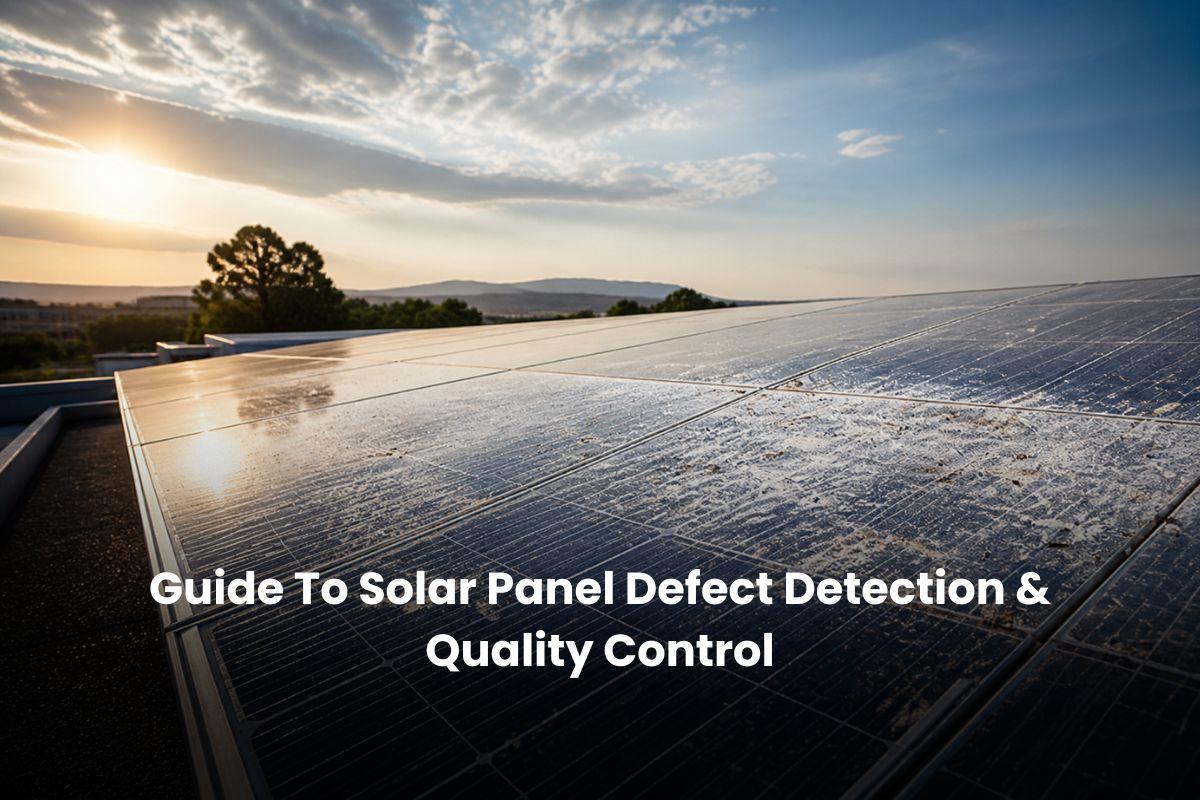
Heavy dust, bird droppings, agricultural film, and biological growth create localized shading patterns that lead directly to hot spots. Coastal salt spray and industrial pollutants corrode frames, fasteners, and exposed metal contacts.
Unlike most defects on this list, this one is genuinely maintenance-dependent. It’s fixable, but only if the cleaning schedule matches the site’s actual soiling rate.
Root causes: Arid/agricultural environments (dust, pollen), nearby industry (soot), birds, coastal salt spray – combined with long cleaning intervals.
Detection: Visual inspection and drone imagery for soiling patterns at scale; monitoring analytics for uniform power loss that recovers after rain or cleaning.
Fix: Site-matched cleaning schedules; for corrosion, replace affected components and upgrade to coated or stainless hardware with improved drainage design.
How to Detect Solar Panel Defects: Inspection Methods Compared
No single method catches everything. A robust O&M program layers techniques, using monitoring data to target expensive imaging where it matters most.
No physical localisation; needs IR/EL to confirm findings
The Practical Rule:
Visual inspection is your triage tool. IR, EL, and IV tracing are your diagnostic tools.
Monitoring is the always-on early warning layer that decides where to point everything else.
Inspection Frequency Benchmarks:
Utility-scale: Full professional inspection annually + drone IR survey at least once per year. SCADA monitoring is continuous.
Commercial/industrial: Annual professional inspection. IR survey annually or every 1–2 years depending on size and risk profile.
The Inspection Workflow That Works:
AI Inspection Platforms Accelerate This Loop Significantly
Applied to drone IR and RGB imagery, computer vision can automatically classify anomaly types (hot cell, hot string, connector fault), georeference each finding to a specific module ID and string, rank issues by estimated energy loss and safety risk, and compare across repeated campaigns to distinguish new defects from stable ones.
On a large farm, this is the difference between 10,000 images and an actionable maintenance plan.
How Much Yield Is Slipping Through Undetected?
See exactly which defects are costing you – before they compound.
Fixing Solar Panel Defects: Repair vs. Replace
Most cell-level and laminate-level solar panel defects are not repairable in the field. What you can repair on-site is the electrical and mechanical periphery.
Repairable On-Site:
Wiring and connector faults (replace with approved, matched connectors)
Extensive cell cracks, PID affecting large cell areas
Broken/shattered glass, severely warped frames
Burnt junction boxes where re-potting isn’t viable
The Replace-Vs-Repair Decision Isn’t Just Technical, But Financial
Consider:
safety risk severity
energy loss magnitude
module age relative to remaining warranty
whether a replacement module from the same batch carries the same underlying risk
How To Prevent Solar Panel Defects
Prevention maps directly back to the four root cause stages (which means it’s also four distinct intervention points).
The Five Highest-ROI Prevention Levers For Asset Owners:
Buy proven modules with reliability data (not cheapest per watt)
Enforce connector and cabling standards across every installation crew
Deploy real-time string monitoring from day one
Run annual drone IR campaigns on any site above a few hundred kW
Calibrate maintenance intensity to your specific climate risk profile
Solar Panel Defects FAQs
How much does a solar panel drone inspection cost?
Solar panel drone inspection services typically start at $300–$500 per MW, meaning a 120 MW facility runs $36,000–$60,000 for comprehensive analysis. For smaller commercial systems, basic thermal inspections average around $350, with advanced infrared inspections ranging $400–$600 depending on reporting depth and whether AI-powered defect classification is included.
How often should solar panels be inspected?
Utility-scale sites should have a full professional inspection annually, plus at least one thermal drone survey per year – more frequently in harsh climates or high-soiling environments. Commercial systems follow a similar annual cadence.
What is the best software for solar farm drone inspection?
The best solar farm drone inspection software automatically classifies defect types from thermal and RGB imagery, georeferencing each anomaly to a specific module ID and string rather than just flagging hot pixels. Platforms like Averroes apply computer vision directly to drone data to prioritize findings by energy loss and safety risk – turning thousands of images into an actionable maintenance plan without manual image review.
Can solar panel defects be detected without a drone?
Many solar panel defects can be partially detected without a drone – IR handheld cameras, IV curve tracers, and EL imaging all work at module or string level. But for sites above a few hundred kilowatts, ground-based methods miss the farm-wide patterns that thermal drone surveys catch in a single pass: string outages, soiling zones, connector hot spots, and row-level anomalies that would take weeks to find manually.
Conclusion
A microcrack from rough transit, a connector mismatch on installation day, PID creeping through an edge string. By the time any of these show up in a performance chart, they’ve often been compounding for months.
The gap between a well-managed asset and an underperforming one usually comes down to how early problems surface and whether the fix goes after the root cause.
The through-line across all 15 solar panel defects covered here: procurement decisions, handling procedures, and installation quality set the trajectory. Inspection and monitoring determine whether that trajectory gets corrected before it gets expensive.
Averroes applies computer vision directly to drone imagery to automatically detect anomalies, thermal issues, and microcracks at 98.5% accuracy – processing up to 80,000 images in under 20 hours, without manual review. Book a free demo.







A solar panel defect and normal degradation can look identical in a performance chart – until they don’t.
One follows the warranty curve.
The other is quietly compounding behind it.
Catching the difference early is where yield, safety, and warranty claims are won or lost.
Here’s a complete breakdown of the 15 most common solar panel defects, from microcracks to PID to delamination, covering root causes, detection methods, and remediation.
Key Notes
What Causes Solar Panel Defects? Root Causes Across The Lifecycle
Before cataloging individual defects, it helps to understand where they originate.
Defects don’t appear randomly. They trace back to four distinct stages, and most field failures involve more than one.
Climate Risk Matters Too
Site-specific risk profiling should inform both procurement specs and O&M frequency.
The 15 Most Common Solar Panel Defects
Structural & Physical Defects
1. Cell Cracks and Microcracks
Fine fractures in silicon cells (from hairline to full breaks) that are often invisible to the naked eye. They manifest as inactive cell areas, reduced current, and string underperformance, eventually progressing to hot spots.
2. Glass Damage
Chips, cracks, or shattered front glass – usually traceable to mechanical impact during installation or handling, hail events, or frame/clamp misalignment causing point loads.
Cracked glass means moisture ingress risk and safety exposure.
3. Backsheet Cracking and Degradation
Cracks, chalking, or embrittlement on the rear surface, sometimes exposing conductors.
UV radiation and temperature cycling degrade backsheet polymers over time; aggressive environments (ammonia from agriculture, industrial pollutants) accelerate this significantly.
4. Frame Defects and Mechanical Deformation
Bent, twisted, or cracked frames – and separation of the frame from the laminate. Results include water pooling at lower edges, glass stress, and eventual cracking.
Thermal & Electrical Defects
5. Hot Spots
Localized overheating where current is forced through a high-resistance area – a cracked cell, a shading pattern, a failed diode, or a wiring fault. Beyond a yield issue, hot spots are a fire risk too.
Fixing the module without addressing the root cause means the next module fails too.
6. Junction Box and Bypass Diode Defects
Failed or poorly constructed junction boxes – loose terminals, water ingress, defective bypass diodes.
Bypass diode failures are particularly problematic under partial shading: without a functioning diode, a shaded cell group becomes a resistive load that heats everything around it.
7. Busbar, Ribbon, and Solder Joint Defects
Broken, corroded, or poorly bonded metal conductors inside the module – completely invisible on visual inspection. Thermal cycling and mechanical flexing fatigue solder joints over time, causing progressive performance loss that’s easy to miss until it’s significant.
8. Wiring and Connector Faults
Loose, mismatched, corroded, or burnt DC connectors and cables.
One of the most common installation defects (and one of the most fixable). Mixing connector brands (non-matched MC4-style plugs), improper crimping, and absent strain relief are the typical culprits.
9. Potential Induced Degradation (PID)
A high-voltage leakage mechanism where current flows from cells to frame and ground, eroding cell performance – often silently.
Typically starts at array edges and can spread across strings before monitoring catches it.
Material & Layer Degradation Defects
10. Delamination
Separation of encapsulant or backsheet from the glass or cell stack – presenting as milky patches, blisters, or lifted edges.
Once those gaps form, moisture follows, driving corrosion and compounding power loss.
11. Discoloration and Yellowing/Browning
Color changes in the encapsulant, backsheet, or cells.
The spectrum matters: mild, uniform yellowing is typically cosmetic. Severe or patchy browning correlates with optical losses, increased series resistance, and sometimes underlying hot spots or microcracks.
12. Snail Trails and Surface Staining
Dark, trail-like lines on the glass surface, often following silver grid lines or microcrack patterns. They appear after years of field exposure and are caused by moisture-driven oxidation of silver paste through microcrack pathways.
13. Encapsulation and Sealing Defects / Moisture Ingress
Distinct from full delamination – this is edge seal or encapsulant failure that allows moisture into the laminate before visible layer separation.
Presents as fogging, corrosion of cell fingers, bubbles, or backsheet blistering.
14. Light-Induced Degradation (LID) & LeTID – When Abnormal
Standard LID (1–3% loss in first hours to weeks of exposure) is expected and warrantied for.
The problem is when it isn’t standard – whole batches of PERC cells dropping multi-percent in the first months, signaling LeTID (Light and elevated Temperature Induced Degradation).
Environmental & Surface Defects
15. Severe Soiling & Contact Corrosion
Heavy dust, bird droppings, agricultural film, and biological growth create localized shading patterns that lead directly to hot spots. Coastal salt spray and industrial pollutants corrode frames, fasteners, and exposed metal contacts.
Unlike most defects on this list, this one is genuinely maintenance-dependent. It’s fixable, but only if the cleaning schedule matches the site’s actual soiling rate.
How to Detect Solar Panel Defects: Inspection Methods Compared
No single method catches everything. A robust O&M program layers techniques, using monitoring data to target expensive imaging where it matters most.
The Practical Rule:
Visual inspection is your triage tool.
IR, EL, and IV tracing are your diagnostic tools.
Monitoring is the always-on early warning layer that decides where to point everything else.
Inspection Frequency Benchmarks:
The Inspection Workflow That Works:
AI Inspection Platforms Accelerate This Loop Significantly
Applied to drone IR and RGB imagery, computer vision can automatically classify anomaly types (hot cell, hot string, connector fault), georeference each finding to a specific module ID and string, rank issues by estimated energy loss and safety risk, and compare across repeated campaigns to distinguish new defects from stable ones.
On a large farm, this is the difference between 10,000 images and an actionable maintenance plan.
How Much Yield Is Slipping Through Undetected?
See exactly which defects are costing you – before they compound.
Fixing Solar Panel Defects: Repair vs. Replace
Most cell-level and laminate-level solar panel defects are not repairable in the field. What you can repair on-site is the electrical and mechanical periphery.
Repairable On-Site:
Replace The Module:
The Replace-Vs-Repair Decision Isn’t Just Technical, But Financial
Consider:
How To Prevent Solar Panel Defects
Prevention maps directly back to the four root cause stages (which means it’s also four distinct intervention points).
The Five Highest-ROI Prevention Levers For Asset Owners:
Solar Panel Defects FAQs
How much does a solar panel drone inspection cost?
Solar panel drone inspection services typically start at $300–$500 per MW, meaning a 120 MW facility runs $36,000–$60,000 for comprehensive analysis. For smaller commercial systems, basic thermal inspections average around $350, with advanced infrared inspections ranging $400–$600 depending on reporting depth and whether AI-powered defect classification is included.
How often should solar panels be inspected?
Utility-scale sites should have a full professional inspection annually, plus at least one thermal drone survey per year – more frequently in harsh climates or high-soiling environments. Commercial systems follow a similar annual cadence.
What is the best software for solar farm drone inspection?
The best solar farm drone inspection software automatically classifies defect types from thermal and RGB imagery, georeferencing each anomaly to a specific module ID and string rather than just flagging hot pixels. Platforms like Averroes apply computer vision directly to drone data to prioritize findings by energy loss and safety risk – turning thousands of images into an actionable maintenance plan without manual image review.
Can solar panel defects be detected without a drone?
Many solar panel defects can be partially detected without a drone – IR handheld cameras, IV curve tracers, and EL imaging all work at module or string level. But for sites above a few hundred kilowatts, ground-based methods miss the farm-wide patterns that thermal drone surveys catch in a single pass: string outages, soiling zones, connector hot spots, and row-level anomalies that would take weeks to find manually.
Conclusion
A microcrack from rough transit, a connector mismatch on installation day, PID creeping through an edge string. By the time any of these show up in a performance chart, they’ve often been compounding for months.
The gap between a well-managed asset and an underperforming one usually comes down to how early problems surface and whether the fix goes after the root cause.
The through-line across all 15 solar panel defects covered here: procurement decisions, handling procedures, and installation quality set the trajectory. Inspection and monitoring determine whether that trajectory gets corrected before it gets expensive.
Averroes applies computer vision directly to drone imagery to automatically detect anomalies, thermal issues, and microcracks at 98.5% accuracy – processing up to 80,000 images in under 20 hours, without manual review. Book a free demo.