Guide To Solar Panel Defect Detection & Quality Control
Averroes
May 04, 2026
A 100 MW site spits out tens of thousands of drone frames per campaign.
Reviewing them used to eat weeks of expert time and quietly delay every repair downstream. AI inspection platforms now chew through ~80,000 images in under 20 hours at 98.5%+ accuracy, with georeferencing and prioritization baked in.
We’ll walk through solar panel defect detection – the defect types, method trade-offs, lifecycle QC checkpoints, and what a modern AI-driven inspection workflow looks like.
Key Notes
PV defects sit at three levels (cell, module, and system).
EL, IR, IV tracing, and SCADA each have hard blind spots – no single method catches everything.
Manual review of drone imagery is what dictates how often large fleets get inspected.
A microcrack from month-one transport can take five years to surface as measurable yield loss.
PV defects sit at three levels (cell, module, and system) and most methods only see one or two of them clearly.
Cell-Level Defects Are The Ones That Compound Silently:
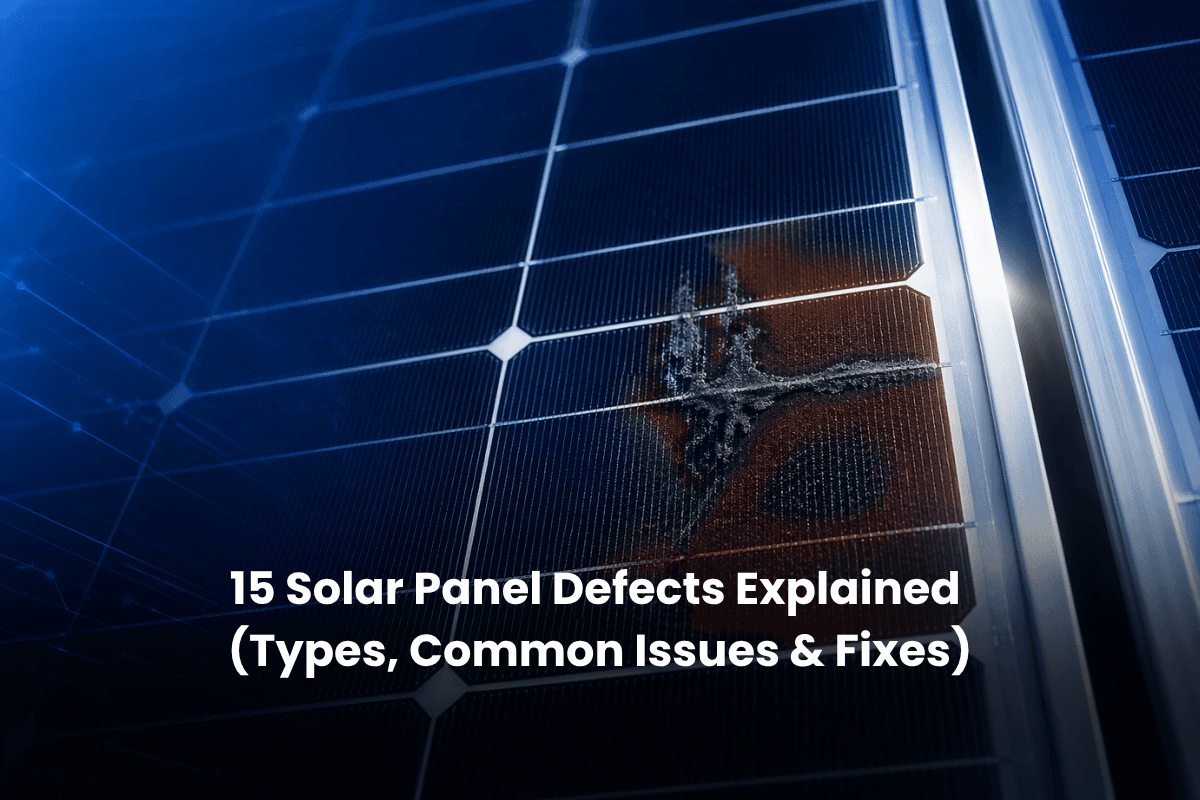
Microcracks. Hairline fractures in silicon, usually invisible to the eye but obvious in EL imagery as dark lines or fragmented cell areas. They create inactive zones, drive hotspots, and accelerate degradation over years.
Broken busbars and fingers. Metallization breaks show up in EL as missing conduction paths. Power loss is immediate.
Snail trails. Brown or grey discoloration along cracks, almost always tied to microcracks plus moisture ingress. A visual symptom of a deeper problem.
PID (Potential Induced Degradation). Voltage-driven leakage that erodes performance. Confirmed by IV curve shape and EL darkening.
Module-Level Defects Are Where Mechanical & Environmental Damage Shows Up:
Delamination and encapsulant bubbles (encapsulant lifting from cells or glass – moisture risk)
Glass breakage, scratches, and chips (water ingress, insulation failure, safety)
Backsheet cracks and junction box faults (often produce hotspots or ground faults)
String & System-Level Defects Are What SCADA Tends To Flag First:
Hotspots from cracked cells, shading, bypass diode faults, or poor connections
Failed bypass diodes, reversed polarity, and open strings
Soiling and shading patterns – non-uniform dirt, droppings, or vegetation
Tracker misalignment and warped frames
The Throughline:
Some defects are visible, some are latent, and some only express themselves under load. No single method catches everything – which is why method selection matters more than method sophistication.
Solar Panel Defect Detection Methods: What Each One Sees
Solar panel inspection methods are complementary, not interchangeable.
Here’s what each one does well, and where it leaves gaps:
Visual / RGB Inspection
The principle is simple – technicians or cameras look for visible damage (cracks, discoloration, broken glass, corrosion, junction box damage, label and serial issues).
Handheld walks work for small sites; drone-mounted RGB scales it to utility farms.
Defects can originate at any stage and surface years later.
The Asymmetry That Matters:
A microcrack from rough transport in month one can take five years to show up as a yield problem. Field inspection is where most operators feel the cost of upstream gaps, which is why it’s also where AI has the most to offer.
The Field Inspection Bottleneck: Why Manual Review Breaks At Scale
Capturing imagery is no longer the hard part. Reviewing it is. A drone campaign on a 100 MW site produces tens of thousands of IR and RGB frames.
The Classical Workflow Looks Like This:
SCADA flags an underperforming string.
Technicians plan an inspection and fly drones row by row.
Experts manually review thousands of images, marking hotspots and pattern anomalies.
Field teams visit flagged locations with handheld IR and electrical testers to confirm.
Findings get logged in spreadsheets, reports, and (eventually) the CMMS.
The Bottleneck Is Steps 3 & 5
Image review and the manual stitching of findings to asset IDs. This is the part that takes weeks, miscategorizes defects, and quietly delays repairs.
Every week of delay is compounding yield loss and a shrinking warranty window.
On large fleets, the campaign cadence ends up dictated by review capacity.
AI Solar Panel Defect Detection: What Changes
AI inspection platforms automate the review step.
Drones still capture. Field crews still execute. But the middle – detection, classification, georeferencing, prioritization – happens in hours instead of weeks.
For Averroes Specifically…
That means processing ~80,000 images in under 20 hours with ~98.5% detection accuracy and near-zero false positives.
The platform is hardware-agnostic (works with existing drone and camera setups) and deploys cloud or on-prem.
What Stays Human?
Spot-checking AI output, refining thresholds, and verifying high-priority findings in the field. The platform handles the volume; experts handle the judgment.
Still Reviewing Drone Images By Hand?
Process 80,000 images in under 20 hours.
Comparison: Solar Panel Defect Detection Methods
Method
Best At
Limitations
Stage
Manual visual
Mechanical damage, glass/frame, labels
Misses microcracks, PID, internal faults
All
Inline EL (factory)
Microcracks, busbar/finger faults, inactive areas
Needs dark conditions; mainly manufacturing
Manufacturing
Field EL
Root cause on suspect strings/modules
Labor-intensive; not for full-farm coverage
Troubleshooting, warranty
IR (handheld)
Local hotspot diagnostics, connectors, junction boxes
Slow at scale; operator-dependent
Commissioning, troubleshooting
IR (drone)
Farm-wide hotspots, string outages, soiling
Misses defects with no thermal expression
Large-scale O&M
IV curve tracing
Electrical characterization, PID, mismatch
No physical localization on its own
Commissioning, troubleshooting
SCADA / monitoring
Performance deviations, degradation trends
Can’t see physical cause or module location
Ongoing operations
AI inspection platform
Automated detection, classification, georeferencing on IR/RGB
Needs good input quality
O&M, asset management
AI QC on manufacturing line
High-throughput micro-defect detection
Requires training data and line integration
Manufacturing
Building A Solar Panel Defect Detection Program That Works
Five things separate a defect detection program from a defect detection budget:
Match methods to defect types you’re seeing. Don’t over-instrument. If your fleet’s pain is hotspots and connector faults, drone IR plus a tight SCADA loop beats adding EL campaigns nobody acts on.
Triangulate. SCADA flags it, IR localizes it, IV or EL confirms it. Skipping a layer is how you end up replacing modules that didn’t need replacing.
Plan cadence around degradation and warranty windows, not around when you have crew availability. Missed warranty windows are pure margin loss.
Automate review before scaling capture. Capture without analysis is wasted spend – more drones flying just makes the bottleneck worse.
Close the loop. Field findings should feed procurement and design. If a specific module batch shows recurring delamination, that’s a supplier conversation (not a maintenance one).
Solar Panel Defect Detection FAQs
How often should solar panels be inspected for defects?
Solar panels should be inspected at least once a year for utility-scale farms, with thermal drone scans typically run every 6–12 months and visual checks quarterly. High-degradation environments (coastal, desert, hail-prone) and post-extreme-weather events warrant additional ad-hoc campaigns.
What is the most common defect in solar panels?
The most common defect in solar panels is microcracking in silicon cells, often caused by transport, installation handling, or thermal cycling over time. Microcracks are the leading driver of long-term yield loss because they’re invisible to the naked eye and only show up clearly under EL imaging.
Can drones detect solar panel defects accurately?
Drones can detect solar panel defects accurately when paired with IR and RGB payloads and an AI analysis platform – Averroes processes ~80,000 drone images in under 20 hours at 98.5% detection accuracy with near-zero false positives. Drone capture alone produces raw imagery; the accuracy comes from what happens to those images after the flight.
How much energy yield is lost to undetected solar panel defects?
Undetected solar panel defects typically erode 2–5% of annual energy yield on poorly inspected sites, and individual underperforming strings can lose 10–20% before SCADA flags them clearly. The cost compounds over the asset’s 25-year life – which is why early detection through regular solar panel inspection pays back fast.
Conclusion
Solar panel defect detection is a layered problem with a layered answer.
Cell-level damage needs EL. Hotspots and connector faults need IR. Performance drift needs SCADA. Physical anomalies need eyes – human or drone. None of these methods compete (they cover for each other’s blind spots).
The shift worth paying attention to is what’s happened to the review step. Manual analysis of drone imagery used to set the ceiling on how often you could realistically inspect a fleet.
AI inspection platforms have lifted that ceiling, which means the operators acting on findings within days instead of months are pulling ahead on yield, warranty recovery, and crew utilization.
If your last inspection campaign produced more imagery than your team could review in a reasonable window, book a free demo and see what 80,000 images analyzed in under 20 hours looks like in practice.







A 100 MW site spits out tens of thousands of drone frames per campaign.
Reviewing them used to eat weeks of expert time and quietly delay every repair downstream. AI inspection platforms now chew through ~80,000 images in under 20 hours at 98.5%+ accuracy, with georeferencing and prioritization baked in.
We’ll walk through solar panel defect detection – the defect types, method trade-offs, lifecycle QC checkpoints, and what a modern AI-driven inspection workflow looks like.
Key Notes
The Defects That Matter (& Where They Hide)
Solar panel defect detection starts with knowing what you’re hunting.
PV defects sit at three levels (cell, module, and system) and most methods only see one or two of them clearly.
Cell-Level Defects Are The Ones That Compound Silently:
Module-Level Defects Are Where Mechanical & Environmental Damage Shows Up:
String & System-Level Defects Are What SCADA Tends To Flag First:
The Throughline:
Some defects are visible, some are latent, and some only express themselves under load. No single method catches everything – which is why method selection matters more than method sophistication.
Solar Panel Defect Detection Methods: What Each One Sees
Solar panel inspection methods are complementary, not interchangeable.
Here’s what each one does well, and where it leaves gaps:
Visual / RGB Inspection
The principle is simple – technicians or cameras look for visible damage (cracks, discoloration, broken glass, corrosion, junction box damage, label and serial issues).
Handheld walks work for small sites; drone-mounted RGB scales it to utility farms.
Electroluminescence (EL) Testing
EL is the gold standard for cell-level diagnostics. Apply forward bias to a module in the dark, and healthy cells emit near-IR light.
Dark zones in the resulting image = inactive areas (cracks, shunts, broken fingers, PID).
Inline EL is standard in factories.
In the field, it’s campaign-based on suspect strings.
Infrared (IR) Thermography
IR cameras see surface temperature. Hot spots and abnormal thermal patterns reveal resistive losses, shading, and electrical faults.
Handheld IR is for diagnostics, while drone-mounted IR is the workhorse for farm-scale scanning.
IV Curve Tracing & Electrical Tests
Plot current versus voltage on a string or module under irradiance, and the curve shape tells you about mismatch, shunts, high resistance, and PID.
Insulation and hi-pot tests check isolation to ground.
SCADA & Monitoring Analytics
Inverter, combiner, and weather data flag underperforming strings and degradation trends over time. It’s the watchdog, not the detective.
The Practical Reality:
Production QC stacks EL + AOI + flash testing.
Field O&M stacks SCADA + drone IR/RGB + targeted EL/IV follow-up.
Solar Panel Quality Control Across The Lifecycle
Defects can originate at any stage and surface years later.
The Asymmetry That Matters:
A microcrack from rough transport in month one can take five years to show up as a yield problem. Field inspection is where most operators feel the cost of upstream gaps, which is why it’s also where AI has the most to offer.
The Field Inspection Bottleneck: Why Manual Review Breaks At Scale
Capturing imagery is no longer the hard part. Reviewing it is. A drone campaign on a 100 MW site produces tens of thousands of IR and RGB frames.
The Classical Workflow Looks Like This:
The Bottleneck Is Steps 3 & 5
Image review and the manual stitching of findings to asset IDs. This is the part that takes weeks, miscategorizes defects, and quietly delays repairs.
AI Solar Panel Defect Detection: What Changes
AI inspection platforms automate the review step.
Drones still capture. Field crews still execute. But the middle – detection, classification, georeferencing, prioritization – happens in hours instead of weeks.
For Averroes Specifically…
That means processing ~80,000 images in under 20 hours with ~98.5% detection accuracy and near-zero false positives.
The platform is hardware-agnostic (works with existing drone and camera setups) and deploys cloud or on-prem.
What Stays Human?
Spot-checking AI output, refining thresholds, and verifying high-priority findings in the field. The platform handles the volume; experts handle the judgment.
Still Reviewing Drone Images By Hand?
Process 80,000 images in under 20 hours.
Comparison: Solar Panel Defect Detection Methods
Building A Solar Panel Defect Detection Program That Works
Five things separate a defect detection program from a defect detection budget:
Solar Panel Defect Detection FAQs
How often should solar panels be inspected for defects?
Solar panels should be inspected at least once a year for utility-scale farms, with thermal drone scans typically run every 6–12 months and visual checks quarterly. High-degradation environments (coastal, desert, hail-prone) and post-extreme-weather events warrant additional ad-hoc campaigns.
What is the most common defect in solar panels?
The most common defect in solar panels is microcracking in silicon cells, often caused by transport, installation handling, or thermal cycling over time. Microcracks are the leading driver of long-term yield loss because they’re invisible to the naked eye and only show up clearly under EL imaging.
Can drones detect solar panel defects accurately?
Drones can detect solar panel defects accurately when paired with IR and RGB payloads and an AI analysis platform – Averroes processes ~80,000 drone images in under 20 hours at 98.5% detection accuracy with near-zero false positives. Drone capture alone produces raw imagery; the accuracy comes from what happens to those images after the flight.
How much energy yield is lost to undetected solar panel defects?
Undetected solar panel defects typically erode 2–5% of annual energy yield on poorly inspected sites, and individual underperforming strings can lose 10–20% before SCADA flags them clearly. The cost compounds over the asset’s 25-year life – which is why early detection through regular solar panel inspection pays back fast.
Conclusion
Solar panel defect detection is a layered problem with a layered answer.
Cell-level damage needs EL. Hotspots and connector faults need IR. Performance drift needs SCADA. Physical anomalies need eyes – human or drone. None of these methods compete (they cover for each other’s blind spots).
The shift worth paying attention to is what’s happened to the review step. Manual analysis of drone imagery used to set the ceiling on how often you could realistically inspect a fleet.
AI inspection platforms have lifted that ceiling, which means the operators acting on findings within days instead of months are pulling ahead on yield, warranty recovery, and crew utilization.
If your last inspection campaign produced more imagery than your team could review in a reasonable window, book a free demo and see what 80,000 images analyzed in under 20 hours looks like in practice.