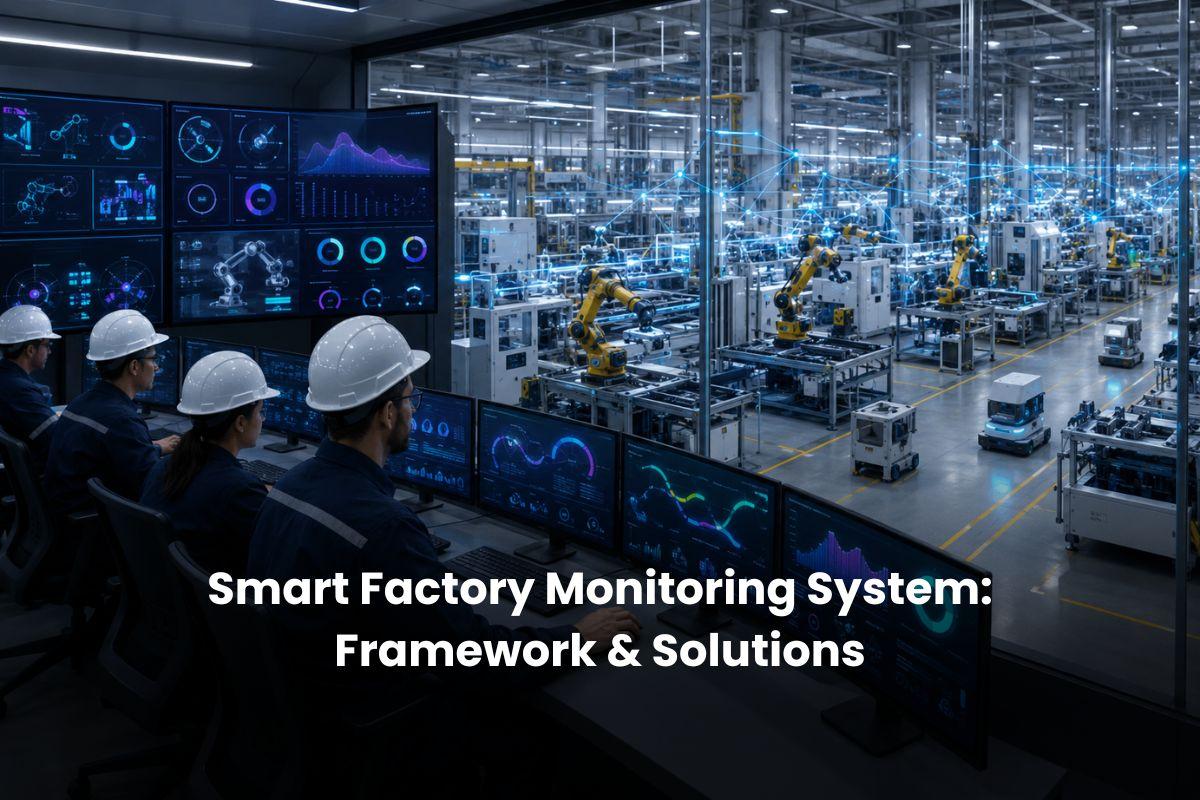
Every manufacturer has a version of the same problem: production data exists, but the decisions it should drive happen too late, or not at all.
Smart factory monitoring fixes the gap between data capture and operational action – connecting machines, lines, and processes into a live system that flags problems before they become losses.
We’ll cover the architecture, use cases, implementation requirements, and where AI visual inspection fits in the stack.
Key Notes
Smart factory monitoring stacks four distinct layers – sensor, connectivity, data, and analytics.
Predictive maintenance cuts unplanned downtime 30–50% and maintenance costs by 18–25%.
Integration with MES, SCADA, and ERP is the most technically demanding implementation requirement.
What Smart Factory Monitoring Produces: Capabilities & Objectives
Smart factory monitoring is the data layer that makes continuous improvement operational.
Here’s what a mature monitoring system delivers:
OEE & Throughput Visibility
Smart factory monitoring systems track machine states, cycle times, and output counts continuously, computing Availability × Performance × Quality in real time.
That means:
micro-stoppages
speed losses
quality deviations
… are visible the moment they occur.
Predictive Maintenance
Vibration signatures, temperature trends, current draw, and hydraulic pressure data feed ML models that detect early-stage equipment degradation – flagging issues before they become failures.
Properly implemented, the numbers are significant:
Unplanned downtime reduction: 30–50%
Maintenance cost reduction: 18–25%
Outcome: planned interventions instead of emergency callouts
Real-Time Quality Monitoring
In-process sensors, vision systems, and test stations push pass/fail data and measurement values into the monitoring stack continuously.
SPC charts update with each part
Alerts fire when processes drift toward specification limits – before non-conforming product ships
Energy & Resource Optimization
Sub-metered electricity, compressed air, steam, and gas consumption data reveals:
energy-intensive machines
idle running losses
leak events
Smart factory technology that includes energy monitoring typically delivers a 10–30% reduction in energy per unit across documented deployments.
Safety & Compliance
Environmental sensors – gas detection, temperature excursions, particle counts in cleanrooms – feed the same monitoring stack as production data.
Alerts are automated
Compliance records are generated continuously
A Single Source Of Truth
This is the strategic value that’s hardest to put a number on: operations, maintenance, quality, and supply chain teams working from the same live dataset.
Decisions get faster and more accurate when they aren’t based on conflicting shift reports.
How A Smart Factory Monitoring System Is Structured
Smart factory monitoring systems aren’t monolithic software platforms. Think of them as layered architectures. Understanding those layers is the prerequisite for designing or evaluating one sensibly.
OPC-UA, MQTT, Modbus, and EtherNet/IP each play a distinct role – and all four are typically present in the same plant:
OPC-UA: De facto standard for structured data integration between PLCs, MES, and monitoring platforms.
MQTT: Lightweight telemetry from edge gateways to cloud brokers.
Modbus / EtherNet/IP: Common at the device and machine level.
So: Fieldbus and Ethernet on the floor; OPC-UA and MQTT between the plant and the cloud.
MES, SCADA, Historians: What Each One Does
All three are typically present in a smart factory monitoring framework & the monitoring layer ingests from all of them rather than replacing any:
SCADA: Real-time supervision and operator control.
Historians: High-frequency time-series data from PLCs, stored at full granularity for months or years.
MES: Contextualizes machine signals into production events, attaching output counts to specific orders, products, operators, and shifts.
Legacy Equipment & Retrofit
A factory doesn’t need new machines to implement smart monitoring.
External sensors – current clamps, vibration monitors, temperature probes – attach to existing motors and gearboxes and feed through industrial gateways.
Non-intrusive techniques like reading stack-light signals or using computer vision to observe machine displays pull data from machines with no native connectivity.
Retrofit is the norm, not the exception.
Smart Factory Monitoring Use Cases By Function
Smart factory applications span production, maintenance, quality, and energy – each with distinct monitoring signals and outcomes.
Here’s where the value is generated:
Production Monitoring
The core use case:
OEE tracking, cycle time measurement, changeover monitoring, and schedule adherence – continuously.
Real-time visibility surfaces the micro-stoppages and speed losses that never make it into manual reports but compound into significant capacity loss across a week.
Throughput uplift on constrained lines from eliminating previously invisible losses: 5–20%
Predictive & Condition-Based Maintenance
Vibration, temperature, pressure, and power draw data feeds models that move maintenance from calendar-based to condition-based – scheduled when assets need it, not on a fixed interval that’s either too early or too late.
MTBF improves
Spare parts inventory shrinks
Emergency call-outs decrease
Quality & Visual Inspection
In-process sensors, SPC, and AI-driven vision systems feed defect data (type, location, frequency) into the monitoring stack.
First-pass yield and scrap metrics update continuously.
Defect events by station and time give quality engineers what they need for root-cause analysis (not just that something went wrong, but when, where, and with what signature).
Energy Monitoring
Machine-level and area-level sub-metering reveals energy per unit across products and shifts.
Patterns that manual monitoring misses (excessive idle running, compressed air leaks, poorly sequenced start-ups) become visible and quantifiable, turning the business case for energy projects from anecdotal to data-driven.
Worker Safety & Environmental Monitoring
Gas sensors, wearables, ambient temperature and humidity monitoring, and access control data feed the same monitoring infrastructure as production signals.
In regulated environments – pharma cleanrooms, semiconductor fabs, food processing – continuous environmental data is also a compliance requirement.
What A Smart Factory Monitoring System Requires To Work
Data Infrastructure
Sensor coverage across critical assets. Monitoring can only surface what sensors are capturing. Gaps in coverage mean blind spots in the data, and blind spots produce misleading OEE numbers.
Edge compute for latency-sensitive signals. Vision systems, fast control loops, and safety-critical alerts need processing close to the machine. Cloud round-trips introduce latency that’s acceptable for analytics but not for real-time intervention.
Storage that matches data volume. High-frequency time-series data from dozens of machines generates significant volume. Storage architecture decisions (historian vs. data lake vs. cloud time-series DB) need to be made before deployment, not after the historian starts falling over.
Integration Prerequisites
Smart factory monitoring only delivers value when it feeds into decisions (which means it has to connect to existing systems).
The key integrations:
System
Why It Matters For Monitoring
MES
Provides order and product context; turns machine states into production KPIs
SCADA
Source of real-time control data and alarms
ERP
Links production actuals to cost, inventory, and scheduling
Quality systems
Connects in-process data to quality records and compliance reporting
Heterogeneous equipment across a plant floor (different PLC vendors, different protocols, machines from different eras) makes integration the most technically demanding part of any smart factory monitoring project.
Organizational Requirements
Infrastructure aside, three organizational factors determine whether monitoring delivers on its business case:
Defined KPIs before deployment
Systems deployed without agreed targets generate dashboards nobody acts on.
Before a sensor goes in, the team needs to agree: what decisions will this data drive, and who owns them?
Cross-functional ownership
Production, maintenance, IT, and quality all touch the monitoring stack. When ownership sits with only one function, the others don’t adopt it.
Shared accountability (including agreed escalation paths when alerts fire) is not optional.
Operator-level adoption
The most common failure mode in smart factory deployments is a sophisticated analytics platform that nobody on the floor uses. Dashboards and alerts need to be actionable at the operator and shift supervisor level, not just readable by a central analytics team.
Deployment Model
On-premise: Required for air-gapped environments, lowest latency, and data sovereignty constraints. The right choice for semiconductor fabs, defense contractors, and any site where data can’t leave the facility.
Cloud: Enables multi-site aggregation, scalable analytics, and access to SaaS-based monitoring platforms. The right choice for corporate-level benchmarking and when on-site infrastructure investment is a constraint.
Hybrid: The most common path for brownfield manufacturers. Edge or on-prem processing handles real-time and latency-sensitive workloads; cloud handles aggregation, long-term storage, and advanced analytics.
Where AI Visual Inspection Fits in the Smart Factory Monitoring Stack
AI visual inspection functions as the quality sensor cluster in the smart factory monitoring architecture: cameras and edge GPUs at inspection points generate structured defect data – pass/fail, defect type, location, confidence score – that feeds MES, dashboards, and analytics exactly like any other monitored signal.
What It Adds To The Monitoring Stack:
Part-level quality signals. Pass/fail decisions and defect codes feed scrap, FPY, and OEE calculations in real time.
Granular RCA data. Defect patterns by station, shift, and tool give root-cause analysis a level of specificity aggregate metrics can’t match.
Predictive quality inputs. Anomaly trends feed process control models before defect rates escalate.
Unknown defect detection. Flags novel signatures outside predefined defect classes that rule-based systems miss entirely.
Repeated defects at a specific station also signal mechanical wear or tooling degradation – making vision data a direct input to predictive maintenance models.
What is the difference between SCADA and a smart factory monitoring system?
SCADA is a real-time supervisory control layer – it manages equipment states, alarms, and operator interfaces at the plant level. A smart factory monitoring system sits above that, aggregating data from SCADA, MES, historians, and other sources to deliver cross-functional analytics, predictive models, and KPI tracking that SCADA alone wasn’t designed to provide.
How long does it take to implement smart factory monitoring?
Implementation timelines for smart factory monitoring vary by scope – a single-line pilot with existing connectivity can be live in 4–8 weeks, while a multi-site rollout typically runs 6–18 months. The biggest variable is data integration with legacy systems and the time needed to define KPIs and alert logic before deployment.
What is OEE in smart factory monitoring?
OEE – Overall Equipment Effectiveness – is the primary production KPI in smart factory monitoring, calculated as Availability × Performance × Quality. It gives manufacturers a single, continuously updated number that quantifies how much productive capacity is being lost and to which cause, making it the standard starting point for any monitoring deployment.
Which industries benefit most from smart factory automation?
Smart factory automation delivers the highest ROI in industries where downtime is expensive and quality tolerances are tight – automotive, semiconductors, electronics, pharmaceuticals, and aerospace consistently lead adoption. That said, high-volume discrete and process manufacturers across food and beverage, medical devices, and solar are closing the gap as retrofit sensor costs continue to fall.
Conclusion
Smart factory monitoring delivers on its promise when three things align: the right data infrastructure, integration with existing systems, and organizational ownership that runs from the shop floor to the C-suite.
Get those right, and the outcomes are well-documented – meaningful reductions in unplanned downtime, scrap, energy per unit, and maintenance spend, with throughput gains that don’t require new capital equipment.
The architecture isn’t exotic. Most of what makes a factory “smart” runs on existing machines, retrofit sensors, and software layers that sit above the OT stack manufacturers already have.
For manufacturers where quality losses and process drift are the primary yield killers, AI visual inspection is where smart factory monitoring gets precise.
Averroes integrates with existing inspection equipment to deliver 99%+ detection accuracy and virtual metrology – book a free demo to see what that looks like on your line.







Every manufacturer has a version of the same problem: production data exists, but the decisions it should drive happen too late, or not at all.
Smart factory monitoring fixes the gap between data capture and operational action – connecting machines, lines, and processes into a live system that flags problems before they become losses.
We’ll cover the architecture, use cases, implementation requirements, and where AI visual inspection fits in the stack.
Key Notes
What Smart Factory Monitoring Produces: Capabilities & Objectives
Smart factory monitoring is the data layer that makes continuous improvement operational.
Here’s what a mature monitoring system delivers:
OEE & Throughput Visibility
Smart factory monitoring systems track machine states, cycle times, and output counts continuously, computing Availability × Performance × Quality in real time.
That means:
… are visible the moment they occur.
Predictive Maintenance
Vibration signatures, temperature trends, current draw, and hydraulic pressure data feed ML models that detect early-stage equipment degradation – flagging issues before they become failures.
Properly implemented, the numbers are significant:
Real-Time Quality Monitoring
In-process sensors, vision systems, and test stations push pass/fail data and measurement values into the monitoring stack continuously.
Energy & Resource Optimization
Sub-metered electricity, compressed air, steam, and gas consumption data reveals:
Smart factory technology that includes energy monitoring typically delivers a 10–30% reduction in energy per unit across documented deployments.
Safety & Compliance
Environmental sensors – gas detection, temperature excursions, particle counts in cleanrooms – feed the same monitoring stack as production data.
A Single Source Of Truth
This is the strategic value that’s hardest to put a number on: operations, maintenance, quality, and supply chain teams working from the same live dataset.
Decisions get faster and more accurate when they aren’t based on conflicting shift reports.
How A Smart Factory Monitoring System Is Structured
Smart factory monitoring systems aren’t monolithic software platforms. Think of them as layered architectures. Understanding those layers is the prerequisite for designing or evaluating one sensibly.
Here’s how the stack works from the floor up:
A Few Details That Matter In Practice:
Industrial Protocols
OPC-UA, MQTT, Modbus, and EtherNet/IP each play a distinct role – and all four are typically present in the same plant:
So: Fieldbus and Ethernet on the floor; OPC-UA and MQTT between the plant and the cloud.
MES, SCADA, Historians: What Each One Does
All three are typically present in a smart factory monitoring framework & the monitoring layer ingests from all of them rather than replacing any:
Legacy Equipment & Retrofit
A factory doesn’t need new machines to implement smart monitoring.
Retrofit is the norm, not the exception.
Smart Factory Monitoring Use Cases By Function
Smart factory applications span production, maintenance, quality, and energy – each with distinct monitoring signals and outcomes.
Here’s where the value is generated:
Production Monitoring
The core use case:
OEE tracking, cycle time measurement, changeover monitoring, and schedule adherence – continuously.
Predictive & Condition-Based Maintenance
Vibration, temperature, pressure, and power draw data feeds models that move maintenance from calendar-based to condition-based – scheduled when assets need it, not on a fixed interval that’s either too early or too late.
Quality & Visual Inspection
In-process sensors, SPC, and AI-driven vision systems feed defect data (type, location, frequency) into the monitoring stack.
Energy Monitoring
Machine-level and area-level sub-metering reveals energy per unit across products and shifts.
Patterns that manual monitoring misses (excessive idle running, compressed air leaks, poorly sequenced start-ups) become visible and quantifiable, turning the business case for energy projects from anecdotal to data-driven.
Worker Safety & Environmental Monitoring
Gas sensors, wearables, ambient temperature and humidity monitoring, and access control data feed the same monitoring infrastructure as production signals.
In regulated environments – pharma cleanrooms, semiconductor fabs, food processing – continuous environmental data is also a compliance requirement.
What A Smart Factory Monitoring System Requires To Work
Data Infrastructure
Integration Prerequisites
Smart factory monitoring only delivers value when it feeds into decisions (which means it has to connect to existing systems).
The key integrations:
Heterogeneous equipment across a plant floor (different PLC vendors, different protocols, machines from different eras) makes integration the most technically demanding part of any smart factory monitoring project.
Organizational Requirements
Infrastructure aside, three organizational factors determine whether monitoring delivers on its business case:
Defined KPIs before deployment
Systems deployed without agreed targets generate dashboards nobody acts on.
Before a sensor goes in, the team needs to agree: what decisions will this data drive, and who owns them?
Cross-functional ownership
Production, maintenance, IT, and quality all touch the monitoring stack. When ownership sits with only one function, the others don’t adopt it.
Shared accountability (including agreed escalation paths when alerts fire) is not optional.
Operator-level adoption
The most common failure mode in smart factory deployments is a sophisticated analytics platform that nobody on the floor uses. Dashboards and alerts need to be actionable at the operator and shift supervisor level, not just readable by a central analytics team.
Deployment Model
Where AI Visual Inspection Fits in the Smart Factory Monitoring Stack
AI visual inspection functions as the quality sensor cluster in the smart factory monitoring architecture: cameras and edge GPUs at inspection points generate structured defect data – pass/fail, defect type, location, confidence score – that feeds MES, dashboards, and analytics exactly like any other monitored signal.
What It Adds To The Monitoring Stack:
Repeated defects at a specific station also signal mechanical wear or tooling degradation – making vision data a direct input to predictive maintenance models.
Ready To Close The Gaps In Quality Monitoring?
99%+ detection accuracy, near-zero false positives, existing equipment.
Smart Factory Monitoring FAQs
What is the difference between SCADA and a smart factory monitoring system?
SCADA is a real-time supervisory control layer – it manages equipment states, alarms, and operator interfaces at the plant level. A smart factory monitoring system sits above that, aggregating data from SCADA, MES, historians, and other sources to deliver cross-functional analytics, predictive models, and KPI tracking that SCADA alone wasn’t designed to provide.
How long does it take to implement smart factory monitoring?
Implementation timelines for smart factory monitoring vary by scope – a single-line pilot with existing connectivity can be live in 4–8 weeks, while a multi-site rollout typically runs 6–18 months. The biggest variable is data integration with legacy systems and the time needed to define KPIs and alert logic before deployment.
What is OEE in smart factory monitoring?
OEE – Overall Equipment Effectiveness – is the primary production KPI in smart factory monitoring, calculated as Availability × Performance × Quality. It gives manufacturers a single, continuously updated number that quantifies how much productive capacity is being lost and to which cause, making it the standard starting point for any monitoring deployment.
Which industries benefit most from smart factory automation?
Smart factory automation delivers the highest ROI in industries where downtime is expensive and quality tolerances are tight – automotive, semiconductors, electronics, pharmaceuticals, and aerospace consistently lead adoption. That said, high-volume discrete and process manufacturers across food and beverage, medical devices, and solar are closing the gap as retrofit sensor costs continue to fall.
Conclusion
Smart factory monitoring delivers on its promise when three things align: the right data infrastructure, integration with existing systems, and organizational ownership that runs from the shop floor to the C-suite.
Get those right, and the outcomes are well-documented – meaningful reductions in unplanned downtime, scrap, energy per unit, and maintenance spend, with throughput gains that don’t require new capital equipment.
The architecture isn’t exotic. Most of what makes a factory “smart” runs on existing machines, retrofit sensors, and software layers that sit above the OT stack manufacturers already have.
For manufacturers where quality losses and process drift are the primary yield killers, AI visual inspection is where smart factory monitoring gets precise.
Averroes integrates with existing inspection equipment to deliver 99%+ detection accuracy and virtual metrology – book a free demo to see what that looks like on your line.