QA In Manufacturing: Complete Guide To Systems, Methods & Metrics
Averroes
Jun 26, 2026
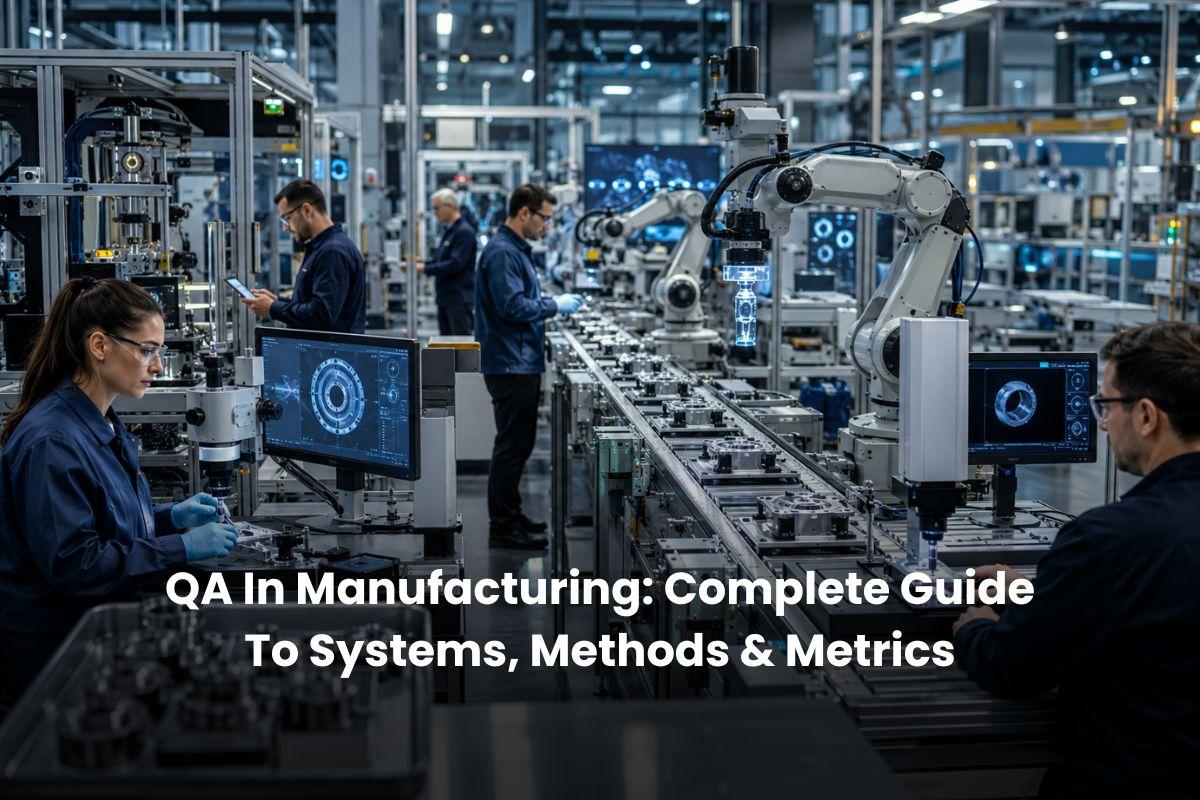
Every QA in manufacturing function answers the same two questions on repeat: can the process make good parts and can you prove each one is good before it leaves?
Standards, methodologies, inspection, and metrics all exist to answer those two.
We’ll cover the full stack – QA versus QC, ISO and sector standards, quality planning, process control, AI-driven inspection, KPIs, and corrective action.
Key Notes
QA prevents defects; QC detects them (assurance owns the process, while control checks the output).
Quality planning tools like APQP, FMEA, and PPAP build defects out before production starts.
AI visual inspection hits 99%+ accuracy with near-zero false positives on existing hardware.
First pass yield, DPPM, and COPQ are the KPIs that prove QA is working.
QA vs QC in Manufacturing: Prevention vs Detection
The difference between QA and QC in manufacturing comes down to one question: are you preventing defects or detecting them?
Quality assurance is the system that designs problems out before production.
Quality control is the activity that catches problems in the output once production is running.
They’re complementary, not interchangeable.
Approach
Focus
Goal
Timing
Owns
Question
Quality Assurance (QA)
Process and system
Prevent defects
Before and during production
Procedures, standards, training
“Is the process capable?”
Quality Control (QC)
Product and output
Detect defects
During and after production
Inspection, testing, sampling
“Is this unit good?”
QC Is A Subset Of What QA Governs
A mature manufacturing quality assurance function uses QC data as feedback to improve the process, which is where the prevention loop closes.
QA In Manufacturing Standards & The QMS Framework
Industrial quality assurance operates inside a quality management system (QMS) – the documented framework of:
policies
processes
records that makes quality repeatable and auditable
The QMS is what turns QA from a set of good intentions into a system that survives staff turnover and scales across lines.
ISO 9001 Is The Global Baseline For Quality Management Systems
Built on risk-based thinking and process orientation.
The current version is ISO 9001:2015 (a revised ISO 9001:2026 is expected to publish in late 2026 with a three-year transition window) so 2015 remains the standard to certify against today.
On top of that base, most regulated sectors layer their own requirements:
Automotive – IATF 16949: Extends ISO 9001 with automotive-specific demands around defect prevention, PPAP, and supply chain discipline.
Aerospace – AS9100: Adds rigorous traceability, risk management, and configuration control for safety-critical parts.
Medical devices – ISO 13485: Emphasizes design controls, validation, and documentation tied to regulatory submissions.
Pharma and food – GMP/cGMP: Governs hygiene, batch records, and process validation under FDA and equivalent oversight.
The standard you operate under shapes everything downstream – your control plans, your audit cadence, and how much evidence you keep.
Quality Planning & Risk Prevention
Quality planning is the preventive arm of QA: the work you do before production so defects never get designed or built into the product.
A handful of structured methods carry most of the load here:
Skip this layer and you’ve built a quality system that can only ever react. The plants that run lean on scrap are the ones that front-loaded the thinking.
Process Control & Improvement Methodologies
Process control methodologies keep a running production process stable and capable over time – the standing disciplines that hold quality steady once the line is live.
These are ongoing operating systems, distinct from the one-time planning above and the reactive fixes below.
Four Show Up Across Most QA In Manufacturing Programs:
SPC (Statistical Process Control): Uses control charts to track process variation in real time and flag drift before it becomes a defect, separating normal noise from genuine signals.
Six Sigma / DMAIC: A data-driven method (Define, Measure, Analyze, Improve, Control) for reducing variation and defects toward a target of 3.4 defects per million opportunities.
Lean / TQM: Focuses on eliminating waste and embedding quality ownership across every role rather than quarantining it in a QA department.
PDCA / Kaizen: The Plan-Do-Check-Act cycle that institutionalizes continuous, incremental improvement as a habit rather than a project.
None of these is a silver bullet, and stacking all four without discipline just creates overhead. Strong programs pick the methodology that fits their variation problem and commit to it.
Inspection & Verification On The Line
Inspection is where QA output gets verified (& it’s the area undergoing the biggest shift in manufacturing quality assurance right now).
Verification has historically meant people and rules; it’s increasingly becoming a question of models and data.
The Progression Runs Roughly Like This:
That Last Limitation Is The Real Cost Center
Rule-based automated inspection is notorious for false positives – flagging good parts as defective – which forces expensive manual re-review and erodes trust in the system.
False negatives, the escapes that reach customers, are worse.
AI Visual Inspection: Cutting False Positives & Escapes
AI visual inspection is the current frontier for verification, and it’s where our platform sits.
Instead of hand-coded rules, it learns what defects look like from examples, which lets it catch subtle and previously unseen flaws that rule-based systems miss.
The Practical Gains We See In Deployment:
Accuracy and false positives: 99%+ defect detection accuracy with near-zero false positives, which removes most of the wasted re-inspection labor that plagues rule-based AOI.
Minimal training data: Useful models trained on roughly 20–40 images per defect class, so you’re not waiting months to collect a dataset before going live.
No new hardware: Runs on your existing equipment – no new cameras or capital outlay, deployed on-prem (including air-gapped) or in the cloud.
Catching the unknowns: WatchDog flags novel anomalies that fall outside configured defect classes, the failures rule-based tools structurally can’t see.
The point isn’t to replace your inspection equipment, but to make what you already own substantially better at telling a real defect from a false alarm.
Ready To Stop Defects From Escaping?
Catch the subtle and unknown flaws rules miss.
Measuring QA In Manufacturing Performance
Quality assurance KPIs in manufacturing tell you whether the system is working.
The metrics that earn their place track outcomes (did quality improve?) rather than effort (how many inspections did we run?).
These Are The Quality Assurance Measures Most Programs Live By:
First Pass Yield (FPY): Percentage of units that pass without rework on the first attempt – the cleanest single read on process health.
Defect/Escape Rate (DPPM): Defective parts per million, especially escapes that reach the customer; the number most directly tied to reputation.
Scrap and Rework Rate: Material and labor lost to nonconforming product, a direct hit to margin.
Supplier PPM: Defect rate on incoming material, since a lot of “your” defects start upstream.
On-Time Quality / Audit Findings: Delivery performance and the count of nonconformities raised in internal and external audits.
Cost of Poor Quality (COPQ)
COPQ is the metric that translates quality performance into money that leadership cares about. It sorts every quality-related dollar into four buckets:
Cost Category
What It Covers
Prevention
Planning, training, FMEA, process design – spent to avoid defects
Appraisal
Inspection, testing, audits – spent to find defects
Internal failure
Scrap and rework caught before shipment
External failure
Returns, warranty, recalls, lost trust – the most expensive bucket by far
The pattern is consistent across industries: every dollar moved into prevention and appraisal saves several in failure costs.
Corrective Action For QA In Manufacturing: Closing The Loop
Corrective action is the reactive machinery that kicks in when a specific defect gets through – distinct from the standing improvement disciplines, because this is triggered by an actual failure.
Root cause analysis: Techniques like 5 Whys and fishbone (Ishikawa) diagrams that trace a defect back past its symptoms to the underlying cause.
CAPA (Corrective and Preventive Action): A formal, documented process to correct the immediate problem and prevent recurrence, required in regulated industries.
8D (Eight Disciplines): A structured team-based problem-solving method for complex or recurring failures, widely used in automotive.
Feed those findings back into your control plans and FMEAs and the loop closes – yesterday’s escape becomes tomorrow’s prevention.
Ready To Upgrade Inspection Without New Hardware?
99%+ accuracy on your existing tools.
QA In Manufacturing FAQs
What are the 7 QA tools in manufacturing?
The 7 QA tools in manufacturing are the classic quality control tools: check sheets, Pareto charts, fishbone diagrams, histograms, scatter diagrams, control charts, and stratification. They’re the standard toolkit for identifying and analyzing quality problems on the shop floor.
Who is responsible for quality assurance in manufacturing?
Quality assurance in manufacturing is owned by the quality team but shared across the plant, with QA engineers and managers setting the system while operators, process engineers, and suppliers each carry quality responsibility for their part of the line.
What is the difference between quality assurance and quality engineering?
Quality assurance focuses on the overall system and processes that prevent defects, while quality engineering applies technical methods – tolerance analysis, test design, statistical tools – to build quality into specific products and processes.
Conclusion
QA in manufacturing works as a chain, and the chain is only as strong as its weakest handoff.
Standards give it structure, planning builds defects out at the source, process control holds the line stable, and KPIs like first pass yield and DPPM tell you whether any of it is working. Corrective action feeds failures back upstream so the same defect can’t return.
The stage moving fastest right now is verification, where AI visual inspection is closing the false-positive and escape gaps that manual and rule-based methods leave wide open.
That gap is exactly where we work: 99%+ accuracy and near-zero false positives on the equipment you already run. Book a free demo and see it on your own parts.







Every QA in manufacturing function answers the same two questions on repeat: can the process make good parts and can you prove each one is good before it leaves?
Standards, methodologies, inspection, and metrics all exist to answer those two.
We’ll cover the full stack – QA versus QC, ISO and sector standards, quality planning, process control, AI-driven inspection, KPIs, and corrective action.
Key Notes
QA vs QC in Manufacturing: Prevention vs Detection
The difference between QA and QC in manufacturing comes down to one question: are you preventing defects or detecting them?
They’re complementary, not interchangeable.
QC Is A Subset Of What QA Governs
A mature manufacturing quality assurance function uses QC data as feedback to improve the process, which is where the prevention loop closes.
QA In Manufacturing Standards & The QMS Framework
Industrial quality assurance operates inside a quality management system (QMS) – the documented framework of:
The QMS is what turns QA from a set of good intentions into a system that survives staff turnover and scales across lines.
ISO 9001 Is The Global Baseline For Quality Management Systems
Built on risk-based thinking and process orientation.
The current version is ISO 9001:2015 (a revised ISO 9001:2026 is expected to publish in late 2026 with a three-year transition window) so 2015 remains the standard to certify against today.
On top of that base, most regulated sectors layer their own requirements:
The standard you operate under shapes everything downstream – your control plans, your audit cadence, and how much evidence you keep.
Quality Planning & Risk Prevention
Quality planning is the preventive arm of QA: the work you do before production so defects never get designed or built into the product.
A handful of structured methods carry most of the load here:
Skip this layer and you’ve built a quality system that can only ever react. The plants that run lean on scrap are the ones that front-loaded the thinking.
Process Control & Improvement Methodologies
Process control methodologies keep a running production process stable and capable over time – the standing disciplines that hold quality steady once the line is live.
These are ongoing operating systems, distinct from the one-time planning above and the reactive fixes below.
Four Show Up Across Most QA In Manufacturing Programs:
None of these is a silver bullet, and stacking all four without discipline just creates overhead. Strong programs pick the methodology that fits their variation problem and commit to it.
Inspection & Verification On The Line
Inspection is where QA output gets verified (& it’s the area undergoing the biggest shift in manufacturing quality assurance right now).
Verification has historically meant people and rules; it’s increasingly becoming a question of models and data.
The Progression Runs Roughly Like This:
That Last Limitation Is The Real Cost Center
Rule-based automated inspection is notorious for false positives – flagging good parts as defective – which forces expensive manual re-review and erodes trust in the system.
False negatives, the escapes that reach customers, are worse.
AI Visual Inspection: Cutting False Positives & Escapes
AI visual inspection is the current frontier for verification, and it’s where our platform sits.
Instead of hand-coded rules, it learns what defects look like from examples, which lets it catch subtle and previously unseen flaws that rule-based systems miss.
The Practical Gains We See In Deployment:
The point isn’t to replace your inspection equipment, but to make what you already own substantially better at telling a real defect from a false alarm.
Ready To Stop Defects From Escaping?
Catch the subtle and unknown flaws rules miss.
Measuring QA In Manufacturing Performance
Quality assurance KPIs in manufacturing tell you whether the system is working.
The metrics that earn their place track outcomes (did quality improve?) rather than effort (how many inspections did we run?).
These Are The Quality Assurance Measures Most Programs Live By:
Cost of Poor Quality (COPQ)
COPQ is the metric that translates quality performance into money that leadership cares about. It sorts every quality-related dollar into four buckets:
The pattern is consistent across industries: every dollar moved into prevention and appraisal saves several in failure costs.
Corrective Action For QA In Manufacturing: Closing The Loop
Corrective action is the reactive machinery that kicks in when a specific defect gets through – distinct from the standing improvement disciplines, because this is triggered by an actual failure.
The goal is to fix the root cause so the same defect doesn’t recur.
Three Tools Structure Most Of This Work:
Feed those findings back into your control plans and FMEAs and the loop closes – yesterday’s escape becomes tomorrow’s prevention.
Ready To Upgrade Inspection Without New Hardware?
99%+ accuracy on your existing tools.
QA In Manufacturing FAQs
What are the 7 QA tools in manufacturing?
The 7 QA tools in manufacturing are the classic quality control tools: check sheets, Pareto charts, fishbone diagrams, histograms, scatter diagrams, control charts, and stratification. They’re the standard toolkit for identifying and analyzing quality problems on the shop floor.
Who is responsible for quality assurance in manufacturing?
Quality assurance in manufacturing is owned by the quality team but shared across the plant, with QA engineers and managers setting the system while operators, process engineers, and suppliers each carry quality responsibility for their part of the line.
What is the difference between quality assurance and quality engineering?
Quality assurance focuses on the overall system and processes that prevent defects, while quality engineering applies technical methods – tolerance analysis, test design, statistical tools – to build quality into specific products and processes.
Conclusion
QA in manufacturing works as a chain, and the chain is only as strong as its weakest handoff.
Standards give it structure, planning builds defects out at the source, process control holds the line stable, and KPIs like first pass yield and DPPM tell you whether any of it is working. Corrective action feeds failures back upstream so the same defect can’t return.
The stage moving fastest right now is verification, where AI visual inspection is closing the false-positive and escape gaps that manual and rule-based methods leave wide open.
That gap is exactly where we work: 99%+ accuracy and near-zero false positives on the equipment you already run. Book a free demo and see it on your own parts.