AI vs Rule Based Machine Vision: When To Use Which
Averroes
Jun 26, 2026
The AI vs rule based machine vision decision has a single axis: how much your production environment resembles a controlled specification.
Stable parts, defined defects, engineered conditions – rule-based wins on speed, cost, and auditability. Variable morphology, shifting suppliers, unknown defect types – that’s where deep learning earns its place.
Most lines run both.
We’ll cover how to assign the right approach to the right inspection task, including a decision framework and where AI platforms slot into an existing stack.
Key Notes
Rule-based vision breaks when variation, supplier changes, or surface complexity enter the equation.
Deep learning handles variable defect morphology and unknown anomalies that threshold logic can’t parameterize.
Most industrial inspection lines run both approaches in parallel, divided by task type.
Rule-Based Machine Vision: Where It Earns Its Place & Where It Breaks
Rule-based machine vision has been the backbone of industrial inspection for decades, and for good reason.
When the task is mathematically describable, the system is deterministic, fast, and fully explainable – every pass/fail decision traces back to a specific rule and threshold.
Where Rule-Based Vision Works Well:
Dimensional gauging and metrology. Tight tolerances, hole diameters, distances, angles, runout. If the check can be specified as a number, rule-based handles it cleanly.
Presence/absence checks. Is the label present? Is the connector seated? Is this feature there or not? Simple, binary, high-speed.
Controlled, stable environments. Rigid fixtures, engineered lighting, low product variation. When the world behaves like a CAD drawing, rule-based is the right tool.
Regulated industries. Pharmaceutical packaging, medical devices, aerospace. Full traceability to an explicit rule is often a compliance requirement, not just a preference.
The Architecture Behind This Is Straightforward:
Edge detection, blob analysis, pattern matching, geometric measurement, fixed thresholds chained into a decision flowchart.
A vision engineer designs the logic, sets tolerances, and the system runs it.
Low compute overhead, ultra-fast inference, easy to validate.
Where Rule-Based Machine Vision Breaks Down:
The brittleness surfaces the moment real-world conditions drift from the engineered baseline.
Material & Supplier Variation
A new surface finish, slightly different color from a new supplier lot, minor gloss change.
Any of these can break rules that were tuned on the original material, requiring re-engineering of the entire threshold set.
These don’t have clean geometric signatures. Parameterizing them in rule logic either misses half the population or generates so many false positives the line becomes unmanageable.
False Positive Burden
The typical response to missed defects in a rule-based system is to tighten thresholds. Tighter thresholds flag more good product. More false positives means more manual reinspection, more labor, more throughput loss.
It’s a painful trade-off with no clean resolution inside a rule-based architecture.
Unknown Defects
If a defect type wasn’t anticipated when the rules were written, it passes. No rule exists for it. This is the escape problem, and it’s structural.
AI & Deep Learning Machine Vision: Capability & Trade-Offs
AI-based machine vision – specifically deep learning – learns from labeled examples rather than explicit rules. The model infers what “defective” looks like from data, builds internal feature representations, and generalizes to images it hasn’t seen before.
That’s a fundamentally different capability profile.
Where AI & Deep Learning Machine Vision Excels:
Variable Defect Morphology
Scratches that curve differently every time, dents with inconsistent depth, stains with fuzzy edges. Deep learning handles all of these as variations on a learned concept, not as rule violations.
Cosmetic & Subjective Tolerances
Aesthetic inspection where “acceptable” is operator-dependent. AI models trained on human-reviewed examples capture that judgment and apply it consistently at scale.
Anomaly Detection
Flagging anything that looks meaningfully different from normal, including defect types that weren’t in the training set. This is the unknown unknowns problem, and it’s where rule-based systems have no answer.
Submicron Defect Sensitivity
At advanced semiconductor nodes, defect signals are at or near the resolution floor.
Deep learning extracts features that human-designed rules and human inspectors both miss. This is why Averroes customers see 40–60% more submicron defect discovery versus legacy inspection approaches.
It requires labeled training data – though modern platforms like Averroes significantly reduce the threshold (20–40 images per defect class to reach useful accuracy, rather than thousands).
Models are less inherently explainable than rule logic. Interpretability tools exist, but the decision doesn’t trace back to a single line in a flowchart.
Process drift requires retraining. When your production environment changes significantly, the model needs to see the new data.
The Hybrid Reality: How Most Lines Run
The binary framing – AI versus rule-based – doesn’t reflect what industrial inspection looks like on the floor.
Most serious inspection setups combine both, and the vendors who built the rule-based installed base (Cognex, Omron) are now layering AI modules on top of their existing rule-based engines precisely because neither approach covers everything alone.
Common Hybrid Patterns In Practice:
Task Type
Better Approach
Part location and orientation
Rule-based
Code reading (barcode, OCR)
Rule-based
Dimensional measurement
Rule-based
Surface defect detection
AI / deep learning
Cosmetic grading
AI / deep learning
Anomaly / unknown defect detection
AI / deep learning
Correlating defects with process data
AI / deep learning
This Isn’t An Either/Or Architecture
It’s sequential or parallel stages in the same inspection cell.
Rule-based handles location, orientation, and geometry checks at speed.
AI handles the surface analysis, complex assemblies, and anomaly flagging that rule logic can’t parameterize.
Each layer does what it’s suited for.
The Practical Implication:
If your current AOI or vision system is rules-based, that doesn’t mean ripping it out.
It means identifying where the rule-based layer is causing pain – false positives, escapes, constant re-tuning – and addressing those specific failure modes with AI.
AI vs Rule Based Machine Vision: A Decision Framework
Run these diagnostic questions against any inspection task before deciding on an approach:
1. How Stable Is Part Presentation?
Rigid fixtures, controlled lighting, single supplier, minimal variation → rule-based is viable.
Variable presentation, multiple suppliers, lighting drift → AI handles this more robustly.
2. How Precisely Can You Define The Defect?
If you can write the defect spec as a geometric or dimensional constraint, rule-based can encode it.
If the defect is “looks wrong” or varies significantly in shape and texture, that’s AI territory.
3. What’s Your Current False Positive Rate & What’s Driving It?
High false positives in a rule-based system are usually a signal that thresholds are doing work they were never designed to do.
Tightening them further won’t fix the underlying problem – it will make it worse.
4. Is Full Decision Explainability A Regulatory Requirement?
If every inspection decision needs to trace back to an auditable rule for compliance, that constraint shapes your architecture. Hybrid approaches can maintain rule-based logic for regulated checks while running AI on adjacent tasks.
5. What Happens When A New Defect Type Appears On The Line?
In a rule-based system, a new defect type requires engineering work before the system can catch it.
In an AI system, it requires labeled examples and a model update – faster to operationalize, and in an active learning setup, the model can surface low-confidence samples automatically to prioritize labeling.
Where Averroes Fits Into An Existing Inspection Stack
Averroes is a software-native AI layer. It runs on existing tools (like KLA, Cognex, Omron, Onto) without new cameras or hardware, which means it addresses the specific failure modes of rule-based inspection without requiring a capital equipment decision.
What That Looks Like In Practice:
Near-zero false positives. AI defect detection and segmentation models replace over-tightened threshold logic, reducing reinspection labor.
WatchDog for unknown defects. Flags anomalies that fall outside configured defect classes. The escapes that rule-based systems structurally can’t catch because no rule exists for them.
Submicron detection. 40–60% more submicron defect discovery versus legacy AOI, directly relevant to semiconductor and advanced electronics inspection.
No-code training. Process engineers and QA leads configure and retrain models without data science expertise. The no-code interface preserves the sense of ownership that made rule-based systems feel controllable.
Minimal data to start. 20–40 labeled images per defect class to reach production-ready accuracy. The data barrier that kills most AI adoption programs in manufacturing doesn’t apply here.
Still Tuning Thresholds That Keep Breaking?
See how AI inspection handles what rule-based logic can’t.
AI vs Rule Based Machine Vision FAQs
Can machine vision AI work without large datasets?
Machine vision AI can reach production-ready accuracy on small datasets – Averroes trains usable models from as few as 20–40 labeled images per defect class. Active learning then surfaces the highest-value samples to label next, so the dataset grows efficiently rather than indiscriminately.
What is rule-based AI in machine vision?
Rule-based AI in machine vision refers to hybrid systems that combine hand-coded inspection logic with AI modules – typically deep learning layers added on top of a traditional rules engine. Vendors like Cognex and Omron use this architecture: rule-based tools handle measurement and presence checks, while AI handles surface defects and anomaly detection.
How does machine vision deep learning handle new defect types?
Machine vision deep learning models handle new defect types through retraining on labeled examples of the new class – faster to operationalize than rewriting rule logic. Anomaly detection models like Averroes’ WatchDog go further, flagging unknown defects before they’ve been defined or labeled at all.
What industries still rely on rule-based machine vision?
Rule-based machine vision remains standard in industries where full decision explainability is a compliance requirement – pharmaceutical packaging, medical devices, and aerospace in particular. Dimensional metrology and presence/absence checks across most regulated manufacturing lines also stay rule-based, with AI handling adjacent inspection tasks where variation makes rule logic unmanageable.
Conclusion
The AI vs rule based machine vision decision comes down to a straightforward capability match – stable, well-defined tasks on one side, variable and unpredictable inspection problems on the other.
Get the assignment right and both approaches do exactly what they’re supposed to. Get it wrong and you’re either drowning in false positives from over-tightened thresholds or missing defects that rule logic was structurally never going to catch.
Most lines need both running in parallel, with the division of labor mapped to the inspection problem rather than a blanket technology preference.
If your current setup is generating either of those failure modes, Averroes runs on your existing equipment and trains on minimal data – a practical starting point for seeing what AI changes on your line. Get your free demo now.




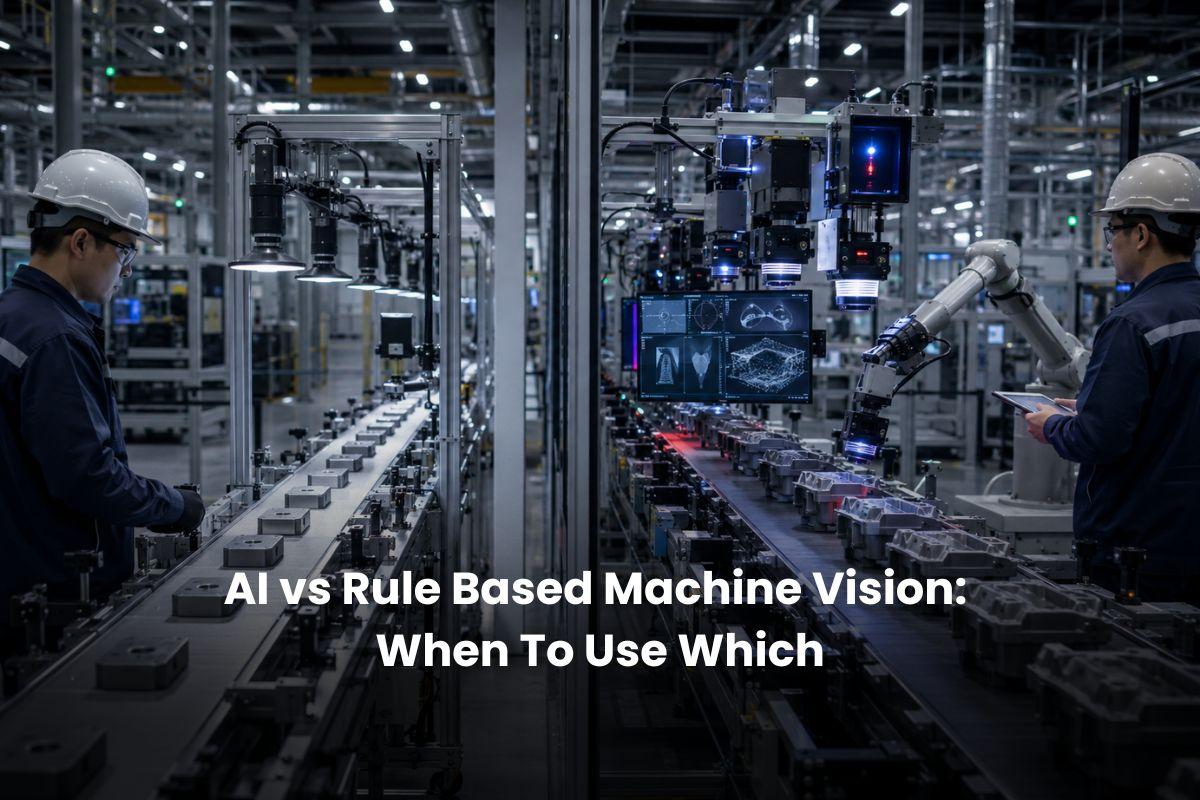





The AI vs rule based machine vision decision has a single axis: how much your production environment resembles a controlled specification.
Stable parts, defined defects, engineered conditions – rule-based wins on speed, cost, and auditability. Variable morphology, shifting suppliers, unknown defect types – that’s where deep learning earns its place.
Most lines run both.
We’ll cover how to assign the right approach to the right inspection task, including a decision framework and where AI platforms slot into an existing stack.
Key Notes
Rule-Based Machine Vision: Where It Earns Its Place & Where It Breaks
Rule-based machine vision has been the backbone of industrial inspection for decades, and for good reason.
When the task is mathematically describable, the system is deterministic, fast, and fully explainable – every pass/fail decision traces back to a specific rule and threshold.
Where Rule-Based Vision Works Well:
The Architecture Behind This Is Straightforward:
Edge detection, blob analysis, pattern matching, geometric measurement, fixed thresholds chained into a decision flowchart.
A vision engineer designs the logic, sets tolerances, and the system runs it.
Low compute overhead, ultra-fast inference, easy to validate.
Where Rule-Based Machine Vision Breaks Down:
The brittleness surfaces the moment real-world conditions drift from the engineered baseline.
Material & Supplier Variation
A new surface finish, slightly different color from a new supplier lot, minor gloss change.
Any of these can break rules that were tuned on the original material, requiring re-engineering of the entire threshold set.
Complex Surface Defects
Scratches, stains, coating anomalies, subtle texture changes.
These don’t have clean geometric signatures. Parameterizing them in rule logic either misses half the population or generates so many false positives the line becomes unmanageable.
False Positive Burden
The typical response to missed defects in a rule-based system is to tighten thresholds. Tighter thresholds flag more good product. More false positives means more manual reinspection, more labor, more throughput loss.
It’s a painful trade-off with no clean resolution inside a rule-based architecture.
Unknown Defects
If a defect type wasn’t anticipated when the rules were written, it passes. No rule exists for it. This is the escape problem, and it’s structural.
AI & Deep Learning Machine Vision: Capability & Trade-Offs
AI-based machine vision – specifically deep learning – learns from labeled examples rather than explicit rules. The model infers what “defective” looks like from data, builds internal feature representations, and generalizes to images it hasn’t seen before.
That’s a fundamentally different capability profile.
Where AI & Deep Learning Machine Vision Excels:
Variable Defect Morphology
Scratches that curve differently every time, dents with inconsistent depth, stains with fuzzy edges. Deep learning handles all of these as variations on a learned concept, not as rule violations.
Cosmetic & Subjective Tolerances
Aesthetic inspection where “acceptable” is operator-dependent. AI models trained on human-reviewed examples capture that judgment and apply it consistently at scale.
Anomaly Detection
Flagging anything that looks meaningfully different from normal, including defect types that weren’t in the training set. This is the unknown unknowns problem, and it’s where rule-based systems have no answer.
Submicron Defect Sensitivity
At advanced semiconductor nodes, defect signals are at or near the resolution floor.
Deep learning extracts features that human-designed rules and human inspectors both miss. This is why Averroes customers see 40–60% more submicron defect discovery versus legacy inspection approaches.
The Trade-Offs:
AI vision isn’t a free upgrade.
The costs are real and worth stating clearly.
The Hybrid Reality: How Most Lines Run
The binary framing – AI versus rule-based – doesn’t reflect what industrial inspection looks like on the floor.
Most serious inspection setups combine both, and the vendors who built the rule-based installed base (Cognex, Omron) are now layering AI modules on top of their existing rule-based engines precisely because neither approach covers everything alone.
Common Hybrid Patterns In Practice:
This Isn’t An Either/Or Architecture
It’s sequential or parallel stages in the same inspection cell.
Each layer does what it’s suited for.
The Practical Implication:
If your current AOI or vision system is rules-based, that doesn’t mean ripping it out.
It means identifying where the rule-based layer is causing pain – false positives, escapes, constant re-tuning – and addressing those specific failure modes with AI.
AI vs Rule Based Machine Vision: A Decision Framework
Run these diagnostic questions against any inspection task before deciding on an approach:
1. How Stable Is Part Presentation?
2. How Precisely Can You Define The Defect?
3. What’s Your Current False Positive Rate & What’s Driving It?
High false positives in a rule-based system are usually a signal that thresholds are doing work they were never designed to do.
Tightening them further won’t fix the underlying problem – it will make it worse.
4. Is Full Decision Explainability A Regulatory Requirement?
If every inspection decision needs to trace back to an auditable rule for compliance, that constraint shapes your architecture. Hybrid approaches can maintain rule-based logic for regulated checks while running AI on adjacent tasks.
5. What Happens When A New Defect Type Appears On The Line?
Where Averroes Fits Into An Existing Inspection Stack
Averroes is a software-native AI layer. It runs on existing tools (like KLA, Cognex, Omron, Onto) without new cameras or hardware, which means it addresses the specific failure modes of rule-based inspection without requiring a capital equipment decision.
What That Looks Like In Practice:
Still Tuning Thresholds That Keep Breaking?
See how AI inspection handles what rule-based logic can’t.
AI vs Rule Based Machine Vision FAQs
Can machine vision AI work without large datasets?
Machine vision AI can reach production-ready accuracy on small datasets – Averroes trains usable models from as few as 20–40 labeled images per defect class. Active learning then surfaces the highest-value samples to label next, so the dataset grows efficiently rather than indiscriminately.
What is rule-based AI in machine vision?
Rule-based AI in machine vision refers to hybrid systems that combine hand-coded inspection logic with AI modules – typically deep learning layers added on top of a traditional rules engine. Vendors like Cognex and Omron use this architecture: rule-based tools handle measurement and presence checks, while AI handles surface defects and anomaly detection.
How does machine vision deep learning handle new defect types?
Machine vision deep learning models handle new defect types through retraining on labeled examples of the new class – faster to operationalize than rewriting rule logic. Anomaly detection models like Averroes’ WatchDog go further, flagging unknown defects before they’ve been defined or labeled at all.
What industries still rely on rule-based machine vision?
Rule-based machine vision remains standard in industries where full decision explainability is a compliance requirement – pharmaceutical packaging, medical devices, and aerospace in particular. Dimensional metrology and presence/absence checks across most regulated manufacturing lines also stay rule-based, with AI handling adjacent inspection tasks where variation makes rule logic unmanageable.
Conclusion
The AI vs rule based machine vision decision comes down to a straightforward capability match – stable, well-defined tasks on one side, variable and unpredictable inspection problems on the other.
Get the assignment right and both approaches do exactly what they’re supposed to. Get it wrong and you’re either drowning in false positives from over-tightened thresholds or missing defects that rule logic was structurally never going to catch.
Most lines need both running in parallel, with the division of labor mapped to the inspection problem rather than a blanket technology preference.
If your current setup is generating either of those failure modes, Averroes runs on your existing equipment and trains on minimal data – a practical starting point for seeing what AI changes on your line. Get your free demo now.