Laser Inspection for Defect Detection (Complete Guide)
Averroes
Feb 04, 2026
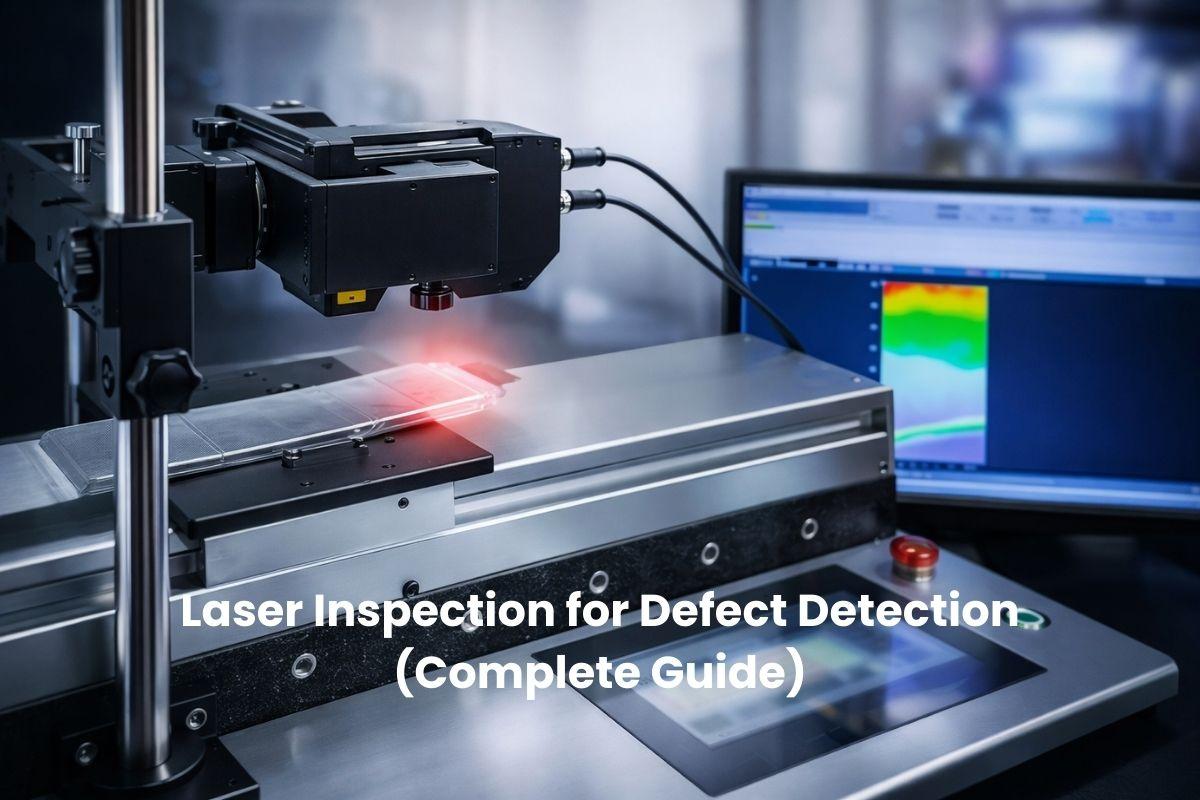
Laser inspection shows up when precision matters.
When parts move fast, surfaces reflect unpredictably, and defects live in tenths of a millimeter, cameras and gauges start to fall short. Lasers cut through that noise by turning surface change into data you can measure and act on.
We’ll break down how laser inspection works, the techniques behind it, where it performs best, where it struggles, and how teams use it for defect detection on production lines.
Key Notes
Laser inspection detects defects by measuring deviations from ideal surface models, not just visual contrast.
It excels at cracks, dents, pits, scratches, weld defects, and wafer particles down to ~0.1 mm.
Hybrid laser + vision and laser + AI systems reduce false rejects by combining depth and context.
What Is Laser Inspection?
Laser inspection is a non-contact inspection method that uses laser light to measure surface shape, texture, or material response in order to identify defects.
In manufacturing quality control, laser inspection is typically used for:
Inline inspection on fast-moving production lines
High-precision surface and weld inspection
Applications where contact measurement would damage parts or slow throughput
Defect Detection In Laser Inspection
When we talk about defect detection in laser inspection, we are usually referring to one of three outcomes:
Detecting that a defect exists
Measuring its size, depth, or geometry
Classifying whether it is acceptable or reject-worthy
Laser inspection often sits alongside other inspection methods rather than replacing them outright. It fills the gap between traditional camera-based vision and contact metrology.
How Laser Inspection Works
At a high level, laser inspection follows a simple idea:
What makes lasers useful is their optical properties:
Coherence, which enables interference-based measurements
Collimation, which keeps beams tight over distance
Monochromaticity, which improves signal-to-noise ratios
From that foundation, several physical principles are used.
Core Optical Principles
Triangulation
A laser line or point is projected at an angle. A camera observes its displacement and calculates 3D height information.
This is the workhorse of most inline laser inspection systems.
Scattering
Defects alter how light scatters. Smooth surfaces reflect predictably. Roughness, particles, or pits scatter light in measurable ways.
Specular Reflection
Highly reflective surfaces return light sharply. Changes in intensity or saturation can indicate defects but require careful control.
Interferometry and Speckle Methods
Laser wavefronts interfere, creating fringe or speckle patterns that shift with microscopic surface changes.
Laser Ultrasonics
Pulsed lasers generate ultrasonic waves that reflect from internal boundaries, revealing near-surface or subsurface flaws.
The Main Laser Inspection Techniques
Laser inspection is not one technique but a family of methods. Choosing the right one depends on the defect and the surface.
Line-Structured Light (Laser Profiling)
This is the most common technique in production environments.
A laser line is projected across the surface
Cameras capture the line’s shape
Deviations from a reference profile indicate defects
Typical outputs include height maps, cross-sectional profiles, and point clouds. This method is widely used for weld inspection, gap and flush measurement, and surface profiling.
Point or Spot Scanning
Instead of a line, a focused spot scans across the surface.
Higher local precision
Slower coverage
Useful for detailed metrology or small features
Scattering-Based Laser Inspection
Here the system measures how light scatters rather than where it lands.
Extremely sensitive to particles and micro-roughness
Common in semiconductor and wafer inspection
Height information is limited or absent
Interferometric and Shearography Methods
These techniques exploit interference effects to detect tiny displacements or strain patterns.
Nanometer-scale sensitivity
Used in aerospace composites and precision optics
Typically offline or lower-speed applications
Laser Ultrasonics
Laser ultrasonics combines optical generation and detection of sound waves.
Non-contact alternative to traditional ultrasonic testing
Detects voids, delaminations, and internal weld flaws
Slower and more complex, but powerful for thick or hot parts
Are Your Laser Results Fully Actionable?
Turn laser signals into 99% accurate defect decisions.
Defects Laser Inspection Detects Best
Laser inspection shines when defects express themselves as geometric or physical deviations.
Surface Defects
Common examples include:
Cracks and scratches
Dents, pits, and gouges
Edge defects and burrs
Surface waviness or ovality
In weld inspection, laser profiling can detect underfill, mismatch, excessive reinforcement, and spatter signatures by analyzing profile residuals.
Near-Surface and Internal Defects
With methods like laser ultrasonics or shearography, teams can detect:
Delaminations in composites
Voids and porosity indicators
Subsurface weld flaws
Resolution depends on method and setup, but many production systems reliably detect defects in the 0.1–1 mm range at high speed.
Where Laser Inspection Struggles
Laser inspection is precise, not universal.
It is less effective for:
Transparent or translucent materials where light passes through
Very rough surfaces that scatter light unpredictably
Deep internal voids beyond ultrasonic penetration limits
Extremely small subsurface defects below ~0.4 mm
Geometry also matters – steep slopes, deep concavities, and narrow gaps can violate triangulation assumptions and cause data loss. Heavy vibration or poor synchronization with part motion can introduce noise if not handled correctly.
Laser Inspection Equipment and System Components
A laser inspection system is a coordinated stack of hardware and software. Each piece matters.
Laser Source
Most systems use diode or fiber lasers in the 650–980 nm range. Wavelength selection affects reflectivity, absorption, and safety.
Optics and Beam Shaping
Line generators or focusing lenses
Filters to reject ambient light
Protective windows for harsh environments
Spot sizes typically range from 10 to 100 microns.
Sensors and Detectors
High-speed CMOS or CCD cameras capture reflected light. High dynamic range is critical for handling shiny surfaces without saturation.
Scanning and Motion Hardware
Galvanometers, polygon mirrors, encoders, and stages synchronize scanning with part movement. This is essential for inline inspection.
Processing and Control
Embedded controllers and PCs run reconstruction, segmentation, and classification algorithms. Integration with PLCs and MES systems enables automated reject handling and traceability.
Laser Inspection Data Pipeline
Turning laser signals into decisions requires several steps:
Real-time systems complete this pipeline in under a second per part.
Laser Inspection vs Vision vs Contact Measurement
Laser inspection occupies a middle ground:
Laser inspection often acts as the depth authority, while vision provides context.
Hybrid Systems: Laser + Vision and Laser + AI
Modern inspection systems increasingly combine sensors.
Laser provides precise 3D shape data. Vision adds color, texture, and context. AI models fuse both to reduce false positives and handle variability.
In practice, hybrids:
Flag anomalies using laser profiles
Confirm defect type using vision
Adapt over time using machine learning
This approach is now common in automotive welding, semiconductor inspection, and electronics manufacturing.
Choosing the Right Laser Inspection Machine
The fastest way to make a bad laser inspection purchase is to start with vendors or specs. The fastest way to make a good one is to start with the defect signature and work backward to the hardware.
Step 1: Start With the Defect Signal, Not the Part
Ask one question first:
What physical change does the defect create?
Defect Type
Physical Signal
Laser Method That Fits
Cracks, dents, underfill, mismatch
Height / geometry deviation
Laser triangulation
Scratches, pits, particles on shiny surfaces
Scattering / intensity change
Laser scattering systems
Delamination, voids, internal weld flaws
Acoustic reflection
Laser ultrasonics
Micro-strain, composite separation
Phase or speckle distortion
Interferometry / shearography
If the defect does not produce a measurable height, scatter, or wave response, laser inspection will struggle no matter how expensive the system is.
Step 2: Define The Smallest Defect You Must Reliably Catch
This sets your optical and mechanical floor.
Rule Of Thumb: Required defect size should be 3–5× larger than system repeatability.
Required Detection
Practical System Class
≥ 1.0 mm
Standard inline triangulation
0.1–0.5 mm
High-resolution triangulation or scattering
< 0.1 mm
Interferometry or specialized wafer systems
If a vendor claims 0.05 mm detection but cannot show repeatability data across shifts, assume marketing, not physics.
Step 3: Match The Laser To Surface Reflectivity
This is where many projects fail quietly.
Surface Type
Risk
What To Look For In The Machine
Polished / shiny metals
Sensor saturation
Adjustable angles, HDR sensors, power control
Matte / coated surfaces
Noise
Strong signal-to-noise, stable optics
Rough textures
Profile broadening
Wider line width tolerance, adaptive filtering
Transparent / translucent
Signal loss
Often unsuitable for laser inspection alone
If your parts are highly reflective, a “stronger laser” is usually the wrong answer. Geometry and optics matter more than power.
Step 4: Check Geometry Before Throughput
Geometry decides whether inspection is even feasible.
Ask:
Are there slopes steeper than ~60°?
Are there deep grooves or concave regions?
Does the defect sit near edges or transitions?
Geometry Challenge
Machine Requirement
Curved or large parts
Robotic or multi-angle systems
Steep slopes
Wider triangulation angles or multiple heads
Narrow gaps
Spot scanning or repositioned optics
If geometry is complex, fixed inline systems may look cheaper but fail in production.
Step 5: Size The System For Throughput Last
Only after defect, surface, and geometry are clear should you size speed.
Key parameters to check:
Profiles per second
Scan width vs part speed
Encoder synchronization
Processing latency (not just camera FPS)
Line Condition
Preferred System
High-volume, stable part flow
Fixed inline laser inspection machine
High-mix, variable parts
Robotic laser inspection
Low volume, R&D, audits
Benchtop laser inspection tools
If the system requires slowing the line to meet specs, it’s the wrong system.
Step 6: Choose Deployment Type Based On Variability, Not Budget
Robotic systems cost more upfront but often cost less over time when part variation is high.
Step 7: Validate With Real Parts, Not Vendor Demos
This step is non-negotiable.
A proper evaluation includes:
Good parts
Marginal parts
Known bad parts near the reject threshold
If a laser inspection vendor cannot show how defects appear in the signal, you cannot trust the decision logic downstream.
Common Laser Inspection Failure Modes & How to Prevent Them
Sensor saturation on shiny parts → adjust angles and exposure
Calibration drift → schedule reference checks
Under-sampling → match scan density to defect size
Poor fixturing → stabilize part presentation
Aggressive thresholds → validate with production data
Frequently Asked Questions
How accurate is laser inspection compared to X-ray inspection?
Laser inspection excels at surface and near-surface defects with high repeatability, often down to 0.1 mm. X-ray is better for deep internal defects but is slower, costlier, and harder to deploy inline.
Does laser inspection require frequent recalibration?
Not typically. Most systems rely on stable optical geometry and reference models, with recalibration done periodically or after mechanical changes rather than daily operation.
Can laser inspection replace all camera-based vision systems?
No. Laser inspection is best for geometry and depth-related defects, while cameras remain more efficient for color, print, or presence checks. Many production lines use both together.
Is laser inspection safe to use on production lines?
Yes, when properly designed. Industrial laser inspection machines use Class 2 or Class 3R lasers with enclosures, interlocks, and safety compliance for continuous operation.
Conclusion
Laser inspection works because it measures what cameras often miss: real surface change.
Using structured light, scattering, or interference, it turns geometry and material response into measurable signals that reveal cracks, dents, pits, weld defects, and particles at production speed.
But the value does not stop at detection. The difference shows up in how reliably those signals are modeled, segmented, classified, and tracked as parts, lines, and defect libraries grow. When done well, laser inspection becomes a steady source of quality truth that supports yield, consistency, and faster decisions across manufacturing.
If you are already generating high-fidelity laser inspection data, now is the time to turn it into 99% accurate defect decisions that scale across every line. Get your free demo.




![Inspection Methods Explained [Manual, Remote & Visual]](/_next/image?url=https%3A%2F%2F303922.eu15.myftpupload.com%2Fwp-content%2Fuploads%2F2026%2F07%2FAverroes.ai-Blog-Covers-JA-4.jpg&w=3840&q=75)



Laser inspection shows up when precision matters.
When parts move fast, surfaces reflect unpredictably, and defects live in tenths of a millimeter, cameras and gauges start to fall short. Lasers cut through that noise by turning surface change into data you can measure and act on.
We’ll break down how laser inspection works, the techniques behind it, where it performs best, where it struggles, and how teams use it for defect detection on production lines.
Key Notes
What Is Laser Inspection?
Laser inspection is a non-contact inspection method that uses laser light to measure surface shape, texture, or material response in order to identify defects.
In manufacturing quality control, laser inspection is typically used for:
Defect Detection In Laser Inspection
When we talk about defect detection in laser inspection, we are usually referring to one of three outcomes:
Laser inspection often sits alongside other inspection methods rather than replacing them outright. It fills the gap between traditional camera-based vision and contact metrology.
How Laser Inspection Works
At a high level, laser inspection follows a simple idea:
What makes lasers useful is their optical properties:
From that foundation, several physical principles are used.
Core Optical Principles
Triangulation
A laser line or point is projected at an angle. A camera observes its displacement and calculates 3D height information.
This is the workhorse of most inline laser inspection systems.
Scattering
Defects alter how light scatters. Smooth surfaces reflect predictably. Roughness, particles, or pits scatter light in measurable ways.
Specular Reflection
Highly reflective surfaces return light sharply. Changes in intensity or saturation can indicate defects but require careful control.
Interferometry and Speckle Methods
Laser wavefronts interfere, creating fringe or speckle patterns that shift with microscopic surface changes.
Laser Ultrasonics
Pulsed lasers generate ultrasonic waves that reflect from internal boundaries, revealing near-surface or subsurface flaws.
The Main Laser Inspection Techniques
Laser inspection is not one technique but a family of methods. Choosing the right one depends on the defect and the surface.
Line-Structured Light (Laser Profiling)
This is the most common technique in production environments.
Typical outputs include height maps, cross-sectional profiles, and point clouds. This method is widely used for weld inspection, gap and flush measurement, and surface profiling.
Point or Spot Scanning
Instead of a line, a focused spot scans across the surface.
Scattering-Based Laser Inspection
Here the system measures how light scatters rather than where it lands.
Interferometric and Shearography Methods
These techniques exploit interference effects to detect tiny displacements or strain patterns.
Laser Ultrasonics
Laser ultrasonics combines optical generation and detection of sound waves.
Are Your Laser Results Fully Actionable?
Turn laser signals into 99% accurate defect decisions.
Defects Laser Inspection Detects Best
Laser inspection shines when defects express themselves as geometric or physical deviations.
Surface Defects
Common examples include:
In weld inspection, laser profiling can detect underfill, mismatch, excessive reinforcement, and spatter signatures by analyzing profile residuals.
Near-Surface and Internal Defects
With methods like laser ultrasonics or shearography, teams can detect:
Resolution depends on method and setup, but many production systems reliably detect defects in the 0.1–1 mm range at high speed.
Where Laser Inspection Struggles
Laser inspection is precise, not universal.
It is less effective for:
Geometry also matters – steep slopes, deep concavities, and narrow gaps can violate triangulation assumptions and cause data loss. Heavy vibration or poor synchronization with part motion can introduce noise if not handled correctly.
Laser Inspection Equipment and System Components
A laser inspection system is a coordinated stack of hardware and software. Each piece matters.
Laser Source
Most systems use diode or fiber lasers in the 650–980 nm range. Wavelength selection affects reflectivity, absorption, and safety.
Optics and Beam Shaping
Spot sizes typically range from 10 to 100 microns.
Sensors and Detectors
High-speed CMOS or CCD cameras capture reflected light. High dynamic range is critical for handling shiny surfaces without saturation.
Scanning and Motion Hardware
Galvanometers, polygon mirrors, encoders, and stages synchronize scanning with part movement. This is essential for inline inspection.
Processing and Control
Embedded controllers and PCs run reconstruction, segmentation, and classification algorithms. Integration with PLCs and MES systems enables automated reject handling and traceability.
Laser Inspection Data Pipeline
Turning laser signals into decisions requires several steps:
Real-time systems complete this pipeline in under a second per part.
Laser Inspection vs Vision vs Contact Measurement
Laser inspection occupies a middle ground:
Laser inspection often acts as the depth authority, while vision provides context.
Hybrid Systems: Laser + Vision and Laser + AI
Modern inspection systems increasingly combine sensors.
Laser provides precise 3D shape data. Vision adds color, texture, and context. AI models fuse both to reduce false positives and handle variability.
In practice, hybrids:
This approach is now common in automotive welding, semiconductor inspection, and electronics manufacturing.
Choosing the Right Laser Inspection Machine
The fastest way to make a bad laser inspection purchase is to start with vendors or specs.
The fastest way to make a good one is to start with the defect signature and work backward to the hardware.
Step 1: Start With the Defect Signal, Not the Part
Ask one question first:
What physical change does the defect create?
If the defect does not produce a measurable height, scatter, or wave response, laser inspection will struggle no matter how expensive the system is.
Step 2: Define The Smallest Defect You Must Reliably Catch
This sets your optical and mechanical floor.
Rule Of Thumb: Required defect size should be 3–5× larger than system repeatability.
If a vendor claims 0.05 mm detection but cannot show repeatability data across shifts, assume marketing, not physics.
Step 3: Match The Laser To Surface Reflectivity
This is where many projects fail quietly.
If your parts are highly reflective, a “stronger laser” is usually the wrong answer. Geometry and optics matter more than power.
Step 4: Check Geometry Before Throughput
Geometry decides whether inspection is even feasible.
Ask:
If geometry is complex, fixed inline systems may look cheaper but fail in production.
Step 5: Size The System For Throughput Last
Only after defect, surface, and geometry are clear should you size speed.
Key parameters to check:
If the system requires slowing the line to meet specs, it’s the wrong system.
Step 6: Choose Deployment Type Based On Variability, Not Budget
Robotic systems cost more upfront but often cost less over time when part variation is high.
Step 7: Validate With Real Parts, Not Vendor Demos
This step is non-negotiable.
A proper evaluation includes:
If a laser inspection vendor cannot show how defects appear in the signal, you cannot trust the decision logic downstream.
Common Laser Inspection Failure Modes & How to Prevent Them
Frequently Asked Questions
How accurate is laser inspection compared to X-ray inspection?
Laser inspection excels at surface and near-surface defects with high repeatability, often down to 0.1 mm. X-ray is better for deep internal defects but is slower, costlier, and harder to deploy inline.
Does laser inspection require frequent recalibration?
Not typically. Most systems rely on stable optical geometry and reference models, with recalibration done periodically or after mechanical changes rather than daily operation.
Can laser inspection replace all camera-based vision systems?
No. Laser inspection is best for geometry and depth-related defects, while cameras remain more efficient for color, print, or presence checks. Many production lines use both together.
Is laser inspection safe to use on production lines?
Yes, when properly designed. Industrial laser inspection machines use Class 2 or Class 3R lasers with enclosures, interlocks, and safety compliance for continuous operation.
Conclusion
Laser inspection works because it measures what cameras often miss: real surface change.
Using structured light, scattering, or interference, it turns geometry and material response into measurable signals that reveal cracks, dents, pits, weld defects, and particles at production speed.
But the value does not stop at detection. The difference shows up in how reliably those signals are modeled, segmented, classified, and tracked as parts, lines, and defect libraries grow. When done well, laser inspection becomes a steady source of quality truth that supports yield, consistency, and faster decisions across manufacturing.
If you are already generating high-fidelity laser inspection data, now is the time to turn it into 99% accurate defect decisions that scale across every line. Get your free demo.