Labels carry more responsibility than almost any other part of a product.
They carry identity, traceability, compliance, and customer trust, all while moving at production speed.
As lines run faster and SKUs multiply, label inspection has shifted from a manual check into a technical system that has to work every time.
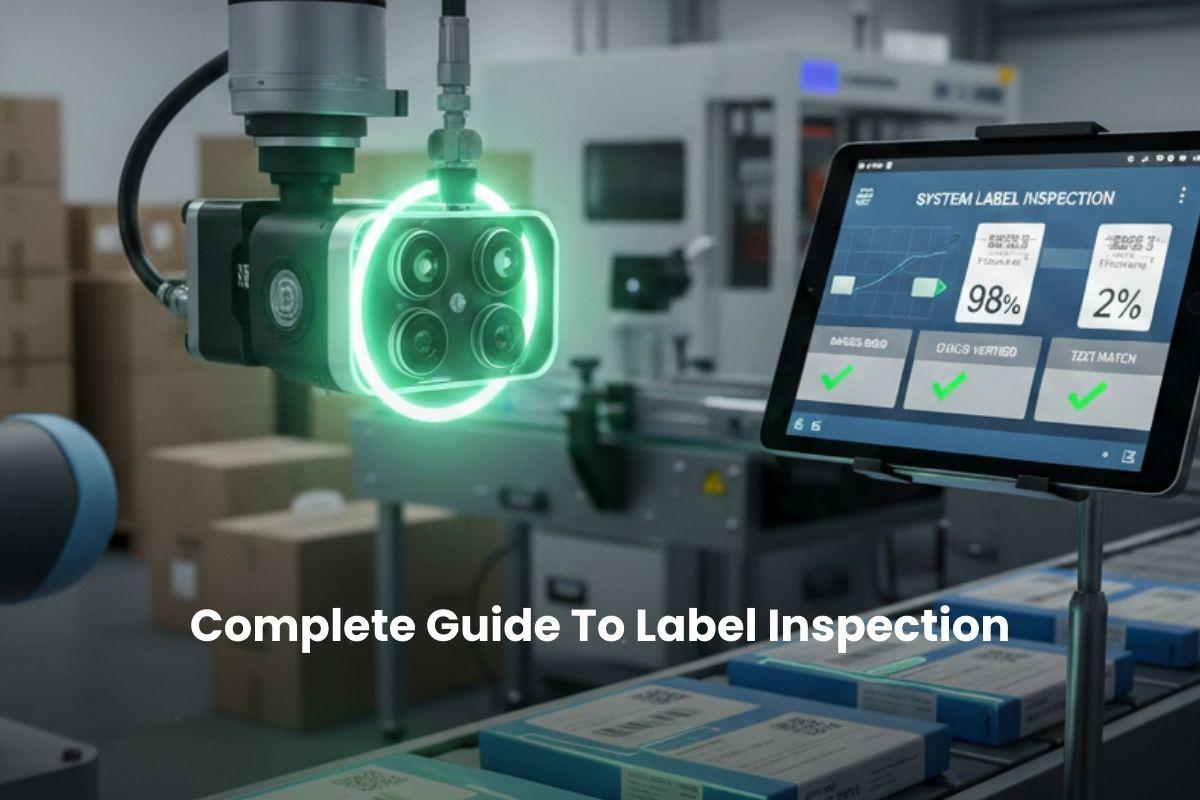
We’ll break down what label inspection involves, how modern systems operate, where legacy approaches struggle, and how AI changes accuracy and reliability on the line.
Key Notes
In-line vision systems combine cameras, lighting, software, and reject mechanisms to operate at full line speed.
Rule-based inspection struggles with variability, while AI adapts to materials, motion, and changing conditions.
Data quality and consistent labeling directly determine inspection accuracy, false rejects, and long-term reliability.
What Is Label Inspection?
Label inspection is the real-time, vision-based scanning of printed or applied labels to verify that:
The label is present and placed correctly
The print quality is acceptable
Barcodes and 2D codes are readable and grade within tolerance
Variable data (lot, batch, expiry, serials) is correct
Required content is present (allergens, warnings, dosage, regulatory codes)
It’s distinct from a few commonly confused terms:
Where Label Inspection Fits In The Manufacturing Workflow
Label inspection typically happens at multiple stages to catch issues early and avoid expensive downstream problems.
Pre-Press Inspection
This happens before printing begins.
Teams review:
Artwork content accuracy
Regulatory requirements and formatting
Master templates for correct versions (no “almost the right label” scenarios)
Pre-press inspection reduces the chance of printing the wrong thing at scale, but it does not catch what happens when the line starts running. Ink behaves differently. Materials flex. People make changes under time pressure.
Off-Line Label Inspection
This happens after printing but before labels are applied to product. It can be manual sampling or automated comparison against approved masters.
Typical checks include:
Smudges, missing ink, registration errors
Tears, scratches, edge defects
Barcode readability and grading
Off-line inspection is often used for incoming goods verification or finishing steps. It’s useful, but on its own it’s not a complete answer because application introduces its own defect set.
In-Line Label Inspection
This is the high-value stage.
In-line inspection integrates directly into printing and/or application on high-speed production lines. Cameras scan 100% of items in real time and trigger automatic ejection when defects are detected.
If you care about preventing recalls and staying compliant in regulated industries, this is where the “no excuses” inspection happens.
What Do Label Inspection Systems Check?
A complete label inspection program covers three categories of problems. Keeping these separate helps you diagnose the root cause faster.
Print Defects
Print defects occur during label production.
Common examples:
Text breakage or missing characters
Filled, smudged, or blurred text
Ink contamination (hickeys)
Color misregistration
Incorrect fonts or colors
1D/2D barcode defects, including unreadable codes or poor grades
Physical Label Defects
These are material or surface issues:
Wrinkles, air bubbles, folds
Tears, scratches, fading
Misalignment and edge lifting
Contamination on label or package surface
They’re often caused by improper tension, static, humidity, surface contamination, or material variation.
Application Defects
These happen on the line when labels are applied:
Skewing, placement errors
Poor adhesion and peeling
Flagging (common on cold products)
Adhesive ooze
Application failures can turn a perfectly printed label into a compliance risk.
Core Components of a Label Inspection System
Cameras & Optics
Cameras mounted over conveyor belts capture high-resolution images of each label as products pass. In high-throughput environments, systems can inspect at speeds ranging from hundreds per minute into the thousands per minute.
Key Considerations:
Resolution: fine fonts, microtext, and low-contrast printing require high-resolution sensors
Frame rate: higher line speeds demand higher frame rates
Field of view: must cover label area plus margins for placement checks
Triggering and synchronization: encoders help sync imaging to product velocity
Lighting Systems
Lighting is not an accessory. It’s the difference between stable inspection and a dashboard full of false rejects.
Common lighting strategies:
Diffuse LED lighting for uniform illumination
Polarized lighting and filters to reduce glare on glossy labels
Dark-field illumination for shiny or curved surfaces
UV lighting for UV inks, security marks, or special coatings
Image Processing & Analysis Software
Software performs inspection tasks like:
Pixel or template comparison against approved masters
OCR (optical character recognition) for readable text extraction
OCV (optical character verification) to confirm character shapes match expected fonts
Timing matters. If you detect late, you either miss the item or have to stop the line. Neither is fun.
Variable Data Inspection and Verification
Variable data is where label inspection gets serious.
A barcode that “looks fine” but contains the wrong lot number is still wrong. A readable expiry date that is invalid for the current batch is still wrong.
Reading Variable Data
Systems typically use:
High-speed OCR to read lot numbers, expiry dates, batch IDs
OCV to confirm font and character integrity
Barcode and 2D decoding plus grading against ANSI/ISO standards
Verifying Data Against Production Systems
Modern label inspection validates variable data in real time by cross-checking extracted values against live systems:
ERP item masters
MES work orders
GS1 schemas or production recipes
Rules-based validation commonly includes:
Format checks (expected length, characters, structure)
Date checks (expiry must be later than today, or within an allowed range)
Sequence checks (serials not duplicated, not skipping ranges)
Integration and Feedback Loops
Factories validate dynamic label data through real-time integrations and bidirectional flows.
Common protocols include:
OPC-UA
MQTT
REST APIs
Environmental & Production Challenges in Label Inspection
Factories are not labs. Your label inspection system has to deal with variability all day, every day.
Motion and Speed Constraints
At high throughput, motion blur and vibration can reduce effective resolution.
Mitigations include:
High-frame-rate cameras
Motion-compensated optics
Encoders synced to conveyor speed
Packaging Material Challenges
Material and geometry can distort images or hide defects:
Reflective foils or metallic inks create glare hotspots
Transparent packaging hides bubbles or wrinkles
Curved surfaces warp text and barcodes
Textured surfaces scatter light unpredictably
Lighting Variability
Inconsistent lighting causes:
Shadows that mimic smudges
Glare that hides print defects
Uneven illumination that triggers false color shift detections
Multi-angle lighting and polarization are often required for stability.
Print Quality Variability
Low contrast inks, fine details, and variable printing quality amplify false negatives and false positives.
If the print process is unstable, inspection becomes a constant negotiation between catching real defects and not rejecting good product.
False Positives & False Negatives
Even well-built systems struggle here if they’re not designed for real variability.
False Positives
Good labels get flagged as defective because:
Glare or shadows look like smudges
Acceptable wrinkles from material flex are treated as tears
Motion blur resembles print defects
Lighting drift changes perceived color
False positives drive waste and slow operators down, because they stop trusting the system.
False Negatives
Bad labels pass undetected because:
Low-contrast inks blend into the background
Subtle data errors slip past OCR
Transparent packaging hides defects
Templates are uncalibrated for variable data mismatches
False negatives are the real risk. They’re the ones that show up later as customer complaints or recalls.
Traditional Rule-Based Label Inspection Systems
Legacy label inspection often relies on rigid, rule-based algorithms that compare pixels and edges to fixed thresholds.
If your line runs high mix, high speed, or uses tricky materials, rule-based inspection tends to hit a ceiling.
AI-Driven Label Inspection Systems
AI changed label inspection by making systems adaptive. Instead of relying on fixed thresholds, models learn patterns from images.
How AI Models Inspect Labels
AI can be deployed across inspection tasks:
Classification: good vs bad, or defect category classification
Detection: localizing issues like missing text or barcode defects
Segmentation: pixel-level boundary detection for smudges, bubbles, tears
New Capabilities Enabled by AI
AI-driven systems can detect:
Subtle anomalies like micro-cracks, color drift, texture irregularities
Novel defects without reprogramming via anomaly detection
Complex edge cases like occluded wrinkles on curved surfaces
Continuous Improvement
When done properly, AI systems improve from production feedback:
Uncertain predictions get routed for human review
Confirmed edge cases are retrained into the model
Model performance stabilizes over time instead of drifting
Is Your Label Inspection Falling Short?
Catch subtle issues with 99%+ AI accuracy.
Data Requirements for AI-Based Label Inspection
AI is only as reliable as the data you train it on.
Dataset Volume
Typical requirements vary by complexity:
Basic classification tasks can start with 100–2,000+ labeled images per defect class
Complex scenarios (curved or reflective surfaces, many SKUs) scale into thousands to millions of samples
A common split is:
80% training
20% validation
Dataset Diversity
A strong dataset includes variability across:
Lighting conditions
Motion blur levels
Material types (glossy, transparent, textured)
Camera angles and placements
Line speeds and shift conditions
Balance matters too.
You need enough “good” examples to define normal, and enough “bad” to teach real defect boundaries.
Synthetic Data
Synthetic data can help with rare defect types, but it’s not a free pass. If it doesn’t reflect your real printing artifacts or material behavior, it can create false confidence.
The Role of Data Labeling in Label Inspection
This is where a lot of inspection projects quietly go wrong.
If your data annotations are sloppy or inconsistent, your model learns the wrong rules. That can turn a model that looks “95% accurate” in testing into something unreliable on the line.
Why Label Quality Matters
Poor annotations propagate errors directly into the model
Inconsistent labels create unpredictable false positives and false negatives
Bias in what gets labeled “acceptable” vs “defective” shows up as drift
Types of Annotations Used
Consistency & QA in Labeling
To keep training data clean:
Use inter-annotator agreement checks
Run spot-check queues for high-risk defect classes
Maintain clear labeling guidelines for “acceptable variation” vs defect
You want the model to learn what you mean, not what your labelers guessed.
Are Labeling Bottlenecks Slowing Inspection Down?
Label 10x faster without sacrificing accuracy.
Handling Edge Cases & Unknown Defects
Production will always throw surprises: material changes, worn printheads, new suppliers, new SKUs.
Anomaly Detection
Unsupervised methods can learn what “normal” looks like and flag deviations:
Autoencoders
One-class SVM
Isolation forest
These approaches are useful when you do not have labeled examples for a new defect yet.
Active Learning Loops
A practical approach:
System flags uncertain cases
Humans confirm what they are
Confirmed edge cases get added back into training incrementally
Hybrid Safeguards
Many plants run hybrid models:
Rules-based checks for extremes (missing label, total occlusion)
AI models for subtle or variable defects
Thresholding tuned by risk level (pharma vs consumer goods)
What Happens When a Defect Is Detected?
Detection is only the start. The system has to act.
Real-Time Rejection
Defective items are diverted within milliseconds using:
Air blasts
Mechanical pushers
Robotic rejectors
Alerts & Visualization
Operators receive:
Dashboard notifications
Defect type and location
Confidence score
Image evidence
Logging & Feedback
Systems generate audit trails and production analytics:
Pass/fail decisions with timestamps
OCR results and decoded barcode values
Defect coordinates and reject reasons
Counts pushed to OEE dashboards
This matters for root cause analysis and regulatory audits.
Regulatory Requirements for Label Inspection
Label inspection becomes non-negotiable in regulated industries.
Pharma
Regulators expect strict control of label issuance, examination, and reconciliation.
Lot, batch, expiry, and identification codes (NDC, UDI)
Errors here can trigger large recalls or worse.
Food
Food labeling failures often involve:
Allergens
Nutrition and ingredient statements
Traceability codes
Mislabels can cause serious harm. This is why inspection systems log results with proof-of-performance.
Audit Trails & Retention
A compliant setup records immutable data per scanned item:
Timestamp
Captured image
OCR results
Pass/fail decision
Reject reason
Operator interventions
Retention can span years depending on product and regulatory regime.
Frequently Asked Questions
How accurate are automated label inspection systems?
Accuracy depends on lighting, camera setup, and how well the system is trained or configured. Modern AI-based systems regularly reach 98–99%+ detection accuracy when deployed with proper data and calibration, while poorly tuned setups can underperform regardless of technology.
Can label inspection systems handle frequent SKU or artwork changes?
Yes, but flexibility varies widely. Rule-based systems often require manual reconfiguration for each change, while AI-driven systems adapt faster by learning variations from new data, reducing downtime on high-mix production lines.
Does label inspection slow down production lines?
When designed correctly, no. Inline label inspection is built to run at full line speed, including environments exceeding 1,000 units per minute, with reject mechanisms operating in milliseconds without stopping the line.
Is label inspection only necessary for regulated industries like pharma and food?
While pharma and food have strict regulatory requirements, label inspection is valuable anywhere traceability, brand integrity, or customer trust matters. Electronics, cosmetics, and consumer goods manufacturers use it to prevent costly rework and reputation damage.
Conclusion
Label inspection is a real-time decision system that determines whether products ship, get reworked, or get rejected altogether.
Modern label inspection systems combine high-speed imaging, lighting, and software to verify print quality, placement, barcodes, and variable data on every unit.
Where legacy rule-based setups struggle with variability, AI-based inspection adapts to real production conditions, catches subtle defects, and reduces both false rejects and costly escapes.
The result is stronger compliance, higher yield, and fewer surprises downstream.
If you are looking to move beyond brittle rules, manual spot checks, or slow rework cycles, get started with AI-driven label inspection – it’s a practical way to improve accuracy, scale with change, and keep production moving without adding new hardware.




![Inspection Methods Explained [Manual, Remote & Visual]](/_next/image?url=https%3A%2F%2F303922.eu15.myftpupload.com%2Fwp-content%2Fuploads%2F2026%2F07%2FAverroes.ai-Blog-Covers-JA-4.jpg&w=3840&q=75)



Labels carry more responsibility than almost any other part of a product.
They carry identity, traceability, compliance, and customer trust, all while moving at production speed.
As lines run faster and SKUs multiply, label inspection has shifted from a manual check into a technical system that has to work every time.
We’ll break down what label inspection involves, how modern systems operate, where legacy approaches struggle, and how AI changes accuracy and reliability on the line.
Key Notes
What Is Label Inspection?
Label inspection is the real-time, vision-based scanning of printed or applied labels to verify that:
It’s distinct from a few commonly confused terms:
Where Label Inspection Fits In The Manufacturing Workflow
Label inspection typically happens at multiple stages to catch issues early and avoid expensive downstream problems.
Pre-Press Inspection
This happens before printing begins.
Teams review:
Pre-press inspection reduces the chance of printing the wrong thing at scale, but it does not catch what happens when the line starts running. Ink behaves differently. Materials flex. People make changes under time pressure.
Off-Line Label Inspection
This happens after printing but before labels are applied to product. It can be manual sampling or automated comparison against approved masters.
Typical checks include:
Off-line inspection is often used for incoming goods verification or finishing steps. It’s useful, but on its own it’s not a complete answer because application introduces its own defect set.
In-Line Label Inspection
This is the high-value stage.
In-line inspection integrates directly into printing and/or application on high-speed production lines. Cameras scan 100% of items in real time and trigger automatic ejection when defects are detected.
If you care about preventing recalls and staying compliant in regulated industries, this is where the “no excuses” inspection happens.
What Do Label Inspection Systems Check?
A complete label inspection program covers three categories of problems. Keeping these separate helps you diagnose the root cause faster.
Print Defects
Print defects occur during label production.
Common examples:
Physical Label Defects
These are material or surface issues:
They’re often caused by improper tension, static, humidity, surface contamination, or material variation.
Application Defects
These happen on the line when labels are applied:
Application failures can turn a perfectly printed label into a compliance risk.
Core Components of a Label Inspection System
Cameras & Optics
Cameras mounted over conveyor belts capture high-resolution images of each label as products pass. In high-throughput environments, systems can inspect at speeds ranging from hundreds per minute into the thousands per minute.
Key Considerations:
Lighting Systems
Lighting is not an accessory. It’s the difference between stable inspection and a dashboard full of false rejects.
Common lighting strategies:
Image Processing & Analysis Software
Software performs inspection tasks like:
Rejection & Control Mechanisms
When defects are detected, systems trigger:
Timing matters. If you detect late, you either miss the item or have to stop the line. Neither is fun.
Variable Data Inspection and Verification
Variable data is where label inspection gets serious.
A barcode that “looks fine” but contains the wrong lot number is still wrong.
A readable expiry date that is invalid for the current batch is still wrong.
Reading Variable Data
Systems typically use:
Verifying Data Against Production Systems
Modern label inspection validates variable data in real time by cross-checking extracted values against live systems:
Rules-based validation commonly includes:
Integration and Feedback Loops
Factories validate dynamic label data through real-time integrations and bidirectional flows.
Common protocols include:
Environmental & Production Challenges in Label Inspection
Factories are not labs. Your label inspection system has to deal with variability all day, every day.
Motion and Speed Constraints
At high throughput, motion blur and vibration can reduce effective resolution.
Mitigations include:
Packaging Material Challenges
Material and geometry can distort images or hide defects:
Lighting Variability
Inconsistent lighting causes:
Multi-angle lighting and polarization are often required for stability.
Print Quality Variability
Low contrast inks, fine details, and variable printing quality amplify false negatives and false positives.
If the print process is unstable, inspection becomes a constant negotiation between catching real defects and not rejecting good product.
False Positives & False Negatives
Even well-built systems struggle here if they’re not designed for real variability.
False Positives
Good labels get flagged as defective because:
False positives drive waste and slow operators down, because they stop trusting the system.
False Negatives
Bad labels pass undetected because:
False negatives are the real risk. They’re the ones that show up later as customer complaints or recalls.
Traditional Rule-Based Label Inspection Systems
Legacy label inspection often relies on rigid, rule-based algorithms that compare pixels and edges to fixed thresholds.
If your line runs high mix, high speed, or uses tricky materials, rule-based inspection tends to hit a ceiling.
AI-Driven Label Inspection Systems
AI changed label inspection by making systems adaptive. Instead of relying on fixed thresholds, models learn patterns from images.
How AI Models Inspect Labels
AI can be deployed across inspection tasks:
New Capabilities Enabled by AI
AI-driven systems can detect:
Continuous Improvement
When done properly, AI systems improve from production feedback:
Is Your Label Inspection Falling Short?
Catch subtle issues with 99%+ AI accuracy.
Data Requirements for AI-Based Label Inspection
AI is only as reliable as the data you train it on.
Dataset Volume
Typical requirements vary by complexity:
A common split is:
Dataset Diversity
A strong dataset includes variability across:
Balance matters too.
You need enough “good” examples to define normal, and enough “bad” to teach real defect boundaries.
Synthetic Data
Synthetic data can help with rare defect types, but it’s not a free pass. If it doesn’t reflect your real printing artifacts or material behavior, it can create false confidence.
The Role of Data Labeling in Label Inspection
This is where a lot of inspection projects quietly go wrong.
If your data annotations are sloppy or inconsistent, your model learns the wrong rules. That can turn a model that looks “95% accurate” in testing into something unreliable on the line.
Why Label Quality Matters
Types of Annotations Used
Consistency & QA in Labeling
To keep training data clean:
You want the model to learn what you mean, not what your labelers guessed.
Are Labeling Bottlenecks Slowing Inspection Down?
Label 10x faster without sacrificing accuracy.
Handling Edge Cases & Unknown Defects
Production will always throw surprises: material changes, worn printheads, new suppliers, new SKUs.
Anomaly Detection
Unsupervised methods can learn what “normal” looks like and flag deviations:
These approaches are useful when you do not have labeled examples for a new defect yet.
Active Learning Loops
A practical approach:
Hybrid Safeguards
Many plants run hybrid models:
What Happens When a Defect Is Detected?
Detection is only the start. The system has to act.
Real-Time Rejection
Defective items are diverted within milliseconds using:
Alerts & Visualization
Operators receive:
Logging & Feedback
Systems generate audit trails and production analytics:
This matters for root cause analysis and regulatory audits.
Regulatory Requirements for Label Inspection
Label inspection becomes non-negotiable in regulated industries.
Pharma
Regulators expect strict control of label issuance, examination, and reconciliation.
In pharma defect detection, that means 100% verification of:
Errors here can trigger large recalls or worse.
Food
Food labeling failures often involve:
Mislabels can cause serious harm. This is why inspection systems log results with proof-of-performance.
Audit Trails & Retention
A compliant setup records immutable data per scanned item:
Retention can span years depending on product and regulatory regime.
Frequently Asked Questions
How accurate are automated label inspection systems?
Accuracy depends on lighting, camera setup, and how well the system is trained or configured. Modern AI-based systems regularly reach 98–99%+ detection accuracy when deployed with proper data and calibration, while poorly tuned setups can underperform regardless of technology.
Can label inspection systems handle frequent SKU or artwork changes?
Yes, but flexibility varies widely. Rule-based systems often require manual reconfiguration for each change, while AI-driven systems adapt faster by learning variations from new data, reducing downtime on high-mix production lines.
Does label inspection slow down production lines?
When designed correctly, no. Inline label inspection is built to run at full line speed, including environments exceeding 1,000 units per minute, with reject mechanisms operating in milliseconds without stopping the line.
Is label inspection only necessary for regulated industries like pharma and food?
While pharma and food have strict regulatory requirements, label inspection is valuable anywhere traceability, brand integrity, or customer trust matters. Electronics, cosmetics, and consumer goods manufacturers use it to prevent costly rework and reputation damage.
Conclusion
Label inspection is a real-time decision system that determines whether products ship, get reworked, or get rejected altogether.
Modern label inspection systems combine high-speed imaging, lighting, and software to verify print quality, placement, barcodes, and variable data on every unit.
Where legacy rule-based setups struggle with variability, AI-based inspection adapts to real production conditions, catches subtle defects, and reduces both false rejects and costly escapes.
The result is stronger compliance, higher yield, and fewer surprises downstream.
If you are looking to move beyond brittle rules, manual spot checks, or slow rework cycles, get started with AI-driven label inspection – it’s a practical way to improve accuracy, scale with change, and keep production moving without adding new hardware.