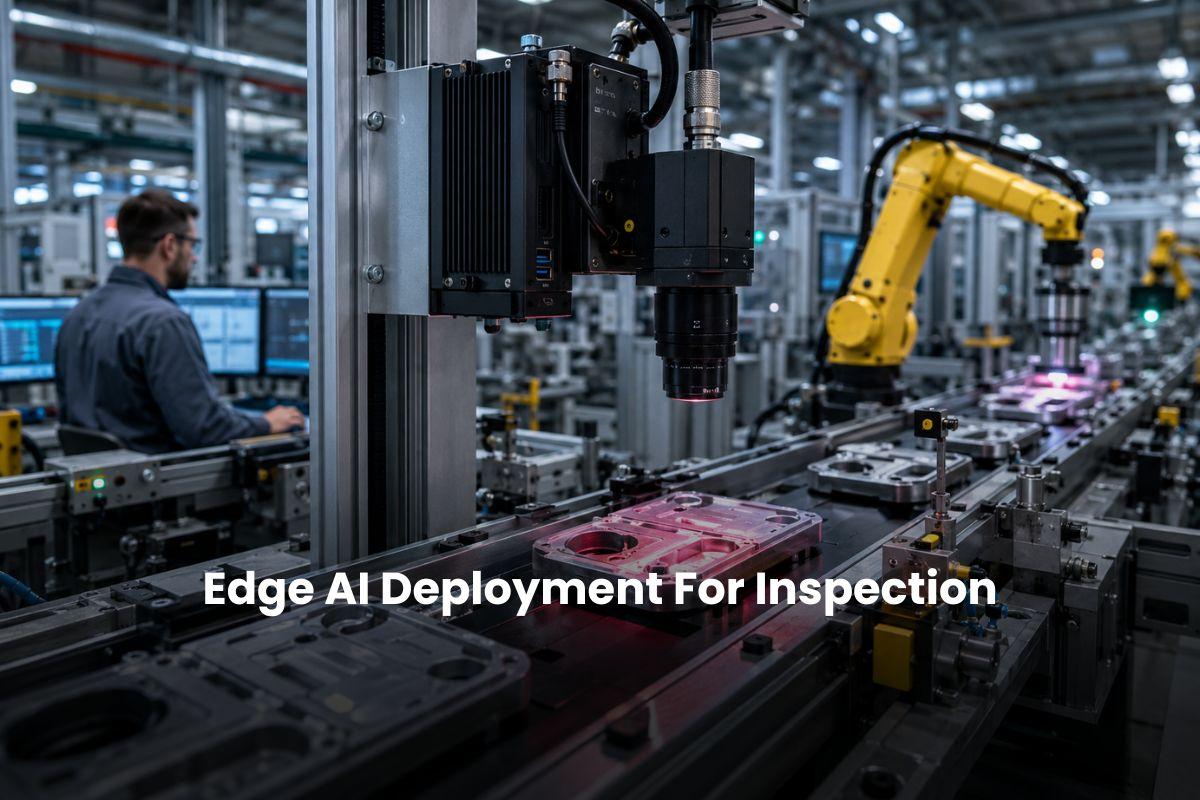
Some quality decisions can wait a few seconds. A reject gate on a high-speed line cannot.
Edge AI deployment for inspection solves for the constraints that make cloud inference physically incompatible with production: sub-50 ms latency requirements, bandwidth limits, data sovereignty rules, and lines that need to keep running when connectivity drops.
Here’s how it works, how to build it, and how to deploy it without unnecessary risk.
Key Notes
Sub-50 ms latency requirements make edge inference mandatory on high-speed lines.
Training models require optimization (quantization, pruning, compilation) before edge deployment.
Hybrid architecture splits real-time inference at the edge from model training centrally.
Why Edge AI Deployment Exists – The Hard Constraints Cloud Can’t Solve
Physics, bandwidth, and data policy dictate the architecture – preference doesn’t factor in.
Specifically, four constraints push inference off the cloud and onto the line:
Latency Is Non-Negotiable On High-Speed Lines
Real-time edge AI inspection requires end-to-end latency – capture to PLC signal – under 50 ms. Some high-speed applications need under 10 ms.
The Problem With Cloud:
Cloud round-trips introduce 50–200 ms of network delay on reliable connections
That makes deterministic reject timing impossible at line speed
Inference at the edge removes the variable entirely – the only latency that matters is local compute time
Bandwidth Constraints Make Streaming Impractical
A single high-resolution camera at 60 fps generates several hundred MB per minute of raw image data. Multiply that across multiple cameras and lines and continuous cloud streaming becomes both technically fragile and expensive.
Edge AI processes images locally and sends upstream only what matters:
Defect counts and KPIs
Selected annotated samples
Model health metrics
Data Sovereignty Rules Out Cloud-Only Architectures in Many Sectors
Semiconductor wafer images, automotive assembly details, medical device geometry – these contain proprietary IP that many manufacturers won’t route through a cloud provider.
In regulated environments (defense, pharma, certain export-controlled sectors), keeping data local isn’t discretionary.
Edge deployments keep raw inspection data within the plant perimeter by design.
Production Lines Can’t Depend On WAN Availability
Cloud connectivity fails. When it does, a cloud-dependent inspection system either stops the line or keeps running blind.
Edge AI continues making inspection decisions autonomously during outages, with no dependency on external services – the line keeps moving regardless of what’s happening on the IT network.
Edge AI vs. Cloud AI vs. Hybrid: A Practical Decision Framework
The edge-vs-cloud decision comes down to latency requirements, connectivity constraints, data sensitivity, and compute needs.
Most modern deployments end up somewhere in between.
The Dominant Production Architecture Today Is Hybrid
Most modern edge deployments split responsibilities across two layers:
Edge: Real-time inference, pass/fail decisions, reject actuation – everything that needs to happen in milliseconds.
Central/cloud: Model training, fleet updates, aggregated analytics, cross-plant reporting – everything that benefits from scale and centralized compute.
The two layers aren’t in competition. The question is which layer does what, not which layer wins.
Edge AI Inspection Architecture
A well-designed edge AI inspection system is a stack:
imaging hardware that produces usable data
compute that runs inference fast enough
decision logic that interfaces with the factory
and a data layer that retains what matters
Cameras & Lighting
Cameras
Camera selection depends on the inspection task:
Area scan: Discrete parts, general surface inspection
Line scan: Continuous web, sheet, or cylindrical material
3D cameras: Dimensional checks and surface-height profiling
Smart cameras: Simpler single-station deployments with integrated compute
Correct optics, mounting, and PLC-driven triggering determine whether the model ever receives a usable image – worth getting right before touching the AI layer.
Lighting
The right illumination geometry exposes defects that are otherwise invisible to the model:
Dark-field: Scratches and surface anomalies
Diffuse dome: Shiny or reflective metal surfaces
Backlight: Silhouettes and dimensional checks
Structured light: 3D profiling
Inconsistent lighting is one of the most common reasons a model that performs well in testing falls apart in production.
Saturates quickly as camera count or model complexity grows
GPU-accelerated edge device
Multi-camera, high-FPS, large CNNs
Higher upfront cost
NPU/TPU-based system
Power-constrained deployments, stable model architectures
Less flexible, tighter toolchain requirements
Sizing Guidance:
Start from the line (parts per minute × images per part = required FPS)
Benchmark candidate models on target hardware
And design for 30–40% performance headroom
Hardware that’s marginal at launch tends to become a bottleneck within six months as SKUs, cameras, or resolutions expand.
Inference: Model Types Used in Edge AI Inspection
The model layer is where the inspection logic runs.
Four task types cover most industrial applications:
Classification. Assigns a pass/fail or defect class to the full image or ROI. Lowest compute footprint, fastest inference, appropriate for station-level go/no-go decisions.
Detection. Localizes defects with bounding boxes. Adds post-processing overhead but stays real-time capable with one-stage architectures like YOLO.
Segmentation. Pixel-level defect masks. More compute-intensive, essential when precise defect boundaries matter for measurement or routing decisions.
Anomaly detection. Learns the signature of normal parts and flags deviations. Requires minimal labeled defect data, useful for catching defect types that weren’t anticipated during training.
Data Flow: What Stays Local, What Goes Upstream
The edge device owns the real-time pipeline – image capture, pre-processing (crop, normalize, ROI extraction), model inference, threshold logic, and PLC output – all within the latency budget.
This split keeps bandwidth manageable and raw product images within the plant perimeter.
Making Models Edge-Ready: Optimization Before Deployment
A model that achieves 98% recall in a training environment may still fail to meet latency requirements on edge hardware, or include layer operations the target accelerator doesn’t support.
Edge model optimization is a distinct engineering step, not an afterthought.
Why Training Models Can’t Go Straight to the Edge
Most training models run FP32 precision, are over-parameterized for datacenter GPUs, and assume compute environments with far more memory and thermal headroom than an industrial edge box.
Pushing them directly to edge hardware results in:
Latency overruns that blow the line’s timing budget
Memory errors from VRAM or RAM constraints
Flat refusal by the target runtime due to unsupported layer operations
Optimization Techniques
Technique
What It Does
Key Consideration
Quantization
Converts FP32 weights/activations to INT8
Accuracy loss typically <1–2% with proper calibration
Pruning
Removes low-contribution weights, channels, or filters
Best results when integrated into training, not applied post-hoc
Knowledge distillation
Trains a compact student model to replicate a larger teacher
Often more accurate than direct compression at the same size target
Runtime compilation
Compiles to TensorRT, OpenVINO, or vendor SDKs
Operator fusion alone can yield significant latency gains
The Calibration Process
Set a recall floor – the minimum acceptable detection rate for critical defect classes – and a latency ceiling (p95 or p99 under realistic load).
Then iterate model configuration (architecture, quantization settings, resolution) until both criteria pass.
Teams that skip this structured iteration tend to land in one of two places: over-compressed models that lose recall on edge-case defects, or models that are technically accurate but too slow for the line.
Factory Integration: PLCs, MES, Automated Actions
An edge AI inspection system running in isolation isn’t useful. The value is realized when it’s wired into the factory control stack and can act on what it finds.
PLC Integration
The edge device reads part-in-position triggers from the PLC (via encoder, proximity sensor, or digital I/O), runs inference, and returns a pass/fail bit plus defect code.
Common integration protocols:
OPC UA
Modbus TCP
EtherNet/IP
Discrete I/O for hard real-time reject timing
The PLC retains final control authority – the AI produces a signal, the PLC decides what to do with it within predefined safety logic.
MES Integration
Inspection outcomes (part ID, lot, station, timestamp, defect class, confidence score) are pushed to the MES via REST APIs or OPC UA ISA-95 data structures.
The MES links them to order and genealogy data, enabling traceability, defect Pareto dashboards, and quality-related workflows – inspection results become quality records.
Automated Actions
Once integrated, the edge AI system can trigger:
Reject gates, diverters, or blow-offs for failed parts
Line stops or alarms when defect rates spike or systematic anomalies appear
Upstream flags – frequent defects tied to a specific lot or process setting can trigger recipe changes, maintenance tickets, or supplier holds before the problem compounds
Downstream routing – AI results determine rework vs. scrap decisions in MES/WMS
Short-term local buffering on the edge device feeds into longer-term compressed archiving centrally, with rich metadata retained throughout to support retraining and root cause investigations.
Deployment Process (Pilot, Validate, Scale)
The staged approach below is faster overall because it surfaces problems before they’re expensive.
Pre-Deployment: Define Before You Build
Before any hardware is ordered, establish two things:
Baseline Current Performance:
Defect rates and false positive rates
Rework cost and scrap volume
Line speed and staffing burden
Without this baseline, you can’t measure improvement or define a go/no-go threshold for the pilot.
Define KPIs Upfront:
Target recall per defect class
Allowable false positive rate
p95 latency budget
Uptime requirements
Business metrics: scrap reduction, labor hours saved
If KPIs are defined after deployment, they tend to shift to fit the results.
Also assess the OT/IT landscape: camera options, edge hardware availability, PLC types, MES/SCADA connectivity, and data security policies for what can leave the plant.
Pilot Phase: One Line, Shadow Mode First
Scope the pilot tightly – one station, one product family, one well-defined inspection task.
Start In Shadow Mode:
The AI produces pass/fail decisions, but the PLC continues acting on the existing inspection method. Real-world model performance, zero production risk.
Choosing The Right Pilot Line:
High scrap rate – meaningful signal to measure against
Cooperative stakeholders – change management matters here
Good data availability – historical images, labeled or labelable
Stable process – avoid recently changed lines during the learning period
Common Issues To Anticipate At Pilot Stage:
Domain mismatch. Model trained on lab images underperforms due to different lighting, fixturing, or surface variation on the actual line. Fix: targeted data collection and fine-tuning on production images.
Label and ground-truth gaps. Historical inspection data is often incomplete or inconsistently labeled, making validation harder than expected.
Integration friction. PLC timing requirements, I/O mapping quirks, MES data schema differences, and OT security policies all slow full integration.
Production Rollout: Four Stages
Stage
Mode
What You’re Proving
1
Shadow – AI decides, line acts on existing inspection
Accuracy and latency in production conditions
2
Assisted – AI proposes, operator confirms each decision
Operator trust, edge case handling
3
Full automation with human override & monitoring
Sustained performance, drift detection
4
Replication to similar lines, new SKUs, other plants
Repeatability of the deployment playbook
Validation Requirements
Use a representative dataset collected from the target line. Run at least 4–6 weeks of parallel operation comparing AI decisions against current inspection and expert re-inspection on a sample.
Stress tests should cover:
Maximum throughput conditions
Lighting perturbations
Simulated edge hardware or network failures
Most industrial AI frameworks put the expected timeline from initial pilot to stable production at 3–4 months for a well-scoped edge AI deployment.
How Averroes Handles Edge AI Inspection
Edge AI inspection deployments live or die on integration with existing equipment.
Averroes runs on current inspection hardware – KLA, AOI, Onto, and other proprietary tools – with no new cameras or hardware required. For edge deployments, that removes the capital equipment decision from the equation entirely.
Accuracy Benchmarks:
99%+ classification accuracy
98.5% object detection accuracy
97.7% segmentation accuracy
Trains with as few as 20–40 images per defect class
Unknown Defects:
WatchDog runs as a persistent anomaly detection layer alongside classification and detection, flagging novel defect types outside the configured classes rather than silently passing them.
Deployment Options:
On-premise or cloud
Fully air-gapped installs for environments where data leaving the plant isn’t an option
What Would Sub-50ms Inspection Do for Your Line?
See 99%+ detection accuracy running on your current equipment.
Edge AI Deployment FAQs
What is edge AI and how does it differ from traditional machine vision?
Edge AI runs trained neural network models on local hardware to detect defects – traditional machine vision uses hand-engineered rules and fixed algorithms. The practical difference: edge AI handles complex, variable, or subtle defects that rule-based systems miss, and adapts as new data is collected rather than requiring manual rule updates.
What edge AI platform do manufacturers use for visual inspection?
Most manufacturers deploy edge AI inspection through dedicated platforms that integrate directly with existing inspection equipment – such as AOI, KLA, or Onto tools – without requiring new hardware. The platform handles model deployment, monitoring, and updates across edge devices from a central environment.
How much training data does edge AI inspection require?
Edge AI inspection models can reach production-grade accuracy with as few as 20–40 images per defect class. This is significantly less than general-purpose AI applications because models are trained on narrow, well-defined inspection tasks rather than broad visual domains.
What are the main risks of edge AI deployment in manufacturing?
The most common risks in edge AI deployment are model drift as process conditions change, domain mismatch between training data and live production, and inadequate validation periods before full automation. All three are manageable with a structured pilot process, defined performance thresholds, and a continuous retraining loop.
Conclusion
Edge AI deployment for inspection works when the architecture matches the operational constraints – latency requirements, data sensitivity, connectivity limits, and line speed all shape where inference runs and how the system is built.
The manufacturers getting the most out of it are the ones who scoped pilots tightly, defined KPIs before deployment, and treated model optimization as a non-negotiable step.
The hardware, integration, and rollout framework covered here applies across industries – semiconductor, automotive, food and beverage, electronics – wherever 100% in-line inspection at line speed is the goal.
If you’re evaluating how edge AI fits your current inspection setup, Averroes deploys on existing equipment with no hardware changes required. Book a free demo to see it running on your use case.








Some quality decisions can wait a few seconds. A reject gate on a high-speed line cannot.
Edge AI deployment for inspection solves for the constraints that make cloud inference physically incompatible with production: sub-50 ms latency requirements, bandwidth limits, data sovereignty rules, and lines that need to keep running when connectivity drops.
Here’s how it works, how to build it, and how to deploy it without unnecessary risk.
Key Notes
Why Edge AI Deployment Exists – The Hard Constraints Cloud Can’t Solve
Physics, bandwidth, and data policy dictate the architecture – preference doesn’t factor in.
Specifically, four constraints push inference off the cloud and onto the line:
Latency Is Non-Negotiable On High-Speed Lines
Real-time edge AI inspection requires end-to-end latency – capture to PLC signal – under 50 ms. Some high-speed applications need under 10 ms.
The Problem With Cloud:
Bandwidth Constraints Make Streaming Impractical
A single high-resolution camera at 60 fps generates several hundred MB per minute of raw image data. Multiply that across multiple cameras and lines and continuous cloud streaming becomes both technically fragile and expensive.
Edge AI processes images locally and sends upstream only what matters:
Data Sovereignty Rules Out Cloud-Only Architectures in Many Sectors
Semiconductor wafer images, automotive assembly details, medical device geometry – these contain proprietary IP that many manufacturers won’t route through a cloud provider.
In regulated environments (defense, pharma, certain export-controlled sectors), keeping data local isn’t discretionary.
Edge deployments keep raw inspection data within the plant perimeter by design.
Production Lines Can’t Depend On WAN Availability
Cloud connectivity fails. When it does, a cloud-dependent inspection system either stops the line or keeps running blind.
Edge AI continues making inspection decisions autonomously during outages, with no dependency on external services – the line keeps moving regardless of what’s happening on the IT network.
Edge AI vs. Cloud AI vs. Hybrid: A Practical Decision Framework
The edge-vs-cloud decision comes down to latency requirements, connectivity constraints, data sensitivity, and compute needs.
Most modern deployments end up somewhere in between.
The Dominant Production Architecture Today Is Hybrid
Most modern edge deployments split responsibilities across two layers:
The two layers aren’t in competition. The question is which layer does what, not which layer wins.
Edge AI Inspection Architecture
A well-designed edge AI inspection system is a stack:
Cameras & Lighting
Cameras
Camera selection depends on the inspection task:
Correct optics, mounting, and PLC-driven triggering determine whether the model ever receives a usable image – worth getting right before touching the AI layer.
Lighting
The right illumination geometry exposes defects that are otherwise invisible to the model:
Inconsistent lighting is one of the most common reasons a model that performs well in testing falls apart in production.
Edge Compute: Matching Hardware To Workload
Sizing Guidance:
Hardware that’s marginal at launch tends to become a bottleneck within six months as SKUs, cameras, or resolutions expand.
Inference: Model Types Used in Edge AI Inspection
The model layer is where the inspection logic runs.
Four task types cover most industrial applications:
Data Flow: What Stays Local, What Goes Upstream
The edge device owns the real-time pipeline – image capture, pre-processing (crop, normalize, ROI extraction), model inference, threshold logic, and PLC output – all within the latency budget.
This split keeps bandwidth manageable and raw product images within the plant perimeter.
Making Models Edge-Ready: Optimization Before Deployment
A model that achieves 98% recall in a training environment may still fail to meet latency requirements on edge hardware, or include layer operations the target accelerator doesn’t support.
Edge model optimization is a distinct engineering step, not an afterthought.
Why Training Models Can’t Go Straight to the Edge
Most training models run FP32 precision, are over-parameterized for datacenter GPUs, and assume compute environments with far more memory and thermal headroom than an industrial edge box.
Pushing them directly to edge hardware results in:
Optimization Techniques
The Calibration Process
Teams that skip this structured iteration tend to land in one of two places: over-compressed models that lose recall on edge-case defects, or models that are technically accurate but too slow for the line.
Factory Integration: PLCs, MES, Automated Actions
An edge AI inspection system running in isolation isn’t useful. The value is realized when it’s wired into the factory control stack and can act on what it finds.
PLC Integration
The edge device reads part-in-position triggers from the PLC (via encoder, proximity sensor, or digital I/O), runs inference, and returns a pass/fail bit plus defect code.
Common integration protocols:
The PLC retains final control authority – the AI produces a signal, the PLC decides what to do with it within predefined safety logic.
MES Integration
Inspection outcomes (part ID, lot, station, timestamp, defect class, confidence score) are pushed to the MES via REST APIs or OPC UA ISA-95 data structures.
The MES links them to order and genealogy data, enabling traceability, defect Pareto dashboards, and quality-related workflows – inspection results become quality records.
Automated Actions
Once integrated, the edge AI system can trigger:
Data Retention
Short-term local buffering on the edge device feeds into longer-term compressed archiving centrally, with rich metadata retained throughout to support retraining and root cause investigations.
Deployment Process (Pilot, Validate, Scale)
The staged approach below is faster overall because it surfaces problems before they’re expensive.
Pre-Deployment: Define Before You Build
Before any hardware is ordered, establish two things:
Baseline Current Performance:
Without this baseline, you can’t measure improvement or define a go/no-go threshold for the pilot.
Define KPIs Upfront:
If KPIs are defined after deployment, they tend to shift to fit the results.
Also assess the OT/IT landscape: camera options, edge hardware availability, PLC types, MES/SCADA connectivity, and data security policies for what can leave the plant.
Pilot Phase: One Line, Shadow Mode First
Scope the pilot tightly – one station, one product family, one well-defined inspection task.
Start In Shadow Mode:
The AI produces pass/fail decisions, but the PLC continues acting on the existing inspection method. Real-world model performance, zero production risk.
Choosing The Right Pilot Line:
Common Issues To Anticipate At Pilot Stage:
Production Rollout: Four Stages
Validation Requirements
Use a representative dataset collected from the target line. Run at least 4–6 weeks of parallel operation comparing AI decisions against current inspection and expert re-inspection on a sample.
Stress tests should cover:
Most industrial AI frameworks put the expected timeline from initial pilot to stable production at 3–4 months for a well-scoped edge AI deployment.
How Averroes Handles Edge AI Inspection
Edge AI inspection deployments live or die on integration with existing equipment.
Averroes runs on current inspection hardware – KLA, AOI, Onto, and other proprietary tools – with no new cameras or hardware required. For edge deployments, that removes the capital equipment decision from the equation entirely.
Accuracy Benchmarks:
Unknown Defects:
WatchDog runs as a persistent anomaly detection layer alongside classification and detection, flagging novel defect types outside the configured classes rather than silently passing them.
Deployment Options:
What Would Sub-50ms Inspection Do for Your Line?
See 99%+ detection accuracy running on your current equipment.
Edge AI Deployment FAQs
What is edge AI and how does it differ from traditional machine vision?
Edge AI runs trained neural network models on local hardware to detect defects – traditional machine vision uses hand-engineered rules and fixed algorithms. The practical difference: edge AI handles complex, variable, or subtle defects that rule-based systems miss, and adapts as new data is collected rather than requiring manual rule updates.
What edge AI platform do manufacturers use for visual inspection?
Most manufacturers deploy edge AI inspection through dedicated platforms that integrate directly with existing inspection equipment – such as AOI, KLA, or Onto tools – without requiring new hardware. The platform handles model deployment, monitoring, and updates across edge devices from a central environment.
How much training data does edge AI inspection require?
Edge AI inspection models can reach production-grade accuracy with as few as 20–40 images per defect class. This is significantly less than general-purpose AI applications because models are trained on narrow, well-defined inspection tasks rather than broad visual domains.
What are the main risks of edge AI deployment in manufacturing?
The most common risks in edge AI deployment are model drift as process conditions change, domain mismatch between training data and live production, and inadequate validation periods before full automation. All three are manageable with a structured pilot process, defined performance thresholds, and a continuous retraining loop.
Conclusion
Edge AI deployment for inspection works when the architecture matches the operational constraints – latency requirements, data sensitivity, connectivity limits, and line speed all shape where inference runs and how the system is built.
The manufacturers getting the most out of it are the ones who scoped pilots tightly, defined KPIs before deployment, and treated model optimization as a non-negotiable step.
The hardware, integration, and rollout framework covered here applies across industries – semiconductor, automotive, food and beverage, electronics – wherever 100% in-line inspection at line speed is the goal.
If you’re evaluating how edge AI fits your current inspection setup, Averroes deploys on existing equipment with no hardware changes required. Book a free demo to see it running on your use case.