Automatic Defect Recognition Guide (Tools, Data & Deployment)
Averroes
Apr 29, 2026
Pick any production line running automatic defect recognition well, and you’ll find the same pattern underneath: tight imaging conditions, clean labeled data, and a team that governs it as a validated quality system.
Most of the work happens around the model.
We’ll cover how ADR works, what it needs to hold up in production, and the failure modes that take down most pilots.
Key Notes
ADR runs five stages: capture, preprocess, analyze, decide, act.
Conventional deep learning needs 10,000–50,000 labeled images, but some platforms work with 20–40 per class.
Regulated industries require validated systems (documented intended use, lifecycle validation, version control, audit trails).
How Automatic Defect Recognition Works End to End
A working automatic defect recognition system runs five stages on every part. Get one of them wrong and the whole thing wobbles.
1. Image Capture
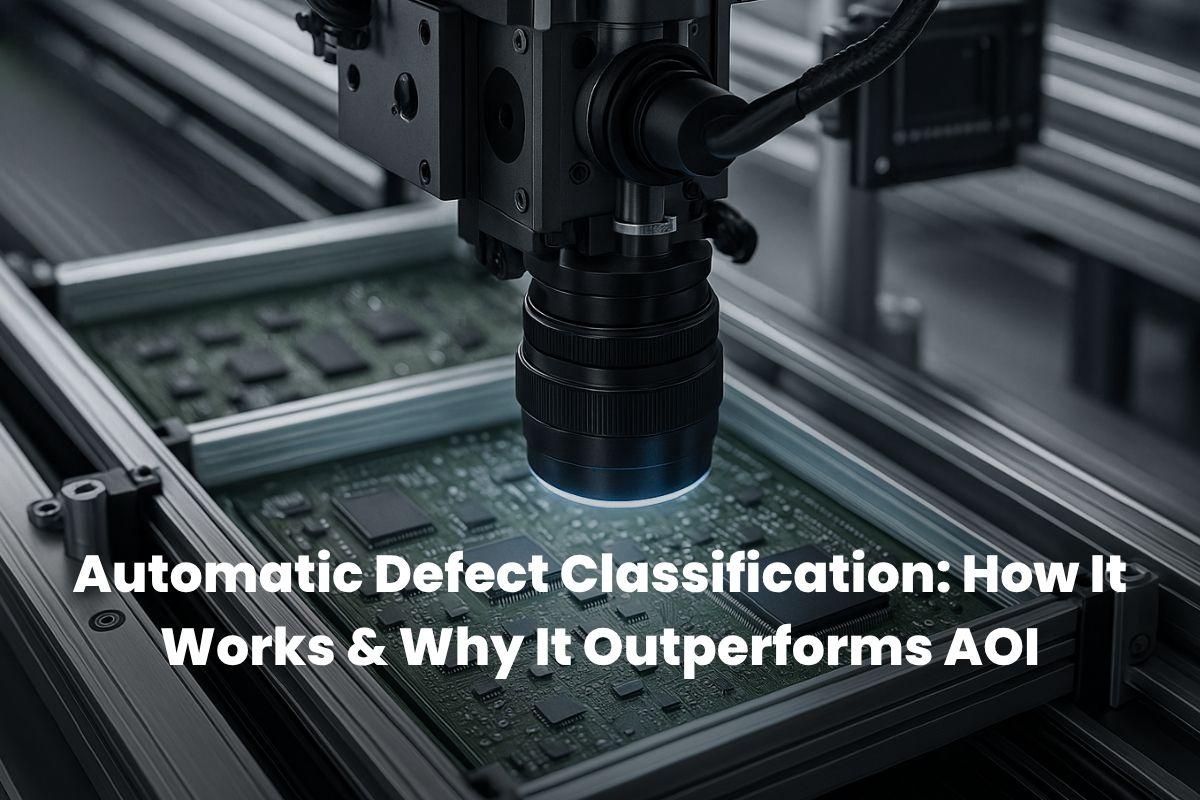
Line-scan or area cameras synced to conveyor speed, capturing 4K+ frames under controlled multi-angle LED lighting. Telecentric lenses for micron-level work.
The single biggest predictor of detection accuracy at this stage is lighting – well-tuned illumination can swing accuracy by 20–40% on the same line with the same model.
2. Preprocessing
Noise reduction, brightness normalization, and ROI cropping standardize the input before the model ever sees it.
3. Analysis
This is where the defect recognition logic lives, and there are three approaches:
Approach
Best For
Tradeoff
Rule-based thresholding
Known, simple defects on stable products (e.g., presence/absence checks, dark spots on light backgrounds)
Fast setup, rigid – breaks when conditions shift
Traditional computer vision (HOG, SVM, blob analysis)
Mid-variability shape detection like edge cracks, gasket alignment
Good generalization, requires manual tuning
Deep learning (CNNs, U-Net, autoencoders for anomaly detection)
Complex, subtle, evolving defects in electronics, semiconductors, varied surfaces
Highest accuracy ceiling (15–25% lift over the others on hard cases), needs training data
Most production lines need a mix of these tools.
4. Decision
The model outputs a confidence score, and the system applies a threshold (for example: reject anything above 0.9 confidence on a critical defect class).
Anomaly detection methods like autoencoders also flag anything that looks unfamiliar, which is useful when you don’t yet know every defect type that will show up.
This stage assigns one of four labels:
Critical defect (fails spec, reject)
Cosmetic issue (flag for review, may pass)
Acceptable variation (within tolerance, pass)
False alarm (a deliberate output class, not a system bug)
5. Action
GPIO signals fire to PLCs, pneumatic ejectors divert bad parts, MES databases log every decision with a timestamp, and HMI dashboards alert operators.
Closed loop, end of cycle.
What Automatic Defect Recognition Needs To Work: Data, Defects, Conditions
The single biggest predictor of automatic defect recognition success is data quality, environmental control, and how clearly the team has defined what “defect” means before anyone trains anything.
10,000–50,000 labeled images as a baseline dataset
80/10/10 split across training, validation, and test sets
~70% normal samples, ~30% defective, with defects spread across every class
95%+ inter-annotator agreement (when two labelers tag the same image, they agree on both the boundary and the class)
Worth noting: Not every platform needs that volume. Averroes’ inspection engine reaches useful accuracy with 20–40 images per defect class because of how the underlying model is built. The general principle still holds though – whatever your minimum is, label it well.
Where Automatic Defect Recognition Struggles
Automatic defect recognition is excellent on stable, repetitive, high-volume defects. A few categories remain hard:
Environmental Conditions
This is where lab demos and production diverge.
Lighting variation, lens contamination, vibration, and orientation drift can take a system that hit 98% accuracy in validation down to 75% in actual production.
So, these should be part of the system:
adaptive lighting
fixtures for orientation
stabilized mounts
air blasts on lenses
Choosing Tools & Vendors for Automatic Defect Recognition
Automatic defect recognition tools fall into three categories.
The right pick depends on defect complexity, in-house ML capability, and how much customization the line needs.
Questions To Ask Any Vendor
The demo will look great. That’s the whole point of a demo.
What separates good systems:
Show production case studies on defect types similar to ours – with sustained accuracy numbers.
How does the system handle drift? What does retraining look like, how often, and who does it?
What’s your false positive rate under variable lighting, in customer environments?
Show integration evidence with PLCs and MES on lines like ours.
Does this run on existing inspection hardware (KLA, AOI, Onto, etc.) or do we need new cameras? This is important because new hardware means capex, downtime, and a longer ROI window.
Want Detection That Survives Production?
99%+ accuracy, near-zero false positives, no new cameras required.
A practical automatic defect recognition rollout takes roughly six months across four phases. Projects fail more often from process and people issues than from the technology.
Phase 1 – Feasibility (Month 1):
Process stability check (CpK > 1.33, <5% variation), clear defect definitions tied to customer specs, baseline imaging tests, ROI model targeting 12-month payback.
Phase 2 – Pilot (Months 2–3):
Install on a shadow line with real production conditions. Run parallel manual verification to establish ground truth. Hit 95%+ on the agreed metrics before moving on.
Phase 3 – Integration (Months 4–5):
Connect to PLCs (Ethernet/IP for reject signals), MES (OPC-UA for traceability and SPC), QMS (REST APIs for compliance reporting), HMI for operator alarms.
Phase 4 – Rollout (Month 6+):
Full line go-live with monitoring, then a quarterly retraining cadence.
Why Automatic Defect Recognition Projects Fail
Unstable upstream process. ADR exposes problems that aren’t ADR’s to solve. If the process drifts daily, no model will look stable.
Insufficient or imbalanced training data. Under 5,000 images for complex defects, or 95% good samples and 5% defective.
Ignored environmental variation. Lighting changes between shifts, vibration from a nearby press, dust on the lens.
No change management. Operators override “black box” decisions about 20% of the time when they don’t trust the system. Explainability and training fix this. Nothing else does.
Plug-and-play expectations. No ADR system works on day one without site-specific tuning.
Measuring Success & Governing ADR Over Time
Automatic defect recognition is a living system.
It drifts over time, and the organizations that get long-term value treat it as a quality-critical asset with active measurement, retraining, and governance built into the operating cadence.
Performance Metrics That Matter
Detection rate: >95%
False positive rate: <1%
False negative rate: <0.5%
Throughput impact: <5% (the system shouldn’t slow the line)
Monthly: Log review, drift monitoring (accuracy drop greater than 5% triggers investigation), optical recalibration.
Quarterly: Retrain on fresh defect data and recent process changes.
When performance degrades, the diagnostic question is whether it’s the model, upstream process variation, or imaging quality – they need different fixes.
Governance for Regulated Industries
In medical devices, pharma, automotive, aerospace, and food, automatic defect recognition is a validated quality system component. That changes what “good” looks like.
What Teams Need To Put In Place:
Documented intended use: Which SKUs, which line speeds, which lighting conditions.
Lifecycle validation: IQ/OQ/PQ plus ongoing performance qualification on production-representative samples.
Version control: For both the model and the system configuration.
Audit trails: Image history and decision history, timestamped and tamper-evident.
Change-control policy: Explicit rules for what counts as a minor, moderate, or major change to retraining, thresholds, or class definitions.
The Mature Framing:
Validate the socio-technical system, not just the algorithm.
Imaging setup, operator procedures, escalation logic, retraining governance, and evidence retention all sit inside the validated boundary.
Curious What 99%+ Accuracy Looks Like On Your Line?
20–40 images per defect class, deployed on your existing equipment.
Automatic Defect Recognition FAQs
What is the difference between AOI and ADR?
AOI (automated optical inspection) is the hardware category – the cameras, lighting, and stage that capture images of a part. ADR (automatic defect recognition) is the software intelligence layer that decides what those images mean. Modern AI-based ADR runs on top of existing AOI equipment, which is why you don’t need to replace cameras to upgrade your inspection capability.
How accurate is automatic defect recognition compared to human inspectors?
Automatic defect recognition typically reaches 95–99% accuracy in production, while human inspectors operate at 70–80% due to fatigue, shift variation, and subjectivity – they miss 20–30% of defects on repetitive visual tasks. ADR also runs 24/7 at consistent accuracy, where human accuracy degrades within hours.
How long does it take to implement automatic defect recognition?
Automatic defect recognition implementation typically takes six months end to end: feasibility in month one, pilot in months two and three, integration in months four and five, and full rollout by month six. Faster deployments are possible on platforms that use minimal training data and run on existing inspection hardware, which removes the longest pole in the tent.
Can automatic defect recognition detect defects it wasn’t trained on?
Automatic defect recognition can detect untrained defects when the system includes anomaly detection methods – typically autoencoders or unsupervised models that flag anything statistically unfamiliar. This is essential in real production where new defect types emerge from process changes, supplier shifts, or tooling wear that no training set could anticipate in advance.
Conclusion
Automatic defect recognition rewards teams who get the fundamentals right: stable processes feeding the line, clean data feeding the model, tight imaging conditions feeding the cameras, and governance keeping all of it honest over time.
The headline numbers (99%+ detection, 25–50% scrap reduction, 3–12 month payback) show up consistently when those fundamentals hold. They disappear when they don’t.
The fastest way to see whether the numbers hold for your defect types and your equipment is on your own line – book a free demo now.








Pick any production line running automatic defect recognition well, and you’ll find the same pattern underneath: tight imaging conditions, clean labeled data, and a team that governs it as a validated quality system.
Most of the work happens around the model.
We’ll cover how ADR works, what it needs to hold up in production, and the failure modes that take down most pilots.
Key Notes
How Automatic Defect Recognition Works End to End
A working automatic defect recognition system runs five stages on every part. Get one of them wrong and the whole thing wobbles.
1. Image Capture
Line-scan or area cameras synced to conveyor speed, capturing 4K+ frames under controlled multi-angle LED lighting. Telecentric lenses for micron-level work.
The single biggest predictor of detection accuracy at this stage is lighting – well-tuned illumination can swing accuracy by 20–40% on the same line with the same model.
2. Preprocessing
Noise reduction, brightness normalization, and ROI cropping standardize the input before the model ever sees it.
3. Analysis
This is where the defect recognition logic lives, and there are three approaches:
Most production lines need a mix of these tools.
4. Decision
The model outputs a confidence score, and the system applies a threshold (for example: reject anything above 0.9 confidence on a critical defect class).
Anomaly detection methods like autoencoders also flag anything that looks unfamiliar, which is useful when you don’t yet know every defect type that will show up.
This stage assigns one of four labels:
5. Action
GPIO signals fire to PLCs, pneumatic ejectors divert bad parts, MES databases log every decision with a timestamp, and HMI dashboards alert operators.
Closed loop, end of cycle.
What Automatic Defect Recognition Needs To Work: Data, Defects, Conditions
The single biggest predictor of automatic defect recognition success is data quality, environmental control, and how clearly the team has defined what “defect” means before anyone trains anything.
Data Requirements
Conventional deep learning approaches typically need:
Worth noting: Not every platform needs that volume. Averroes’ inspection engine reaches useful accuracy with 20–40 images per defect class because of how the underlying model is built. The general principle still holds though – whatever your minimum is, label it well.
Where Automatic Defect Recognition Struggles
Automatic defect recognition is excellent on stable, repetitive, high-volume defects. A few categories remain hard:
Environmental Conditions
This is where lab demos and production diverge.
Lighting variation, lens contamination, vibration, and orientation drift can take a system that hit 98% accuracy in validation down to 75% in actual production.
So, these should be part of the system:
Choosing Tools & Vendors for Automatic Defect Recognition
Automatic defect recognition tools fall into three categories.
The right pick depends on defect complexity, in-house ML capability, and how much customization the line needs.
Questions To Ask Any Vendor
The demo will look great. That’s the whole point of a demo.
What separates good systems:
Does this run on existing inspection hardware (KLA, AOI, Onto, etc.) or do we need new cameras? This is important because new hardware means capex, downtime, and a longer ROI window.
Want Detection That Survives Production?
99%+ accuracy, near-zero false positives, no new cameras required.
Implementing Automatic Defect Recognition: Roadmap & Why Projects Fail
A practical automatic defect recognition rollout takes roughly six months across four phases. Projects fail more often from process and people issues than from the technology.
Phase 1 – Feasibility (Month 1):
Process stability check (CpK > 1.33, <5% variation), clear defect definitions tied to customer specs, baseline imaging tests, ROI model targeting 12-month payback.
Phase 2 – Pilot (Months 2–3):
Install on a shadow line with real production conditions. Run parallel manual verification to establish ground truth. Hit 95%+ on the agreed metrics before moving on.
Phase 3 – Integration (Months 4–5):
Connect to PLCs (Ethernet/IP for reject signals), MES (OPC-UA for traceability and SPC), QMS (REST APIs for compliance reporting), HMI for operator alarms.
Phase 4 – Rollout (Month 6+):
Full line go-live with monitoring, then a quarterly retraining cadence.
Why Automatic Defect Recognition Projects Fail
Measuring Success & Governing ADR Over Time
Automatic defect recognition is a living system.
It drifts over time, and the organizations that get long-term value treat it as a quality-critical asset with active measurement, retraining, and governance built into the operating cadence.
Performance Metrics That Matter
Ongoing Operations
When performance degrades, the diagnostic question is whether it’s the model, upstream process variation, or imaging quality – they need different fixes.
Governance for Regulated Industries
In medical devices, pharma, automotive, aerospace, and food, automatic defect recognition is a validated quality system component. That changes what “good” looks like.
What Teams Need To Put In Place:
The Mature Framing:
Validate the socio-technical system, not just the algorithm.
Imaging setup, operator procedures, escalation logic, retraining governance, and evidence retention all sit inside the validated boundary.
Curious What 99%+ Accuracy Looks Like On Your Line?
20–40 images per defect class, deployed on your existing equipment.
Automatic Defect Recognition FAQs
What is the difference between AOI and ADR?
AOI (automated optical inspection) is the hardware category – the cameras, lighting, and stage that capture images of a part. ADR (automatic defect recognition) is the software intelligence layer that decides what those images mean. Modern AI-based ADR runs on top of existing AOI equipment, which is why you don’t need to replace cameras to upgrade your inspection capability.
How accurate is automatic defect recognition compared to human inspectors?
Automatic defect recognition typically reaches 95–99% accuracy in production, while human inspectors operate at 70–80% due to fatigue, shift variation, and subjectivity – they miss 20–30% of defects on repetitive visual tasks. ADR also runs 24/7 at consistent accuracy, where human accuracy degrades within hours.
How long does it take to implement automatic defect recognition?
Automatic defect recognition implementation typically takes six months end to end: feasibility in month one, pilot in months two and three, integration in months four and five, and full rollout by month six. Faster deployments are possible on platforms that use minimal training data and run on existing inspection hardware, which removes the longest pole in the tent.
Can automatic defect recognition detect defects it wasn’t trained on?
Automatic defect recognition can detect untrained defects when the system includes anomaly detection methods – typically autoencoders or unsupervised models that flag anything statistically unfamiliar. This is essential in real production where new defect types emerge from process changes, supplier shifts, or tooling wear that no training set could anticipate in advance.
Conclusion
Automatic defect recognition rewards teams who get the fundamentals right: stable processes feeding the line, clean data feeding the model, tight imaging conditions feeding the cameras, and governance keeping all of it honest over time.
The headline numbers (99%+ detection, 25–50% scrap reduction, 3–12 month payback) show up consistently when those fundamentals hold. They disappear when they don’t.
The fastest way to see whether the numbers hold for your defect types and your equipment is on your own line – book a free demo now.