Tape and Reel Packaging: Carrier Tape, Cover Tape, Reels and EIA-481
Averroes
Updated10 min read
Table of contents7 sections
ape and reel packaging is the standard way to ship surface mount components for automated assembly. Each part sits in a pocket of a carrier tape, a cover tape is sealed over the pockets, and the tape is wound onto a reel, usually 7 or 13 inches across. Pick-and-place machines feed straight from the reel. Dimensions follow EIA-481 and IEC 60286-3, which fix tape widths, sprocket holes, pocket pitch and reel sizes.
Tape and reel is the last packing step in the semiconductor manufacturing process before chips ship. This guide from Averroes.ai, an AI visual inspection platform for manufacturers, explains each part of the package, the numbers that define it, the standards behind it and how it compares with cut tape, trays and tubes.
Key Notes
Every carrier tape shares one sprocket pattern: 1.5 mm holes at a 4.0 mm pitch, so any feeder can drive it.
Cover tape must peel at 0.1 to 1.3 N, measured at 300 mm per minute, so parts feed smoothly.
7-inch and 13-inch reels are the common sizes, and the same part often comes in both.
Cut tape is tape and reel without the reel: short strips may not feed a machine without a leader.
What Is Tape and Reel Packaging?
Tape and reel packaging is a component packaging format in which parts sit in pockets of a carrier tape sealed by a cover tape and wound onto a reel, used to feed pick-and-place machines without handling individual parts. It is the default format for surface mount components, from resistors and capacitors to integrated circuits.
A finished reel has five parts:
Carrier tape. A strip of pockets, one part per pocket, with sprocket holes along the edge.
Cover tape. A thin film sealed over the pockets to keep the parts in.
Reel. The plastic spool the tape is wound onto.
Leader. A length of empty tape at the start, so the tape can be threaded into a feeder.
Trailer. A length of empty tape at the end.
DigiKey’s guide to taped packaging names three reasons the format exists. Parts can be fed straight into a pick-and-place machine. They are protected during shipping, handling and storage. And they stay in a fixed orientation, so every part reaches the board the same way round. The guide also notes that even the winding direction is standardized, with the tape wound clockwise.
Carrier tape is the strip of pockets that holds each component in tape and reel packaging, used to keep parts separated, oriented and indexed for automatic feeding. It comes in several types, chosen by the size and sensitivity of the part.
Carrier tape types compared
Type
Material
Typical Use
Widths
Embossed plastic
Polystyrene or polycarbonate, carbon-filled to dissipate static
Integrated circuits and larger parts
8 to 200 mm (EIA-481)
Punched paper
Cardboard
Small passive parts
8 and 12 mm
Punched plastic
Plastic
Small parts
8 and 12 mm
Adhesive-backed plastic
Plastic with an adhesive layer
Bare die and parts under 1.0 mm thick
8 to 24 mm (EIA-747)
Micro tape
Embossed plastic
Micro-sized parts
4 mm (EIA-971)
DigiKey describes the two everyday kinds: cardboard-like paper tape, and black embossed plastic tape for parts sensitive to static. Embossed tape has pockets formed into the plastic, so it can hold taller parts. A chip supplier’s datasheet (RF Monolithics) describes its carrier tape as polystyrene or polycarbonate with a carbon anti-static treatment.
Common tape widths are 4, 8, 12, 16 and 24 mm, according to DigiKey, and EIA-481’s embossed tapes run up to 200 mm for large parts.
What Are Sprocket Holes and Pocket Pitch?
Sprocket holes are the evenly spaced holes along the edge of carrier tape, used by the feeder’s sprocket wheel to advance the tape one pocket at a time. Pocket pitch is the distance from one pocket to the next.
The sprocket pattern is shared across suppliers. TDK’s taping document, written to IEC 60286-3, gives sprocket holes 1.5 mm in diameter at a 4.0 mm pitch, with their centres 1.75 mm from the tape edge. Because the drive holes never change, any compliant feeder can drive any compliant tape, whatever part it carries.
Pocket pitch does change with the part. DigiKey lists common pocket pitches of 2, 4, 8 and 12 mm. Each pocket is sized to its part by three dimensions, A0 (width), B0 (length) and K0 (depth), and the pocket is kept just loose enough to release the part. TDK’s specification, for example, limits a part’s rotation in its pocket to 20 degrees.
The drawing shows which dimensions are fixed and which change: the sprocket pattern stays the same on every tape, while the pocket size and pitch are set by the part.
What Is Cover Tape, and How Strong Should the Seal Be?
Cover tape is the film sealed over carrier tape pockets, used to hold components in place until the assembly machine peels it back. It is usually a thin, anti-static polyester film. It is attached in one of two ways:
Heat-activated cover tape bonds to the carrier tape when a heated sealing bar presses it on.
Pressure-sensitive cover tape carries an adhesive that bonds under pressure, without heat.
What matters most is how hard the cover tape is to peel off. Component makers state the same window. KEMET gives a peel force of 0.1 to 1.0 N for 8 mm tape and 0.1 to 1.3 N for 12 mm tape, measured with the cover tape pulled back at 165 to 180 degrees and 300 ± 10 mm per minute. TDK states the same limits. A Texas Instruments note from July 2025 confirms that a peel force of 0.1 to 1.3 N at 300 mm per minute complies with the EIA standard.
The window has a floor and a ceiling for a reason. A seal that is too weak lets parts fall out; a seal that is too strong makes the tape jerk as it peels, which can throw parts out of their pockets at the feeder. How the seal itself is inspected is covered in tape and reel inspection.
The diagram shows the peel window: the force has to stay inside it for the whole length of the reel, or parts either escape or jump.
What Reel Sizes Are Used for Components?
Component reels are the plastic spools that carry taped parts, used in a few standard diameters so they fit assembly-line feeders. DigiKey notes that 7-inch reels are common for many small surface mount parts, and 13-inch reels for large components or large production quantities. In millimeters these are about 180 mm and 330 mm, as TDK and KEMET list them. Reels larger than 360 mm are covered by a separate standard, EIA-784.
The same part often comes on both sizes, in different quantities. As an example from one supplier’s SOT-23 packing document, a 7-inch reel holds 3,000 parts and a 13-inch reel 10,000. KEMET lists 2,500 and 10,000 for its smaller capacitor cases. Quantities always depend on the part, the tape width and the pocket pitch.
Two more details complete the reel:
Leader and trailer. DigiKey puts typical leaders and trailers at 4 to 18 inches. The same SOT-23 document specifies a leader of at least 500 mm or 125 empty pockets, and a trailer of at least 300 mm or 75 empty pockets.
Pin-1 orientation. Packaging documents state which corner of the pocket pin 1 faces, usually by quadrant. Analog Devices’ tape and reel tables, for example, list Quadrant 1 for most of their packages.
A published edition of EIA-481 also warns that a heavy reel may not work on all feeders, and may exceed weight limits for lifting by workers.
What Does EIA-481 Cover?
EIA-481 is the ECIA standard for taping surface mount components, used so that tape, reels and feeders from different makers work together. Its full title is “8 mm Through 200 mm Embossed Carrier Taping and 8 mm & 12 mm Punched Carrier Taping of Surface Mount Components for Automatic Handling”.
The standard has a long history. GlobalSpec’s document history shows the first edition in February 1986, titled “Taping of Surface Mount Components for Automatic Handling”, with later editions in 1990, 2003, 2008, January 2015 and August 2021. ECIA’s list of component handling standards gives EIA-481-E as published in January 2015, and Analog Devices’ packaging tables cite EIA-481-F.
The contents of a published edition show what EIA-481 fixes:
Dimensions for punched and embossed carrier tape, by width
The 2 mm cavity pitch for small parts
Maximum component rotation and lateral movement in the pocket
The bar code label area
Bending radius and maximum camber of the tape
Leader and trailer lengths
Reel dimensions
Tape and reel standards compared
Standard
What It Covers
EIA-481
Embossed tape from 8 to 200 mm and punched tape at 8 and 12 mm, plus reels
EIA-747
Adhesive-backed punched plastic tape for bare die and parts under 1.0 mm thick
EIA-971
4 mm embossed tape for micro-sized parts
EIA-784
Reels larger than 360 mm, for 16 to 56 mm tape
IEC 60286-3
The international standard for taping surface mount components, including cover tape peel performance
The same ECIA family includes EIA-948 and EIA-960-B for component trays, the other main way to ship parts, covered in JEDEC trays. EIA-481 itself is sold by ECIA and its distributors.
What Is the Difference Between Tape and Reel and Cut Tape?
Cut tape is a length of carrier tape cut from a full reel, used to sell smaller quantities of a part that normally ships on tape and reel. It is the same tape, sealed the same way, without the reel.
DigiKey explains the process: its staff remove the leader, count out the requested quantity and cut the tape. That works for engineers and small buyers who need a few hundred parts instead of thousands. The catch is the leader. A short strip of cut tape has no empty tape to thread into a feeder, so it may not run on a pick-and-place machine. Distributors offer re-reeled options that splice a new leader and trailer onto cut tape, so it can feed like a full reel.
Tape and reel vs cut tape vs tray vs tube
Format
Quantity
Feeds a Pick-and-Place Machine?
Best For
Tape and reel
Full reel, often thousands of parts
Yes, directly
Production assembly
Cut tape
Any quantity, cut from a reel
Not without a leader
Prototypes and small runs
Tray
One tray, often dozens to hundreds of parts
Yes, with a tray feeder
Larger and fine-pitch packages
Tube
One tube, a row of parts
Yes, with a tube feeder
Through-hole and some surface mount parts
Trays carry larger packages and can be baked with the parts in them, which tape and reel cannot. Both are compared in JEDEC trays.
The grid shows the trade-off: tape and reel feeds production lines directly, while cut tape gives small quantities at the cost of a missing leader.
Tape and reel only works if every pocket is right. An empty pocket, a rotated part, a weak seal or a warped reel flange turns into a fault on the board, because the machine places each part exactly as it arrives. Those checks are covered in tape and reel inspection, and catching them at tape speed is the role of AI defect detection. Averroes.ai is an AI visual inspection platform that runs as software on the cameras and inspection systems a site already owns. It trains models from 20 to 40 labeled images per defect class, with no code, and deploys on premise.
Pocket by Pocket, Reel by Reel
Test AI defect detection on your own tape and reel images
Frequently Asked Questions
What is tape and reel?
Tape and reel is a packaging format for surface mount components. Each part sits in a pocket of a carrier tape, a cover tape is sealed over the pockets, and the tape is wound onto a reel. Pick-and-place machines feed parts straight from the reel during board assembly, so no one has to handle individual parts.
What are standard reel sizes for components?
The standard reel sizes for components are 7 inches (about 180 mm) and 13 inches (about 330 mm). Seven-inch reels suit many small surface mount parts, and 13-inch reels suit larger parts or larger production quantities. Reels larger than 360 mm exist for wide tapes and are covered by EIA-784.
What is the difference between cut tape and tape and reel?
Tape and reel is a full reel of sealed carrier tape with a leader and trailer, ready to load into a feeder. Cut tape is a shorter length cut from that reel to sell smaller quantities. Without a leader, a cut strip may not feed a pick-and-place machine unless a new leader is spliced on.
What is EIA-481?
EIA-481 is the ECIA standard for taping surface mount components for automatic handling. It sets carrier tape dimensions from 8 to 200 mm, sprocket and pocket spacing, how much a part may move in its pocket, leader and trailer lengths, and reel dimensions. First published in 1986, it was last revised in August 2021.
What is carrier tape made of?
Carrier tape is usually made of plastic, such as polystyrene or polycarbonate, carbon-filled so it dissipates static, or of cardboard-like paper for small passive parts. Plastic tape is embossed, with pockets formed into it, so it can hold taller parts such as integrated circuits. Paper tape has punched pockets and suits flat parts.
What is cover tape peel strength?
Cover tape peel strength is the force needed to pull the cover tape off the carrier tape. Component makers specify 0.1 to 1.0 N for 8 mm tape and 0.1 to 1.3 N for 12 mm and wider tape, measured at a 165 to 180 degree angle and 300 mm per minute.




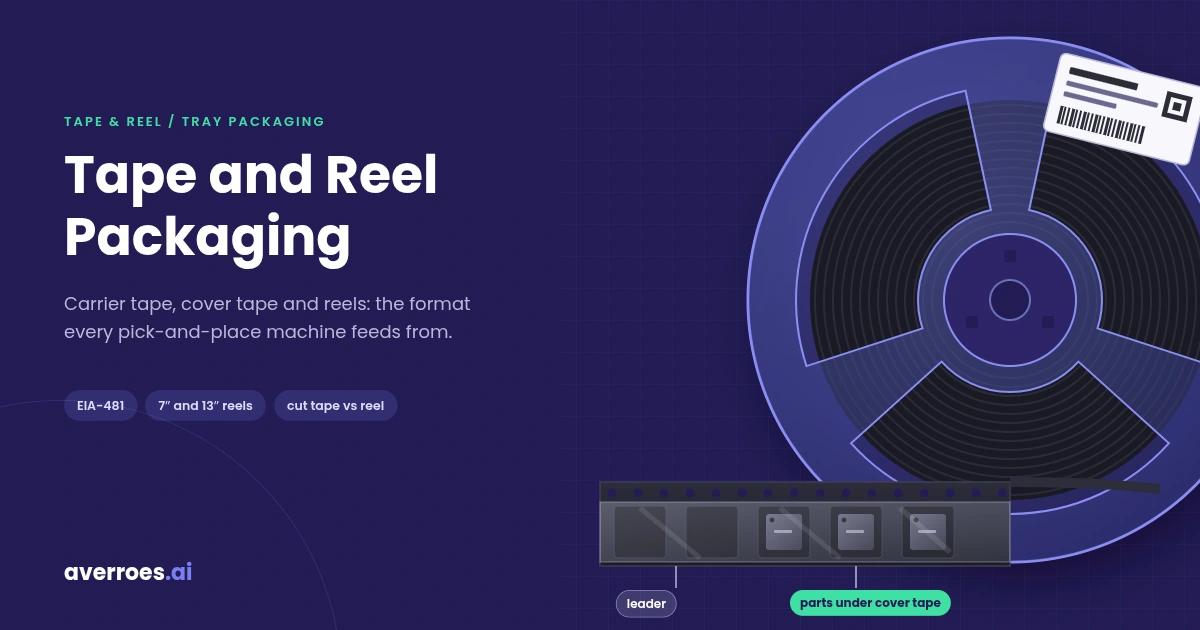
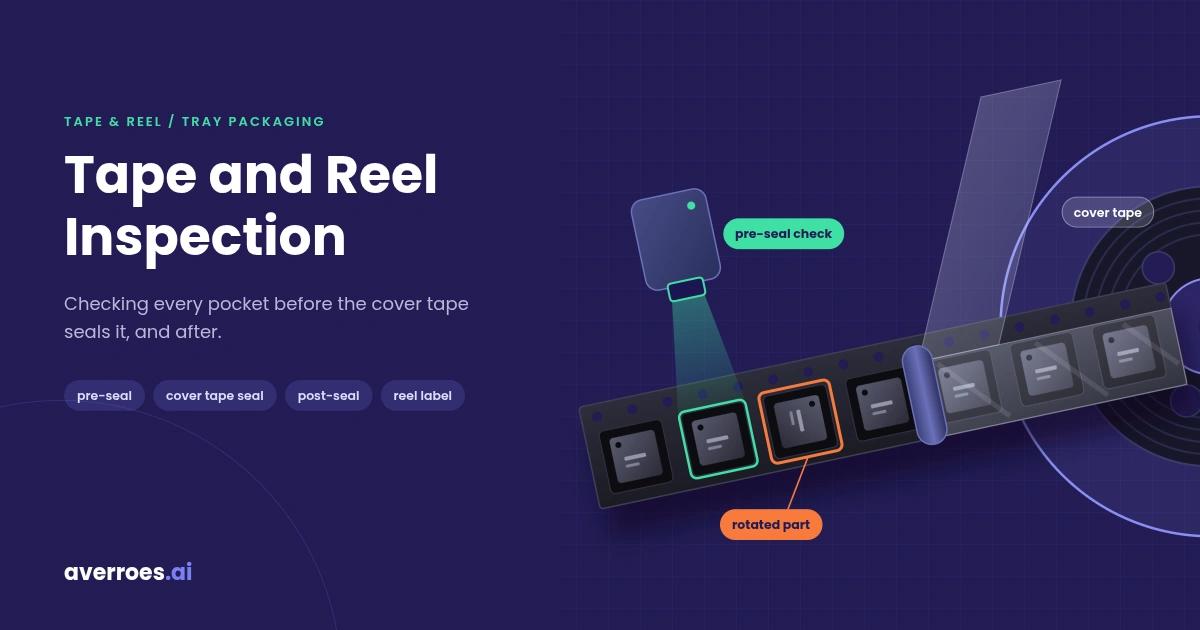
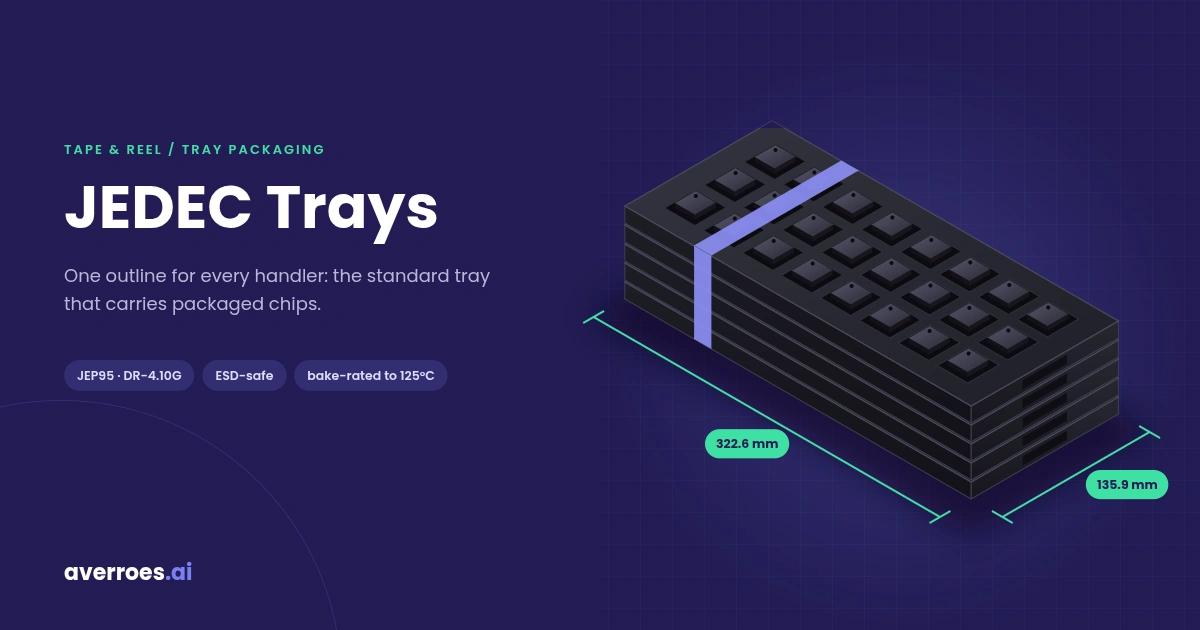



Table of contents7 sections
ape and reel packaging is the standard way to ship surface mount components for automated assembly. Each part sits in a pocket of a carrier tape, a cover tape is sealed over the pockets, and the tape is wound onto a reel, usually 7 or 13 inches across. Pick-and-place machines feed straight from the reel. Dimensions follow EIA-481 and IEC 60286-3, which fix tape widths, sprocket holes, pocket pitch and reel sizes.
Tape and reel is the last packing step in the semiconductor manufacturing process before chips ship. This guide from Averroes.ai, an AI visual inspection platform for manufacturers, explains each part of the package, the numbers that define it, the standards behind it and how it compares with cut tape, trays and tubes.
Key Notes
What Is Tape and Reel Packaging?
Tape and reel packaging is a component packaging format in which parts sit in pockets of a carrier tape sealed by a cover tape and wound onto a reel, used to feed pick-and-place machines without handling individual parts. It is the default format for surface mount components, from resistors and capacitors to integrated circuits.
A finished reel has five parts:
DigiKey’s guide to taped packaging names three reasons the format exists. Parts can be fed straight into a pick-and-place machine. They are protected during shipping, handling and storage. And they stay in a fixed orientation, so every part reaches the board the same way round. The guide also notes that even the winding direction is standardized, with the tape wound clockwise.
Taping machines fill the pockets, seal the cover tape and wind the reel, within the tape and reel and tray packaging stage. How parts are checked on the way is covered in tape and reel inspection.
What Is Carrier Tape?
Carrier tape is the strip of pockets that holds each component in tape and reel packaging, used to keep parts separated, oriented and indexed for automatic feeding. It comes in several types, chosen by the size and sensitivity of the part.
Carrier tape types compared
DigiKey describes the two everyday kinds: cardboard-like paper tape, and black embossed plastic tape for parts sensitive to static. Embossed tape has pockets formed into the plastic, so it can hold taller parts. A chip supplier’s datasheet (RF Monolithics) describes its carrier tape as polystyrene or polycarbonate with a carbon anti-static treatment.
Common tape widths are 4, 8, 12, 16 and 24 mm, according to DigiKey, and EIA-481’s embossed tapes run up to 200 mm for large parts.
What Are Sprocket Holes and Pocket Pitch?
Sprocket holes are the evenly spaced holes along the edge of carrier tape, used by the feeder’s sprocket wheel to advance the tape one pocket at a time. Pocket pitch is the distance from one pocket to the next.
The sprocket pattern is shared across suppliers. TDK’s taping document, written to IEC 60286-3, gives sprocket holes 1.5 mm in diameter at a 4.0 mm pitch, with their centres 1.75 mm from the tape edge. Because the drive holes never change, any compliant feeder can drive any compliant tape, whatever part it carries.
Pocket pitch does change with the part. DigiKey lists common pocket pitches of 2, 4, 8 and 12 mm. Each pocket is sized to its part by three dimensions, A0 (width), B0 (length) and K0 (depth), and the pocket is kept just loose enough to release the part. TDK’s specification, for example, limits a part’s rotation in its pocket to 20 degrees.
The drawing shows which dimensions are fixed and which change: the sprocket pattern stays the same on every tape, while the pocket size and pitch are set by the part.
What Is Cover Tape, and How Strong Should the Seal Be?
Cover tape is the film sealed over carrier tape pockets, used to hold components in place until the assembly machine peels it back. It is usually a thin, anti-static polyester film. It is attached in one of two ways:
What matters most is how hard the cover tape is to peel off. Component makers state the same window. KEMET gives a peel force of 0.1 to 1.0 N for 8 mm tape and 0.1 to 1.3 N for 12 mm tape, measured with the cover tape pulled back at 165 to 180 degrees and 300 ± 10 mm per minute. TDK states the same limits. A Texas Instruments note from July 2025 confirms that a peel force of 0.1 to 1.3 N at 300 mm per minute complies with the EIA standard.
The window has a floor and a ceiling for a reason. A seal that is too weak lets parts fall out; a seal that is too strong makes the tape jerk as it peels, which can throw parts out of their pockets at the feeder. How the seal itself is inspected is covered in tape and reel inspection.
The diagram shows the peel window: the force has to stay inside it for the whole length of the reel, or parts either escape or jump.
What Reel Sizes Are Used for Components?
Component reels are the plastic spools that carry taped parts, used in a few standard diameters so they fit assembly-line feeders. DigiKey notes that 7-inch reels are common for many small surface mount parts, and 13-inch reels for large components or large production quantities. In millimeters these are about 180 mm and 330 mm, as TDK and KEMET list them. Reels larger than 360 mm are covered by a separate standard, EIA-784.
The same part often comes on both sizes, in different quantities. As an example from one supplier’s SOT-23 packing document, a 7-inch reel holds 3,000 parts and a 13-inch reel 10,000. KEMET lists 2,500 and 10,000 for its smaller capacitor cases. Quantities always depend on the part, the tape width and the pocket pitch.
Two more details complete the reel:
A published edition of EIA-481 also warns that a heavy reel may not work on all feeders, and may exceed weight limits for lifting by workers.
What Does EIA-481 Cover?
EIA-481 is the ECIA standard for taping surface mount components, used so that tape, reels and feeders from different makers work together. Its full title is “8 mm Through 200 mm Embossed Carrier Taping and 8 mm & 12 mm Punched Carrier Taping of Surface Mount Components for Automatic Handling”.
The standard has a long history. GlobalSpec’s document history shows the first edition in February 1986, titled “Taping of Surface Mount Components for Automatic Handling”, with later editions in 1990, 2003, 2008, January 2015 and August 2021. ECIA’s list of component handling standards gives EIA-481-E as published in January 2015, and Analog Devices’ packaging tables cite EIA-481-F.
The contents of a published edition show what EIA-481 fixes:
Tape and reel standards compared
The same ECIA family includes EIA-948 and EIA-960-B for component trays, the other main way to ship parts, covered in JEDEC trays. EIA-481 itself is sold by ECIA and its distributors.
What Is the Difference Between Tape and Reel and Cut Tape?
Cut tape is a length of carrier tape cut from a full reel, used to sell smaller quantities of a part that normally ships on tape and reel. It is the same tape, sealed the same way, without the reel.
DigiKey explains the process: its staff remove the leader, count out the requested quantity and cut the tape. That works for engineers and small buyers who need a few hundred parts instead of thousands. The catch is the leader. A short strip of cut tape has no empty tape to thread into a feeder, so it may not run on a pick-and-place machine. Distributors offer re-reeled options that splice a new leader and trailer onto cut tape, so it can feed like a full reel.
Tape and reel vs cut tape vs tray vs tube
Trays carry larger packages and can be baked with the parts in them, which tape and reel cannot. Both are compared in JEDEC trays.
The grid shows the trade-off: tape and reel feeds production lines directly, while cut tape gives small quantities at the cost of a missing leader.
Tape and reel only works if every pocket is right. An empty pocket, a rotated part, a weak seal or a warped reel flange turns into a fault on the board, because the machine places each part exactly as it arrives. Those checks are covered in tape and reel inspection, and catching them at tape speed is the role of AI defect detection. Averroes.ai is an AI visual inspection platform that runs as software on the cameras and inspection systems a site already owns. It trains models from 20 to 40 labeled images per defect class, with no code, and deploys on premise.
Pocket by Pocket, Reel by Reel
Test AI defect detection on your own tape and reel images
Frequently Asked Questions
What is tape and reel?
Tape and reel is a packaging format for surface mount components. Each part sits in a pocket of a carrier tape, a cover tape is sealed over the pockets, and the tape is wound onto a reel. Pick-and-place machines feed parts straight from the reel during board assembly, so no one has to handle individual parts.
What are standard reel sizes for components?
The standard reel sizes for components are 7 inches (about 180 mm) and 13 inches (about 330 mm). Seven-inch reels suit many small surface mount parts, and 13-inch reels suit larger parts or larger production quantities. Reels larger than 360 mm exist for wide tapes and are covered by EIA-784.
What is the difference between cut tape and tape and reel?
Tape and reel is a full reel of sealed carrier tape with a leader and trailer, ready to load into a feeder. Cut tape is a shorter length cut from that reel to sell smaller quantities. Without a leader, a cut strip may not feed a pick-and-place machine unless a new leader is spliced on.
What is EIA-481?
EIA-481 is the ECIA standard for taping surface mount components for automatic handling. It sets carrier tape dimensions from 8 to 200 mm, sprocket and pocket spacing, how much a part may move in its pocket, leader and trailer lengths, and reel dimensions. First published in 1986, it was last revised in August 2021.
What is carrier tape made of?
Carrier tape is usually made of plastic, such as polystyrene or polycarbonate, carbon-filled so it dissipates static, or of cardboard-like paper for small passive parts. Plastic tape is embossed, with pockets formed into it, so it can hold taller parts such as integrated circuits. Paper tape has punched pockets and suits flat parts.
What is cover tape peel strength?
Cover tape peel strength is the force needed to pull the cover tape off the carrier tape. Component makers specify 0.1 to 1.0 N for 8 mm tape and 0.1 to 1.3 N for 12 mm and wider tape, measured at a 165 to 180 degree angle and 300 mm per minute.