Crack inspection is rarely clear-cut. A faint line might be nothing, or it might be the start of a failure path.
Visual inspection catches some issues quickly, surface testing reveals others, and ultrasonic methods answer questions neither can settle alone.
The challenge is knowing what each method can and cannot tell you, and how to combine them without slowing inspections or multiplying false calls.
We’ll explain how crack detection and inspection work in practice, how methods complement each other, and how teams build inspection workflows they can trust.
Key Notes
Crack inspection relies on combining visual, surface, and ultrasonic methods, not a single test.
Tight cracks and unfavorable orientation are the main causes of missed or weak indications.
False positives most often come from scratches, shadows, machining marks, and surface texture.
What Counts As A Crack In Inspection?
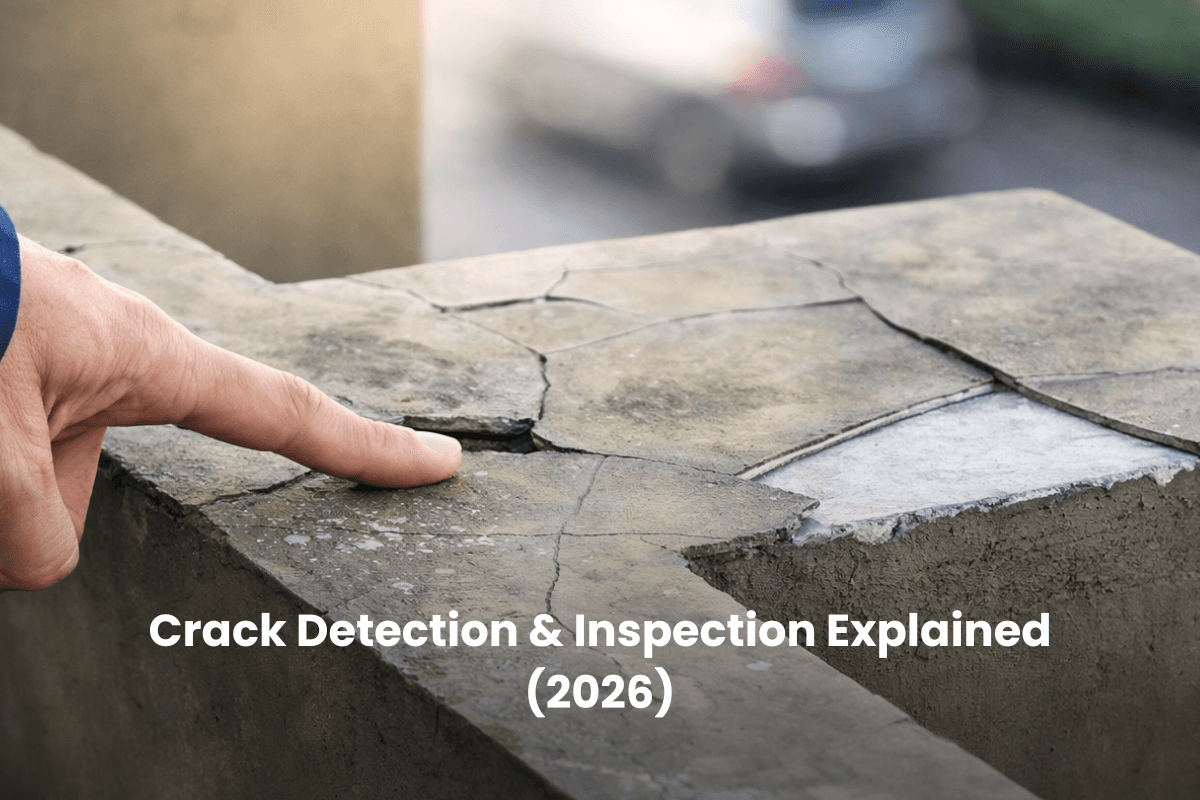
In inspection, a crack is a discontinuity where the material has separated or is opening along a line or plane, even if the opening is extremely small.
The practical giveaway is a sharp, crack-like geometry that behaves like a fracture and can propagate under load. This is why crack indications are often treated as higher severity than other defects. The crack tip concentrates stress and can grow with service loading.
Working Rule For Inspection & Labeling:
Call it a crack when there is actual or incipient separation with a sharp tip.
Treat scratches, pores, inclusions, and corrosion pits as separate classes unless they have evolved into a crack-like discontinuity.
Crack-Like vs Not A Crack: The Mislabels That Break Crack Inspection
Most crack inspection effort is not spent on obvious cracks. It is spent on borderline indications and look-alikes.
Practical Ways To Separate Crack-Like From Look-Alike
Clean, then re-check. If it wipes away, it is not a crack.
Re-light from two directions. Shadows change, cracks do not.
Use low magnification first (5 to 10x). True cracks show an opening path, not just discoloration.
Compare to known geometry. Parting lines and bead ripples are usually regular and repeatable.
What Makes Crack Detection Hard?
Crack detection is tricky because cracks are thin, irregular, and extremely sensitive to conditions.
Three realities drive most misses and false calls:
Tight cracks can be invisible in normal lighting and at normal viewing distances
Surface texture competes with crack edges, especially on rough castings or machined finishes
Orientation matters: cracks aligned unfavorably relative to the sensing method can look weak or disappear
Crack inspection is therefore a workflow problem, not a single-tool problem.
Visual Crack Inspection (VT): How To Run It Well
Visual inspection is the first tier in most industrial crack inspection programs. When done correctly, it clears the majority of parts quickly and flags high-risk zones for targeted NDT.
Core VT Setup
Surface prep: Remove oil, scale, paint, rust, and debris. Roughness and coatings hide tight openings.
Lighting: Use strong, controlled illumination and inspect at a grazing angle. Grazing light creates shadow contrast inside small discontinuities.
Aids: Mirrors, flashlights, 5 to 10x magnifiers, and borescopes for access.
What VT Routinely Misses
Tight cracks with very small crack opening displacement
Subsurface cracks
Cracks masked by roughness, glare, or coatings
Detection Reality Check:
Under good conditions, unaided vision typically resolves features around 0.1 to 0.2 mm at normal distances. Magnification and proper lighting extend capability, but VT still has a ceiling.
Surface Crack Detection Methods: PT & MT
When VT is not enough, and the risk profile is high, surface crack detection methods come next.
Penetrant Testing (PT)
PT uses a dye that wicks into surface-breaking discontinuities by capillary action, then a developer draws it back out to make the indication visible.
PT is useful when:
You need better sensitivity to tight surface cracks than VT
The material is non-magnetic (aluminum, stainless)
You have good access and can control surface preparation
Magnetic Particle Testing (MT)
MT magnetizes a ferromagnetic part and uses magnetic particles that gather where flux leakage occurs at discontinuities.
MT is useful when:
The part is ferromagnetic
You need sensitivity to tight fatigue cracks
You want some near-surface capability, not only open surface cracks
A Practical Tip:
PT and MT are not replacements for VT. They are escalation steps used to confirm and reveal indications on high-risk zones.
Ultrasonic Crack Detection Explained
Ultrasonic crack detection is a core method for internal cracks and for sizing depth, where surface methods cannot help.
At a high level, ultrasonic testing for crack detection sends high-frequency sound waves into the part and looks for reflections and diffracted energy caused by discontinuities.
How Can Ultrasound Check For Cracks In Metal?
Cracks in metal behave like an interface with a strong impedance mismatch, so they reflect and scatter ultrasound.
In pulse-echo UT:
A transducer emits a pulse
Reflections return from boundaries and discontinuities
The system uses time-of-flight and amplitude to infer location and severity
A common depth relationship is: d = (v × t) / 2 Where v is sound velocity in the material and t is the round-trip travel time.
The Detail That Matters: Orientation
Cracks that present a reflective face back to the transducer produce strong signals. Cracks aligned parallel to the beam can produce weak or near-zero reflections.
This is why modern ultrasonic crack detection often uses:
Angle beam UT to interrogate likely crack planes
Phased array UT (PAUT) to steer and focus beams
TOFD to pick up diffracted signals at crack tips for sizing
If you are troubleshooting “UT did not find the crack,” orientation and setup are often the first place to look.
Other NDT Crack Testing Options
Depending on material, access, and crack type, additional methods are common.
Eddy current testing (ECT): Strong for near-surface cracks in conductive materials; useful on fasteners, aircraft skins, and tubing.
Radiographic testing (RT): Images volumetric differences; planar cracks can be challenging if aligned unfavorably to the beam.
Thermography and acoustic approaches: Used in some large structures and composites, often as screening.
No method is universal. The best crack inspection programs choose methods based on crack location, orientation, and the decision that needs to be made.
Selecting the Right Method
Use this table as a practical selection guide for crack inspection planning:
Typical Crack Inspection Workflows in Industry
Crack inspection is usually tiered. That is how you get both coverage and throughput.
A common workflow:
Prep: Clean, isolate, identify high-risk zones
VT: Clear obvious rejects and flag suspect zones
PT or MT: Reveal and confirm tight surface indications
UT or RT: Determine depth, orientation, and extent where needed
Disposition: Repair, re-inspect, document
Examples:
Welds: VT → MT → PAUT or TOFD
Castings: VT → PT → RT or UT
Pipelines: VT → MT → UT
Human vs Camera-Based Crack Detection
Manual inspection can be fast and adaptable, but it is also variable. Camera-based crack detection is repeatable and scalable.
A practical way to use cameras – let imaging do the high-volume screening, then use NDT methods to confirm and size where needed.
How Machine Vision & AI Detect Cracks
Machine vision crack detection typically looks for:
Edges and gradients: Cracks create sharp intensity changes
Geometry: Long, thin, connected paths with high aspect ratio
Topology: Branching, continuity, and crack-like patterns
Deep learning models learn these cues at multiple levels. Early layers pick up edges and texture. Deeper layers learn crack-like structure.
The Conditions That Make Or Break Crack Detection
Lighting variation (shadows or washout)
Reflections on shiny surfaces
Rough textures that create competing edges
In practice, better results come from controlling imaging conditions first: stable lighting, consistent distance, and reduced glare. Models then become far more reliable.
Crack Inspection Frequency & Monitoring
Inspection frequency depends on risk, loading, environment, and consequence of failure.
If a component can fail suddenly with a crack, inspection planning should move from occasional checks to a monitored program.
Acceptance Criteria & Standards: How Crack Calls Become Decisions
In many standards and critical applications, cracks are treated as rejectable regardless of size.
Common themes across major codes:
Cracks are unacceptable in many weld and pressure applications
Linear indications are often treated as cracks unless proven otherwise
Rounded indications typically have size and distribution allowances
This is why crack inspection success starts upstream with classification discipline. Calling everything a crack creates chaos. Missing cracks creates risk. The goal is a workflow that screens efficiently and confirms intelligently.
Are Cracks Escaping Your Inspection Process?
Achieve consistent detection with 99% accuracy on existing equipment.
Frequently Asked Questions
How early can crack inspection realistically catch a crack before failure?
That depends on loading, material, and inspection method. Tight fatigue cracks can exist for long periods before becoming detectable, which is why inspection frequency and method selection matter more than any single test.
Can crack inspection results be reliably compared across inspections or inspectors?
Manual inspection results often vary due to lighting, angle, and human judgment. Consistency improves when inspection conditions are standardized or when camera-based systems are used for repeatable detection.
Why do some cracks only appear under load or after service time?
Some cracks remain closed at rest and only open under tensile stress or thermal expansion. This makes unloaded inspection harder and explains why cracks sometimes appear “suddenly” after time in service.
Is it possible to over-inspect for cracks?
Yes. Excessive inspection without risk-based planning increases false positives, rework, and downtime. Effective crack inspection balances detection sensitivity with defect criticality and service conditions.
Conclusion
Crack inspection is rarely a single moment where something is clearly right or wrong. It is a chain of decisions – lighting, surface condition, orientation, inspector judgment, and method selection all influence whether a crack is found, missed, or misclassified.
Visual inspection moves fast but has limits. Surface NDT improves sensitivity but adds time. Ultrasonic testing answers depth and orientation questions, but only when setup and interpretation are right. When those pieces drift out of alignment, false calls increase and real cracks get harder to trust.
Averroes adds a consistent AI inspection layer on top of existing inspection equipment, using image-based detection and segmentation to flag crack-like defects, separate look-alikes, and standardize review across parts and shifts.
If you want to see how crack inspection can stay consistent without changing hardware or adding manual checks, book a free demo to see it in action.




![Inspection Methods Explained [Manual, Remote & Visual]](/_next/image?url=https%3A%2F%2F303922.eu15.myftpupload.com%2Fwp-content%2Fuploads%2F2026%2F07%2FAverroes.ai-Blog-Covers-JA-4.jpg&w=3840&q=75)




Crack inspection is rarely clear-cut. A faint line might be nothing, or it might be the start of a failure path.
Visual inspection catches some issues quickly, surface testing reveals others, and ultrasonic methods answer questions neither can settle alone.
The challenge is knowing what each method can and cannot tell you, and how to combine them without slowing inspections or multiplying false calls.
We’ll explain how crack detection and inspection work in practice, how methods complement each other, and how teams build inspection workflows they can trust.
Key Notes
What Counts As A Crack In Inspection?
In inspection, a crack is a discontinuity where the material has separated or is opening along a line or plane, even if the opening is extremely small.
The practical giveaway is a sharp, crack-like geometry that behaves like a fracture and can propagate under load. This is why crack indications are often treated as higher severity than other defects. The crack tip concentrates stress and can grow with service loading.
Working Rule For Inspection & Labeling:
Crack-Like vs Not A Crack: The Mislabels That Break Crack Inspection
Most crack inspection effort is not spent on obvious cracks. It is spent on borderline indications and look-alikes.
Practical Ways To Separate Crack-Like From Look-Alike
What Makes Crack Detection Hard?
Crack detection is tricky because cracks are thin, irregular, and extremely sensitive to conditions.
Three realities drive most misses and false calls:
Crack inspection is therefore a workflow problem, not a single-tool problem.
Visual Crack Inspection (VT): How To Run It Well
Visual inspection is the first tier in most industrial crack inspection programs. When done correctly, it clears the majority of parts quickly and flags high-risk zones for targeted NDT.
Core VT Setup
What VT Routinely Misses
Detection Reality Check:
Under good conditions, unaided vision typically resolves features around 0.1 to 0.2 mm at normal distances. Magnification and proper lighting extend capability, but VT still has a ceiling.
Surface Crack Detection Methods: PT & MT
When VT is not enough, and the risk profile is high, surface crack detection methods come next.
Penetrant Testing (PT)
PT uses a dye that wicks into surface-breaking discontinuities by capillary action, then a developer draws it back out to make the indication visible.
PT is useful when:
Magnetic Particle Testing (MT)
MT magnetizes a ferromagnetic part and uses magnetic particles that gather where flux leakage occurs at discontinuities.
MT is useful when:
A Practical Tip:
PT and MT are not replacements for VT. They are escalation steps used to confirm and reveal indications on high-risk zones.
Ultrasonic Crack Detection Explained
Ultrasonic crack detection is a core method for internal cracks and for sizing depth, where surface methods cannot help.
At a high level, ultrasonic testing for crack detection sends high-frequency sound waves into the part and looks for reflections and diffracted energy caused by discontinuities.
How Can Ultrasound Check For Cracks In Metal?
Cracks in metal behave like an interface with a strong impedance mismatch, so they reflect and scatter ultrasound.
In pulse-echo UT:
A common depth relationship is: d = (v × t) / 2
Where v is sound velocity in the material and t is the round-trip travel time.
The Detail That Matters: Orientation
Cracks that present a reflective face back to the transducer produce strong signals. Cracks aligned parallel to the beam can produce weak or near-zero reflections.
This is why modern ultrasonic crack detection often uses:
If you are troubleshooting “UT did not find the crack,” orientation and setup are often the first place to look.
Other NDT Crack Testing Options
Depending on material, access, and crack type, additional methods are common.
No method is universal. The best crack inspection programs choose methods based on crack location, orientation, and the decision that needs to be made.
Selecting the Right Method
Use this table as a practical selection guide for crack inspection planning:
Typical Crack Inspection Workflows in Industry
Crack inspection is usually tiered. That is how you get both coverage and throughput.
A common workflow:
Examples:
Human vs Camera-Based Crack Detection
Manual inspection can be fast and adaptable, but it is also variable. Camera-based crack detection is repeatable and scalable.
A practical way to use cameras – let imaging do the high-volume screening, then use NDT methods to confirm and size where needed.
How Machine Vision & AI Detect Cracks
Machine vision crack detection typically looks for:
Deep learning models learn these cues at multiple levels. Early layers pick up edges and texture. Deeper layers learn crack-like structure.
The Conditions That Make Or Break Crack Detection
In practice, better results come from controlling imaging conditions first: stable lighting, consistent distance, and reduced glare. Models then become far more reliable.
Crack Inspection Frequency & Monitoring
Inspection frequency depends on risk, loading, environment, and consequence of failure.
If a component can fail suddenly with a crack, inspection planning should move from occasional checks to a monitored program.
Acceptance Criteria & Standards: How Crack Calls Become Decisions
In many standards and critical applications, cracks are treated as rejectable regardless of size.
Common themes across major codes:
This is why crack inspection success starts upstream with classification discipline. Calling everything a crack creates chaos. Missing cracks creates risk. The goal is a workflow that screens efficiently and confirms intelligently.
Are Cracks Escaping Your Inspection Process?
Achieve consistent detection with 99% accuracy on existing equipment.
Frequently Asked Questions
How early can crack inspection realistically catch a crack before failure?
That depends on loading, material, and inspection method. Tight fatigue cracks can exist for long periods before becoming detectable, which is why inspection frequency and method selection matter more than any single test.
Can crack inspection results be reliably compared across inspections or inspectors?
Manual inspection results often vary due to lighting, angle, and human judgment. Consistency improves when inspection conditions are standardized or when camera-based systems are used for repeatable detection.
Why do some cracks only appear under load or after service time?
Some cracks remain closed at rest and only open under tensile stress or thermal expansion. This makes unloaded inspection harder and explains why cracks sometimes appear “suddenly” after time in service.
Is it possible to over-inspect for cracks?
Yes. Excessive inspection without risk-based planning increases false positives, rework, and downtime. Effective crack inspection balances detection sensitivity with defect criticality and service conditions.
Conclusion
Crack inspection is rarely a single moment where something is clearly right or wrong. It is a chain of decisions – lighting, surface condition, orientation, inspector judgment, and method selection all influence whether a crack is found, missed, or misclassified.
Visual inspection moves fast but has limits. Surface NDT improves sensitivity but adds time. Ultrasonic testing answers depth and orientation questions, but only when setup and interpretation are right. When those pieces drift out of alignment, false calls increase and real cracks get harder to trust.
Averroes adds a consistent AI inspection layer on top of existing inspection equipment, using image-based detection and segmentation to flag crack-like defects, separate look-alikes, and standardize review across parts and shifts.
If you want to see how crack inspection can stay consistent without changing hardware or adding manual checks, book a free demo to see it in action.