7 Best Inline Inspection Companies (2026 Comparison)
Averroes
Jun 17, 2026
Shortlisting inline inspection companies by reputation is a decent starting point and a terrible finishing line.
The biggest names are built for large transmission systems – put them on a small-bore gathering network or a non-piggable offshore line and you’re paying for capability that doesn’t fit your problem.
We’ll cut through seven vendors, what they’re good at, where they fall short, and how to match technology to threat before you commit to a run.
Best for: AI-powered visual defect detection and automated inspection analytics for imaging-based pipeline, subsea, and industrial programs
We built Averroes as a no-code AI visual inspection platform – and while we’re not a traditional ILI pig vendor, we belong in this conversation.
For operators running ROV surveys, topside camera inspections, or subsea visual assessments, the data bottleneck isn’t capturing footage. It’s analyzing it accurately, at speed, without a team of analysts manually reviewing every frame.
Our platform sits as a software layer on top of your existing cameras and inspection hardware – no new equipment required. It’s been deployed across semiconductor, electronics, oil & gas, and solar inspection programs, and it’s particularly strong where imaging-based defect review is slow, inconsistent, or resource-heavy.
Key Services & Capabilities:
Defect Detection & Classification: 99%+ detection accuracy, near-zero false positives, trained on as few as 20–40 images per defect class.
Defect Segmentation: Precise masks and region boundaries for detailed anomaly characterization.
WatchDog (Anomaly Detection): Flags novel defects outside your configured classes – the ones rule-based tools miss entirely.
Virtual Metrology & APC: Model-driven quality signals without new instrumentation; feeds into MES/SCADA.
Active Learning: Models continuously improve from new field data without full retraining.
Real-Time Dashboards & Alerts: Defect trend monitoring with configurable thresholds and alert logic.
Deployment: On-premise, air-gapped, or cloud – your security posture, not ours.
Pros:
Works with existing cameras, ROVs, and AOI hardware – no capex required.
Model training takes hours & ~20–40 images per class to hit production-ready accuracy.
Handles imaging data types that traditional ILI platforms don’t touch.
Strong fit for subsea and external pipeline inspection where visual review is the bottleneck.
Cons:
Not an ILI hardware vendor – no smart pig fleet for internal corrosion or crack detection.
Best for: Full-spectrum pipeline ILI across the widest range of threats, line configurations, and global geographies
ROSEN is the vendor that comes up most consistently when integrity engineers compare notes.
As a privately owned specialist with 40+ years in the field, they’ve built one of the broadest ILI technology portfolios available, covering almost every threat type across upstream, midstream, and downstream assets. More than a million miles of pipeline inspected annually, across 110+ countries, gives them a depth of operational experience that’s hard to match.
What sets them apart from the other large players is the combination of in-house R&D and modular tool architecture. They design and manufacture their own sensors across MFL, UT, EMAT, and eddy current technologies – which means more control over customization than vendors who rely on third-party components.
Key Services & Capabilities:
High-Resolution MFL: Metal loss and pitting detection across a wide diameter range.
Best for: Large-scale transmission operators needing multi-technology ILI combined with digital PIMS integration and post-run integrity engineering
Baker Hughes Process & Pipeline Services is one of the legacy heavyweights in ILI – recognized as a pioneer in high-resolution MFL and ultrasonic technologies, with a global footprint that suits operators running complex, multi-region integrity programs.
Their combination tools (notably the GEMINI and CPIG platforms) reduce the need for multiple separate runs, which matters when operational disruption is the constraint.
The digital layer is mature here. Their InspectionWorks platform centralizes multi-source inspection data, supports AI-assisted defect recognition, and connects to their PVi PIMS for enterprise-level integrity management.
That said, smaller operators may find the full package is considerably more than they need.
Key Services & Capabilities:
VECTRA & VECTRA HD MFL: High-resolution metal loss detection with tight triaxial sensor spacing.
TranScan / UltraScan / EMATScan: Axial flaw, crack, and seam weld inspection via UT and EMAT.
GEMINI & CPIG Combination Tools: MFL + caliper + IMU in a single run with active speed control.
AXISS Strain Tools: Bending and axial strain quantification for geohazard-affected lines.
CalScan / GEOPIG: High-resolution geometry and mapping with integrated IMU.
Best for: Mechanical damage characterization, seam-related anomalies, and operators who want cleaning, ILI, and intervention under one vendor
TDW’s identity is pipelines, specifically – 100+ years of it.
Their MDS (Multiple Data Set) ILI platform is the standout differentiator: a single run that integrates geometry, axial MFL, SpirALL MFL, low-field MFL, and XYZ mapping into one dataset. That multi-layer approach is particularly valuable on aging pipelines where complex mechanical damage and seam-related threats are the primary concern.
The SpirALL MFL technology is worth calling out specifically – it’s designed to detect narrow, crack-like anomalies and preferential seam corrosion that standard axial MFL will miss.
For pipelines where seam integrity is a known risk, that’s not a minor detail.
Key Services & Capabilities:
MDS Pro / MDS Flex: Multi-dataset ILI combining geometry, multiple MFL modes, and XYZ mapping.
SpirALL MFL (SMFL): Patented detection for seam-oriented anomalies and crack-like features.
Mechanical Damage Characterization: Wrinkle dents, hard spots, dents with metal loss, gouges.
Interactive Report Software: Included with ILI runs; charts, dig sheet export, anomaly navigation.
Pigging & Cleaning: Assurance-based cleaning campaigns integrated with ILI planning.
Hot Tapping & Line Isolation: Intervention and repair services alongside inspection programs.
In-Situ NDE: Validation and verification of anomalies found during ILI.
Best for: Midstream and gathering operators, and multi-asset owners wanting ILI, NDT, and digital integrity management from a single vendor
MISTRAS – including their Onstream ILI subsidiary – occupies a practical middle ground that the “big three” ILI specialists don’t always serve well.
Their focus on small- to mid-bore gathering and midstream pipelines, combined with a broad advanced NDT portfolio, makes them the pragmatic choice for North American operators who need real inspection capability without the complexity of a full-scale global ILI program.
The MISTRAS Data Solutions brand (launched 2025) signals a deliberate push toward digital: cloud-based integrity software, digital twins, risk modelling, and real-time condition monitoring. It’s a platform that suits operators moving toward predictive maintenance rather than interval-based inspection.
Key Services & Capabilities:
TriStream MFL & Onstream ILI: Small- to mid-bore metal loss and deformation inspection.
Advanced NDT (DR, AUT, ART): Digital radiography, automated UT, and advanced RT for piping and facilities.
Guided Wave Testing: Screening corrosion and defects in pipelines with limited external access.
MISTRAS Data Solutions: Cloud integrity software, digital twins, risk modelling, and IoT monitoring.
Acoustic Emission (AE) Services: Online monitoring of critical assets and structural integrity.
Pipeline Integrity Software: ILI data management, mapping, and reporting.
Pros:
Strong fit for gathering systems and midstream pipelines where large-diameter specialists are over-engineered.
Single vendor for pipeline ILI, plant piping inspection, structural monitoring, and QA/QC.
Growing digital platform with real-time monitoring and predictive maintenance capability.
Best for: Non-piggable, offshore, and district heating pipelines where conventional ILI tools simply can’t run
Applus+ is the vendor to know when your pipeline geometry makes standard pigs a non-starter.
Their DTI Trekscan free-swimming UT tool is engineered for exactly the conditions that rule out conventional ILI: tight-radius bends, constrained offshore lines, minimal straight runs. It provides high-resolution pulse-echo wall-thickness measurements in pipelines that have no business hosting a standard inspection pig.
Beyond niche tooling, Applus+ brings 85+ years of NDT experience and a strong digital stack – digital twins, AR/VR visualization, GIS dashboards – which positions them well for utilities and mixed-asset operators who need more than just a tool run.
Key Services & Capabilities:
DTI Trekscan: Free-swimming UT ILI for non-piggable and highly constrained pipelines.
PIT Crawler: Self-propelled UT crawler for segments where free-swimming tools aren’t suitable.
Advanced NDT (TOFD, PAUT, Rayscan): High-accuracy weld and defect inspection.
Pipeline Integrity Assurance (PIA): DA support, ILI validation, code interpretation, class-change programs.
Digital Twins & GIS Dashboards: Asset lifecycle visualization and inspection data management.
AIM Services: Risk management for pipelines, vessels, tanks, and power plant assets.
Pros:
Trekscan and PIT crawler fill a genuine gap that no standard ILI fleet addresses.
Strong NDT and integrity engineering backbone for DA programs and ILI validation.
Multi-sector capability: energy, utilities, water, district heating, and industrial.
Custom tool development capability for unusual inspection challenges.
Cons:
Not a full-fleet, all-diameter standard ILI provider – routine transmission programs may need to look elsewhere.
Less visible in oil & gas ILI procurement shortlists compared to pure-play ILI vendors.
Broader TIC brand identity can obscure the depth of their pipeline-specific capability.
Best for: Independent ILI validation, in-ditch NDE, and standards-aligned pipeline integrity management programs
SGS plays a different role than the other vendors on this list.
Rather than operating a pig fleet, their pipeline integrity division (SGS PfiNDE) specializes in what happens after the ILI run: reviewing findings, performing in-ditch NDE to verify anomalies, and supporting dig programs with accurate sizing and characterization. For thin-walled pipelines in particular, where over- or under-calling anomalies has significant cost and safety implications, that validation capability matters.
Their PIMS and AIM services are aligned with ASME B31.8S and API RP 1160, making them a credible partner for operators who need structured integrity programs alongside inspection, not just tool runs.
Key Services & Capabilities:
SGS PfiNDE In-Ditch NDE: Pipeline-specific NDE for ILI anomaly validation and dig program support.
Guided Wave Testing: Corrosion screening on pipelines with limited external access.
Advanced NDT (TOFD, MFL, ACFM, digital RT): Comprehensive defect detection and characterization.
PIMS & AIM Services: ASME B31.8S / API RP 1160 aligned integrity management programs.
Risk-Based Inspection (RBI): Threat evaluation, direct assessment (ECDA, ICDA, SCCDA).
Remote Visual Inspection: Videoscope and push-rod inspection for piping and heat exchangers.
Pros:
Best-in-class for independent ILI validation and in-ditch anomaly evaluation.
Strong standards alignment (ASME, API) for regulatory defensibility.
Global footprint with cross-sector AIM experience.
100% quality review on all inspection reporting.
Cons:
Not a primary ILI pig fleet provider – operators still need a separate ILI vendor for the tool run.
Less focus on multi-dataset inline tools or combination pig technology.
Picking an inline inspection vendor before defining your threat profile is the most common – and most expensive – mistake in pipeline integrity programs.
Here’s a structured framework to work through before you shortlist anyone:
1. Define Your Threat Profile First
ILI technologies are optimized for specific threats. Vendor selection follows from threat identification – not the other way around.
Threat
Technology Needed
Internal/External Corrosion
High-resolution MFL or UT wall-thickness tools
Cracking & SCC
Specialized UT or EMAT; SpirALL-type MFL for seam issues
Mechanical Damage
Multi-dataset tools combining MFL, geometry, and mapping
Geohazard & Strain
IMU-integrated geometry tools with bending strain measurement
Seam Weld Integrity
Combined UT or EMAT with weld-specific analysis
Best Coverage:
ROSEN and Baker Hughes across all threat types.
TDW where mechanical damage and seam integrity dominate.
MISTRAS for simpler corrosion programs on small-bore lines.
2. Match Technology To Your Line Configuration
A tool that can’t physically run your pipeline produces nothing.
Document these before shortlisting:
Diameter, wall thickness, and bore changes along the run
Minimum bend radius and valve configurations
Launch/receive trap access and limitations
Whether the line is piggable at all
Standard Piggable Lines:
ROSEN, Baker Hughes, TDW, MISTRAS all perform well.
Non-Piggable Or Constrained Lines:
Applus+ with DTI Trekscan is purpose-built for this.
Imaging-Based Subsea Or External Inspection:
Averroes fills the gap pig-based vendors don’t address.
3. Clarify What You Need From The Data
Raw detection and integrity-grade characterized data are different deliverables with different vendor requirements:
Detection only: Anomaly location and rough sizing for screening.
Characterization & sizing: Accurate depth, length, and feature type for fitness-for-service decisions.
Post-run engineering: Corrosion growth modeling, dig prioritization, remaining life assessment.
Independent validation: Third-party in-ditch NDE before committing to a dig program.
ROSEN, Baker Hughes, and TDW deliver strong post-run engineering.
For independent validation specifically, SGS is the right call – they verify what the pig found, rather than running it.
4. Scope The Services You Really Need
Need
Best Fit
Full-stack ILI (hardware + engineering)
ROSEN, Baker Hughes
Mechanical damage + pigging/intervention
T.D. Williamson
Small-bore midstream + integrated NDT
MISTRAS
Non-piggable / constrained pipelines
Applus+
Independent ILI validation
SGS
Imaging-based AI inspection layer
Averroes
5. Evaluate Track Record & Credentials
Technology specs only matter if the vendor can execute in your environment.
Key checks:
API 1163 qualification for ILI systems and personnel
References on comparable assets (same diameter, product, and operating environment)
POD curves and sizing accuracy specs for each tool/threat combination
Post-run analyst qualifications and typical report turnaround times
The lowest-bid pipeline testing companies almost always produce data that costs more to act on than the savings on the run itself.
What If Your Existing Cameras Did More?
99%+ detection accuracy, zero additional equipment required.
Inline Inspection Companies FAQs
What is the difference between inline inspection and NDT?
Inline inspection (ILI) uses instrumented tools – smart pigs – that travel inside a live, pressurized pipeline to detect and size anomalies across the full pipe wall. NDT is performed externally, either above ground or in-ditch, typically to verify specific anomalies already identified by ILI or direct assessment.
How much does pipeline inline inspection cost?
Pipeline inline inspection costs vary significantly by diameter, length, tool technology, and threat type – a basic MFL run on a simple line can run tens of thousands of dollars, while multi-technology combination runs on complex systems reach six figures or more. Post-run engineering, cleaning campaigns, and in-ditch validation add to the total program cost.
How often should pipeline integrity inspections be done?
Pipeline integrity inspection intervals depend on regulatory requirements, threat type, operating conditions, and findings from previous runs – typically ranging from 3 to 10 years under frameworks like ASME B31.8S and API RP 1160. High-consequence areas (HCAs), active corrosion, or crack-growth programs often require shorter reassessment intervals.
What is a smart pig in pipeline inspection?
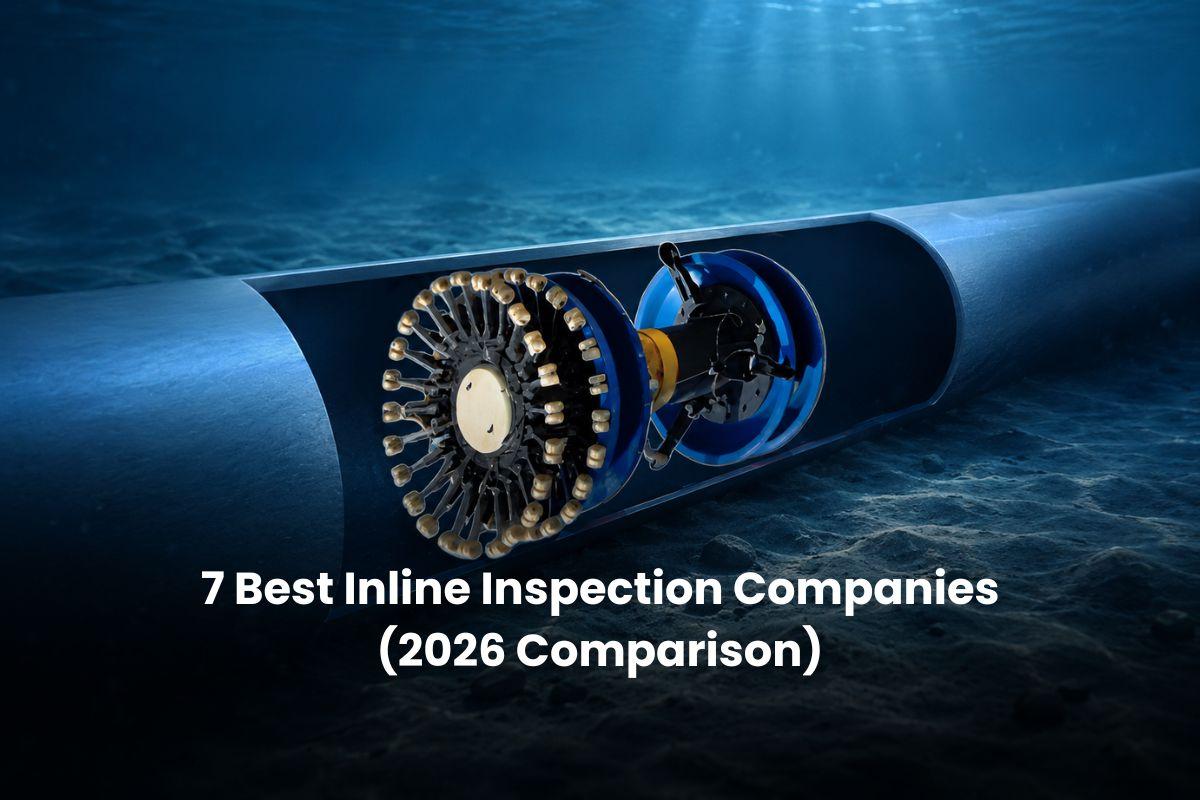
A smart pig is an instrumented inline inspection tool that travels through a pipeline under normal operating pressure, using technologies like MFL, ultrasound, or EMAT to detect, locate, and size anomalies including corrosion, cracks, dents, and weld defects – without taking the line out of service.
Conclusion
The best inline inspection companies on this list serve very different buyers.
ROSEN and Baker Hughes are the right answer for large, complex transmission systems with multi-threat profiles. TDW earns its place where mechanical damage and seam integrity are the primary concern. MISTRAS fits midstream and gathering operators who need ILI and NDT without the overhead of a global program.
Applus+ solves a problem the others can’t: getting data from lines that won’t take a standard pig. SGS validates what everyone else finds. Where imaging-based inspection is the gap – subsea surveys, ROV footage, external visual programs – that’s where Averroes fits.
If your defect review process is slow, inconsistent, or burning analyst hours, book a free demo to see what AI-driven inspection looks like on your existing setup.






Shortlisting inline inspection companies by reputation is a decent starting point and a terrible finishing line.
The biggest names are built for large transmission systems – put them on a small-bore gathering network or a non-piggable offshore line and you’re paying for capability that doesn’t fit your problem.
We’ll cut through seven vendors, what they’re good at, where they fall short, and how to match technology to threat before you commit to a run.
Our Top 3 Picks
Best Full-Stack Pipeline ILI
ROSEN Group
VIEW NOWBest for Midstream, Gathering & Integrated NDT
MISTRAS Group
VIEW NOWBest AI Visual Inspection Layer
Averroes
VIEW NOWThe 7 Best Inline Inspection Companies
1. Averroes
Best for: AI-powered visual defect detection and automated inspection analytics for imaging-based pipeline, subsea, and industrial programs
We built Averroes as a no-code AI visual inspection platform – and while we’re not a traditional ILI pig vendor, we belong in this conversation.
For operators running ROV surveys, topside camera inspections, or subsea visual assessments, the data bottleneck isn’t capturing footage. It’s analyzing it accurately, at speed, without a team of analysts manually reviewing every frame.
Our platform sits as a software layer on top of your existing cameras and inspection hardware – no new equipment required. It’s been deployed across semiconductor, electronics, oil & gas, and solar inspection programs, and it’s particularly strong where imaging-based defect review is slow, inconsistent, or resource-heavy.
Key Services & Capabilities:
Pros:
Cons:
Rating: 4.8/5
View Now
2. ROSEN Group
Best for: Full-spectrum pipeline ILI across the widest range of threats, line configurations, and global geographies
ROSEN is the vendor that comes up most consistently when integrity engineers compare notes.
As a privately owned specialist with 40+ years in the field, they’ve built one of the broadest ILI technology portfolios available, covering almost every threat type across upstream, midstream, and downstream assets. More than a million miles of pipeline inspected annually, across 110+ countries, gives them a depth of operational experience that’s hard to match.
What sets them apart from the other large players is the combination of in-house R&D and modular tool architecture. They design and manufacture their own sensors across MFL, UT, EMAT, and eddy current technologies – which means more control over customization than vendors who rely on third-party components.
Key Services & Capabilities:
Pros:
Cons:
Rating: 4.7/5
View Now
3. Baker Hughes
Best for: Large-scale transmission operators needing multi-technology ILI combined with digital PIMS integration and post-run integrity engineering
Baker Hughes Process & Pipeline Services is one of the legacy heavyweights in ILI – recognized as a pioneer in high-resolution MFL and ultrasonic technologies, with a global footprint that suits operators running complex, multi-region integrity programs.
Their combination tools (notably the GEMINI and CPIG platforms) reduce the need for multiple separate runs, which matters when operational disruption is the constraint.
The digital layer is mature here. Their InspectionWorks platform centralizes multi-source inspection data, supports AI-assisted defect recognition, and connects to their PVi PIMS for enterprise-level integrity management.
That said, smaller operators may find the full package is considerably more than they need.
Key Services & Capabilities:
Pros:
Cons:
Rating: 4.6/5
View Now
4. T.D. Williamson (TDW)
Best for: Mechanical damage characterization, seam-related anomalies, and operators who want cleaning, ILI, and intervention under one vendor
TDW’s identity is pipelines, specifically – 100+ years of it.
Their MDS (Multiple Data Set) ILI platform is the standout differentiator: a single run that integrates geometry, axial MFL, SpirALL MFL, low-field MFL, and XYZ mapping into one dataset. That multi-layer approach is particularly valuable on aging pipelines where complex mechanical damage and seam-related threats are the primary concern.
The SpirALL MFL technology is worth calling out specifically – it’s designed to detect narrow, crack-like anomalies and preferential seam corrosion that standard axial MFL will miss.
For pipelines where seam integrity is a known risk, that’s not a minor detail.
Key Services & Capabilities:
Pros:
Cons:
Rating: 4.5/5
View Now
5. MISTRAS Group
Best for: Midstream and gathering operators, and multi-asset owners wanting ILI, NDT, and digital integrity management from a single vendor
MISTRAS – including their Onstream ILI subsidiary – occupies a practical middle ground that the “big three” ILI specialists don’t always serve well.
Their focus on small- to mid-bore gathering and midstream pipelines, combined with a broad advanced NDT portfolio, makes them the pragmatic choice for North American operators who need real inspection capability without the complexity of a full-scale global ILI program.
The MISTRAS Data Solutions brand (launched 2025) signals a deliberate push toward digital: cloud-based integrity software, digital twins, risk modelling, and real-time condition monitoring. It’s a platform that suits operators moving toward predictive maintenance rather than interval-based inspection.
Key Services & Capabilities:
Pros:
Cons:
Rating: 4.4/5
View Now
6. Applus+
Best for: Non-piggable, offshore, and district heating pipelines where conventional ILI tools simply can’t run
Applus+ is the vendor to know when your pipeline geometry makes standard pigs a non-starter.
Their DTI Trekscan free-swimming UT tool is engineered for exactly the conditions that rule out conventional ILI: tight-radius bends, constrained offshore lines, minimal straight runs. It provides high-resolution pulse-echo wall-thickness measurements in pipelines that have no business hosting a standard inspection pig.
Beyond niche tooling, Applus+ brings 85+ years of NDT experience and a strong digital stack – digital twins, AR/VR visualization, GIS dashboards – which positions them well for utilities and mixed-asset operators who need more than just a tool run.
Key Services & Capabilities:
Pros:
Cons:
Rating: 4.3/5
View Now
7. SGS
Best for: Independent ILI validation, in-ditch NDE, and standards-aligned pipeline integrity management programs
SGS plays a different role than the other vendors on this list.
Rather than operating a pig fleet, their pipeline integrity division (SGS PfiNDE) specializes in what happens after the ILI run: reviewing findings, performing in-ditch NDE to verify anomalies, and supporting dig programs with accurate sizing and characterization. For thin-walled pipelines in particular, where over- or under-calling anomalies has significant cost and safety implications, that validation capability matters.
Their PIMS and AIM services are aligned with ASME B31.8S and API RP 1160, making them a credible partner for operators who need structured integrity programs alongside inspection, not just tool runs.
Key Services & Capabilities:
Pros:
Cons:
Rating: 4.2/5
View Now
Comparison: Best Inline Inspection Companies
How To Choose An Inline Inspection Company
Picking an inline inspection vendor before defining your threat profile is the most common – and most expensive – mistake in pipeline integrity programs.
Here’s a structured framework to work through before you shortlist anyone:
1. Define Your Threat Profile First
ILI technologies are optimized for specific threats. Vendor selection follows from threat identification – not the other way around.
Best Coverage:
2. Match Technology To Your Line Configuration
A tool that can’t physically run your pipeline produces nothing.
Document these before shortlisting:
Standard Piggable Lines:
ROSEN, Baker Hughes, TDW, MISTRAS all perform well.
Non-Piggable Or Constrained Lines:
Applus+ with DTI Trekscan is purpose-built for this.
Imaging-Based Subsea Or External Inspection:
Averroes fills the gap pig-based vendors don’t address.
3. Clarify What You Need From The Data
Raw detection and integrity-grade characterized data are different deliverables with different vendor requirements:
ROSEN, Baker Hughes, and TDW deliver strong post-run engineering.
For independent validation specifically, SGS is the right call – they verify what the pig found, rather than running it.
4. Scope The Services You Really Need
5. Evaluate Track Record & Credentials
Technology specs only matter if the vendor can execute in your environment.
Key checks:
The lowest-bid pipeline testing companies almost always produce data that costs more to act on than the savings on the run itself.
What If Your Existing Cameras Did More?
99%+ detection accuracy, zero additional equipment required.
Inline Inspection Companies FAQs
What is the difference between inline inspection and NDT?
Inline inspection (ILI) uses instrumented tools – smart pigs – that travel inside a live, pressurized pipeline to detect and size anomalies across the full pipe wall. NDT is performed externally, either above ground or in-ditch, typically to verify specific anomalies already identified by ILI or direct assessment.
How much does pipeline inline inspection cost?
Pipeline inline inspection costs vary significantly by diameter, length, tool technology, and threat type – a basic MFL run on a simple line can run tens of thousands of dollars, while multi-technology combination runs on complex systems reach six figures or more. Post-run engineering, cleaning campaigns, and in-ditch validation add to the total program cost.
How often should pipeline integrity inspections be done?
Pipeline integrity inspection intervals depend on regulatory requirements, threat type, operating conditions, and findings from previous runs – typically ranging from 3 to 10 years under frameworks like ASME B31.8S and API RP 1160. High-consequence areas (HCAs), active corrosion, or crack-growth programs often require shorter reassessment intervals.
What is a smart pig in pipeline inspection?
A smart pig is an instrumented inline inspection tool that travels through a pipeline under normal operating pressure, using technologies like MFL, ultrasound, or EMAT to detect, locate, and size anomalies including corrosion, cracks, dents, and weld defects – without taking the line out of service.
Conclusion
The best inline inspection companies on this list serve very different buyers.
ROSEN and Baker Hughes are the right answer for large, complex transmission systems with multi-threat profiles. TDW earns its place where mechanical damage and seam integrity are the primary concern. MISTRAS fits midstream and gathering operators who need ILI and NDT without the overhead of a global program.
Applus+ solves a problem the others can’t: getting data from lines that won’t take a standard pig. SGS validates what everyone else finds. Where imaging-based inspection is the gap – subsea surveys, ROV footage, external visual programs – that’s where Averroes fits.
If your defect review process is slow, inconsistent, or burning analyst hours, book a free demo to see what AI-driven inspection looks like on your existing setup.